
Asian masculinity gets discussed in extremes. On Reddit threads like r/AsianMasculinity and across the rest of the internet, the message to Asian men splits two ways: either fundamentally change who you are to succeed in dating, or accept that your concerns don’t matter. Neither view holds up to what’s actually happening in 2026.
The subreddit gets a lot right. The data on dating disparities, the cultural critiques, the lived frustrations all hold up. What most threads miss is the skills shift that changes outcomes. This article adds to the conversation, not replaces it.
I say that as an Asian man who grew up in the American South, dated across multiple Western countries, and coached thousands of Asian men over the past two decades.
Asian masculinity isn’t broken. It has been profoundly misunderstood.
Racism, Stereotypes, and Social Invisibility in the West
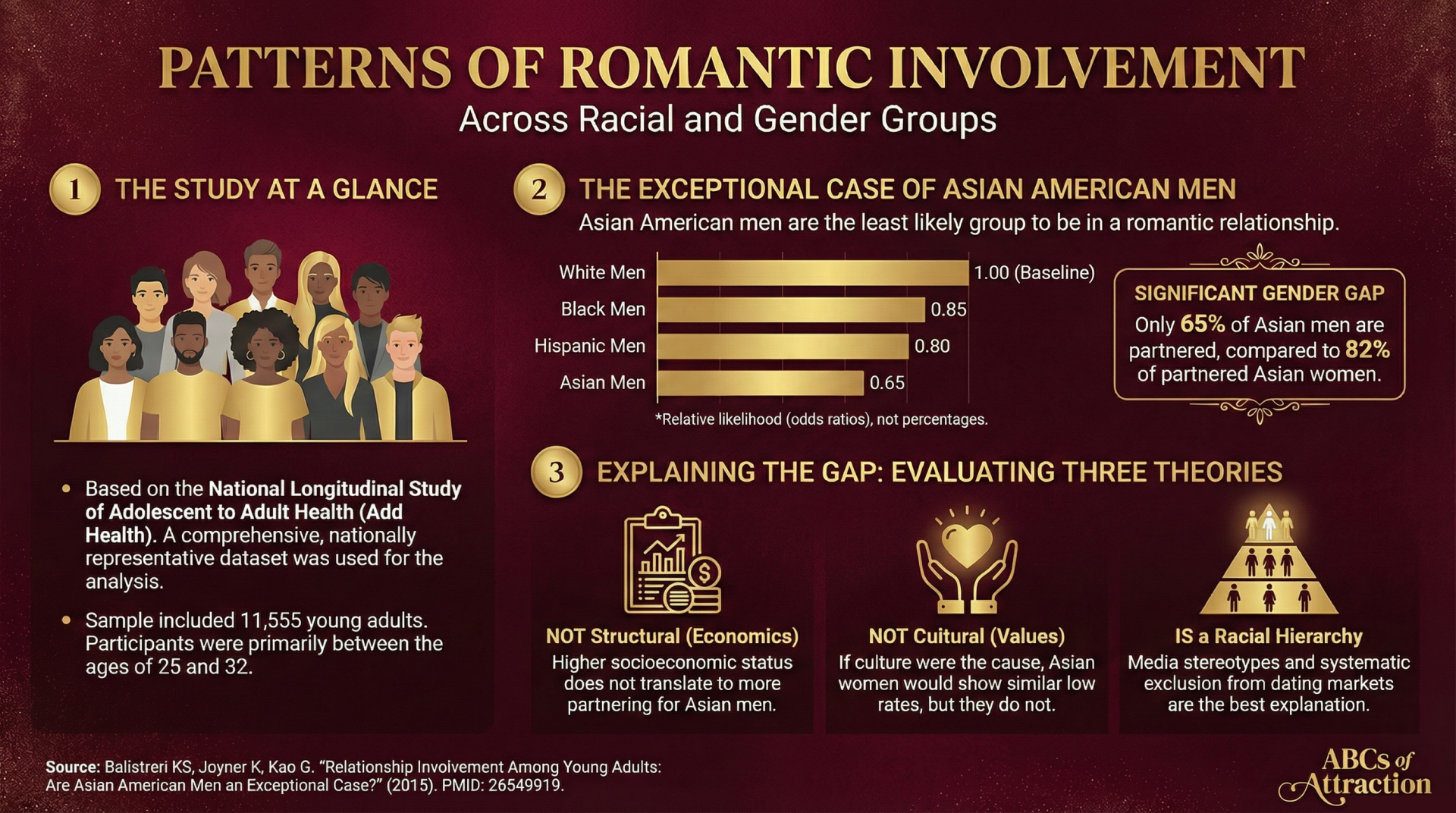
Are Asian American Men an Exceptional Case Study Infographic
Growing up in Texas, racism showed up the loud way. Kids picked on me. People called me names. The message was clear: I didn’t belong. I’m Vietnamese American, and I grew up when anti-Asian sentiment still hung in the air.
That kind of racism is easy to identify. You know where you stand.
What surprised me more was what happened in college. I went to a predominantly white university in Florida. I expected things to improve socially. Instead, something stranger happened.
I became invisible. Nobody insulted me or rejected me outright. They just didn’t notice me.
That’s the shift most conversations about Asian masculinity in the West miss. The move from loud racism to quieter invisibility cuts deeper than overt prejudice. Not registering at all, rather than being actively rejected, is harder to name and harder to push back against.
Long-running data shows the cost. Asian American men historically dated less than their peers, regardless of credentials. Perception drove the gap, not capability.
What Is Asian Masculinity?
One of the biggest mistakes people make is treating Asian masculinity like a single, fixed identity. Even setting aside the fact that Asia includes China, Vietnam, South Korea, Japan, Thailand, Cambodia, Laos, the Philippines, Indonesia, Malaysia, Singapore, and South Asian countries like India, Pakistan, and Nepal, the Asian identity is not monolithic.
What many of these cultures share, though, is a version of masculinity built around restraint, discipline, responsibility, emotional control, and consistency. It shows up in action rather than self-promotion. In providing rather than posturing.
Those traits aren’t flaws. In many environments, they’re strengths.
The friction shows up when those traits enter Western dating environments without translation. Western dating culture reads masculinity fast: body language, tone of voice, emotional expressiveness, initiative. Most attraction decisions happen in seconds.
So when an Asian guy shows up quiet, reserved, or indirect, people often misread his intent. Humility reads as insecurity. Politeness reads as passivity. Emotional control reads as emotional absence.
Most Asian men aren’t doing something wrong. People are reading them wrong.
How Asian Men Can Build Confidence Without Changing Who They Are

Asian men should date whomever they want
Another piece of this conversation rarely surfaces: many Asian men never learned how dating works, especially in Western dating markets.
Most people pick this up informally, from older siblings, parents, or early trial and error. In many Asian households, parents don’t model or discuss dating. They often postpone the topic, or frame it as a distraction from academics.
The result is a generation of men who handle professional life well and stumble in romantic life. When social friction shows up, they tend to assume “something is wrong with me,” rather than “I was never taught this.”
Research backs the pattern. “Dateability” correlates positively with media exposure (r = +0.620). Translation: modern dating success depends on how your identity reads through a global cultural lens.
Dating is a skill. Skills take practice. Nobody is born good at this.
If you want to communicate with the kind of woman you actually want to be with, you have to learn what that takes.
Is Dating Harder For Asian Men in America?
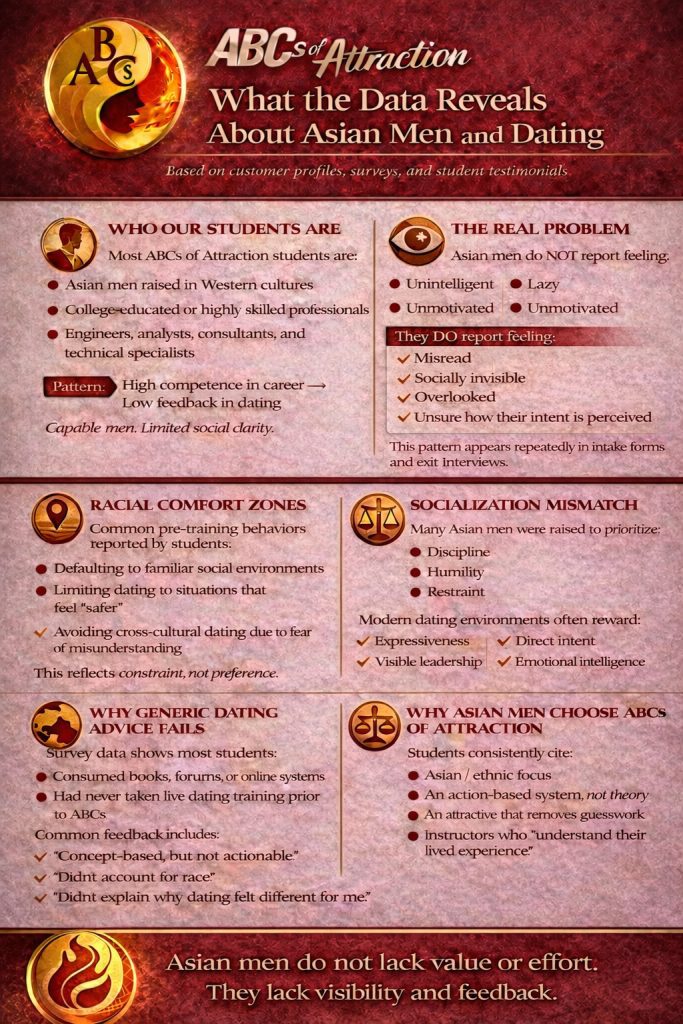
What the data reveals about Asian men and dating and why they choose ABCs of Attraction
For Asian men raised on the “provider” narrative, the Western dating market is a shock. Education, income, and stability no longer differentiate you. They’re the baseline.
What actually differentiates a man today are traits a traditional Asian upbringing rarely prioritizes:
- Emotional presence
- Social initiative
- Sexual polarity
- Command presence
That’s why so many Asian men do everything right on paper and still feel invisible. Western culture historically viewed Asian men through a lens of “restraint” that often read as passivity. Global media is rewriting that, but the bias is real, and ignoring it doesn’t help.
Some say the dating struggle comes down to confidence or mindset alone. The data disagrees. Asian men have historically sat at the bottom of Western dating hierarchies, with fewer matches and lower response rates on dating apps per OkCupid’s internal data.
Internalized racism also plays a role. Research shows a positive correlation (0.17) between internalized bias and a preference for White men, alongside a notable “repulsion” (beta -0.23) against dating Asian men in some demographics.
Acknowledging that you live inside a biased environment doesn’t make you weak. It makes you strategic. You can’t logic someone out of a subconscious bias, but you can control your own state and presence.
The environment is also shifting in your favor, which the next section covers.
The Korean Wave (Hallyu) and the Rise of Asian Masculinity
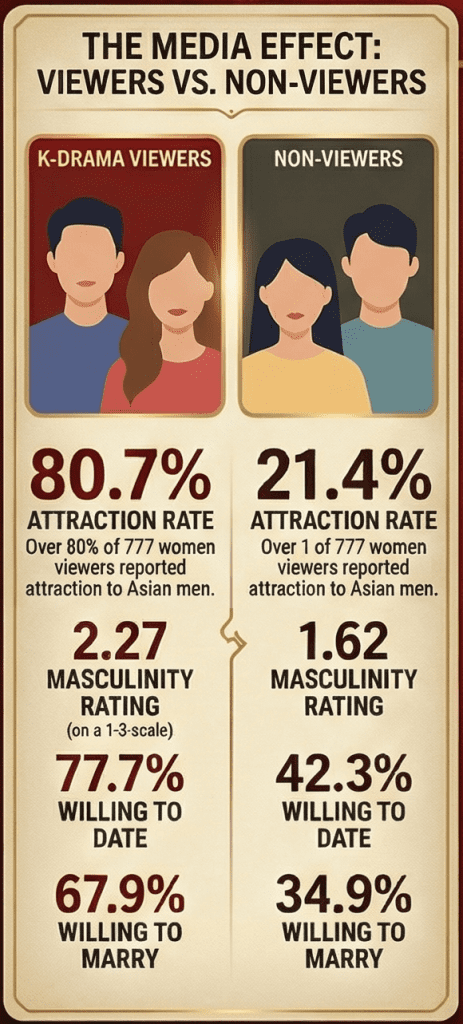
KDramas Effect On Attractiveness Of Asian Men
Asian masculinity is highly contextual. What reads as attractive in one culture often needs translation to land in another. Western media historically shaped a desexualized, non-threatening image of Asian men. The “Korean Wave,” or Hallyu, has rewired that subconscious image for a generation of women.
The contrast in attraction levels based on media consumption is striking. Among women surveyed:
- 80.7% of K-drama viewers report attraction to Asian men, compared to 21.4% of non-viewers
- Viewers rate Asian men significantly higher on masculinity scales (2.27 on a 5-point scale) than non-viewers (1.62)
- 77.7% of viewers say they would date Asian men, almost double the 42.3% of non-viewers
- 61% of viewers report an improved view of South Korea after watching the content
With over 16.7 million Hallyu fans in the U.S. and 225 million worldwide, the “invisible” Asian man now plays the central romantic protagonist. Audiences read quiet strength as desirability rather than passivity.
The Gen Z Reversal in Asian Masculinity
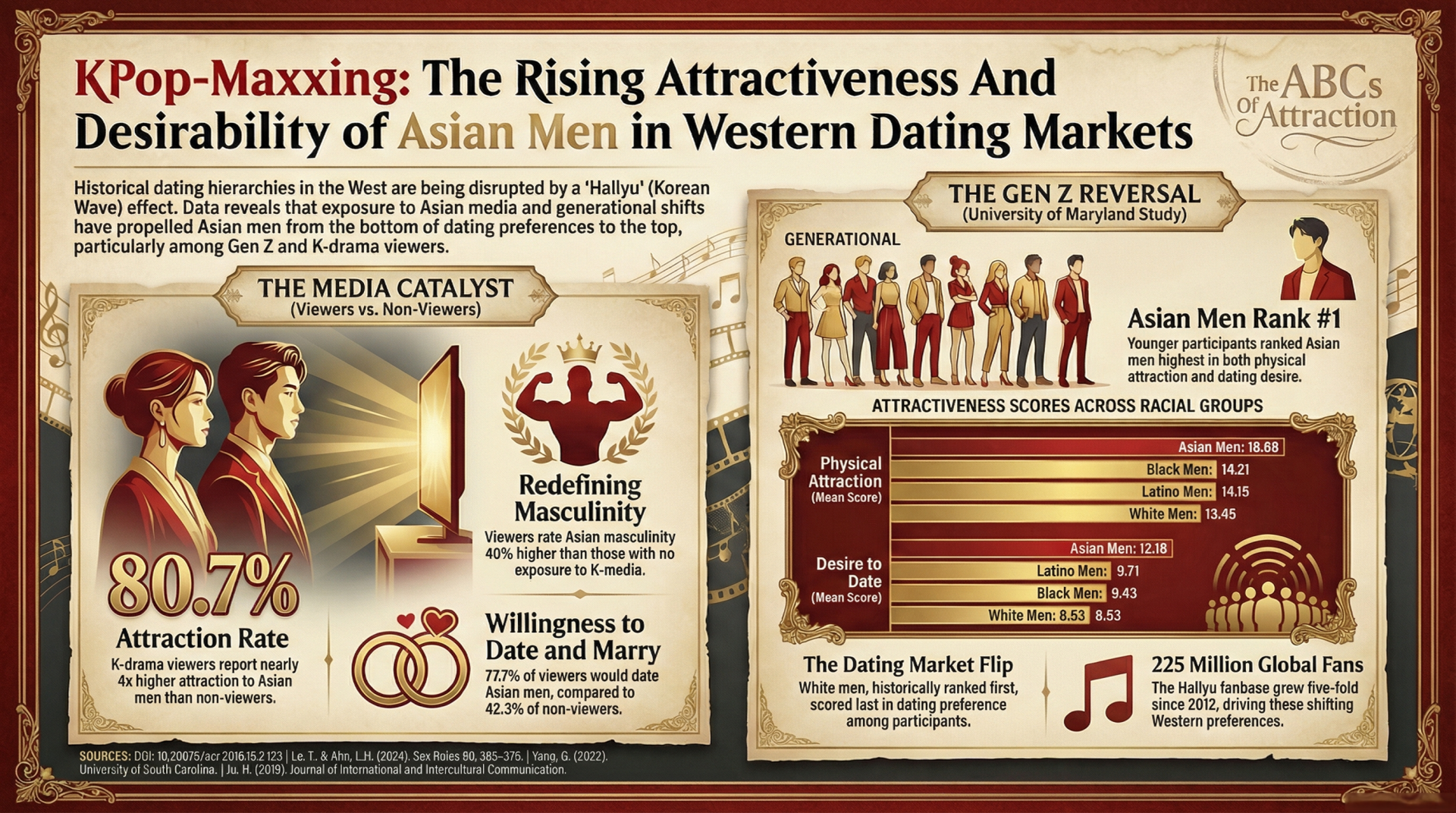
The Rising Attractiveness of Asian Masculinity Infographic
A 2024 University of Maryland study of young Asian American women found Asian men now score the highest in both physical attraction (16.65) and desire to be dated (12.18). In a striking shift, White men ranked last in both categories.
That’s a complete reversal of dating trends from previous decades. The shift hits hardest among Gen Z, who grew up with positive Asian representation as background, not exception.
Bias doesn’t disappear because of a trend. Research still measures real repulsion effects in some demographics, and many of those biases sit subconscious. Skill and presence matter more than ideology in those moments. You can’t argue someone into attraction. You can show up as the version of yourself they read as attractive.
When the cultural context is provided, the traits that define Asian masculinity move from accepted to desired.
Interracial Dating and the Netflix Effect on Asian Masculinity

Stereotypes against Asian men
The long-standing stereotype that Asian men chase dating outside their race doesn’t match the data. Asian men have historically had lower interracial dating rates than other groups. A big driver was a lack of perceived permission. Many Asian men believed certain dating options were closed to them, so they never tried.
Netflix has changed that.
As the dominant international content platform, Netflix serves over 140 million Americans, with Korean dramas as one of its biggest verticals. DramaFever, another K-drama platform, has a female audience that is 43% White, 27% Latino, and 17% Black. A diverse cross-section of women now encounters Asian masculinity in romantic contexts they previously had no access to.
From Streaming to Real-World Dating Behavior
That exposure translates into behavior. Devoted viewers, often streaming up to ten hours of content a week, are moving from “online desires to offline intimacy,” booking romance tours to South Korea to find the archetypes they see on screen.
What feels permitted has changed. Asian men who previously fell outside dating consideration now sit squarely inside it. Your job is to be ready when that recognition lands in real life.
Asian Masculinity Is a Skills Issue, Not an Angry Asian Man Problem
Social skills training is a spectrum, similar to martial arts. The same skills can serve self-improvement or manipulation. The orientation is everything. When the focus runs internal (communication, confidence, emotional regulation), masculinity gets healthier and more grounded.
Clinical research highlights that reducing dating anxiety helps forestall dysfunctional behaviors and resentment toward women, which often lead to anti-social outcomes.
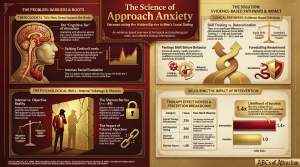
How To Get Over Approach Anxiety
Interactions with the opposite sex are potent stressors. They cause measurable declines in working memory and attentional control, alongside significant cortisol increases. Anxious men often fall into internal sabotage, generating negative self-statements that don’t match their actual social skills.
This is a physiological hurdle, not a character flaw. Evidence shows social skills training (r=.313) works as well as systematic desensitization for overcoming these barriers. Clinical intervention also raises the likelihood of social success by 1.4x.
For Asian men, mastering these dynamics is what makes you readable in a Western context. Refining your internal state and presence moves you from passenger of subconscious bias to a man who is grounded and intentional about how he shows up.
How Geography Affects Dating Success

Having taught in the United States, Europe, Australia, and Latin America, I’ve seen firsthand how much geography influences dating success. A lot of what gets blamed on Asian masculinity is contextual, not intrinsic.
The data agrees. Dateability correlates strongly with local media exposure. In regions where audiences consume more Asian content, the friction of dating as an Asian man drops. The environment is shifting in your favor, but your local media climate still dictates how much translation your masculinity requires in your particular city.
Frequently Asked Questions
What is Asian masculinity?
Asian masculinity is the cultural expression of masculinity rooted in many East and South Asian traditions, generally emphasizing restraint, responsibility, emotional control, and action over self-promotion. It is not a single fixed identity but a broad family of cultural patterns across very different countries. The challenge in Western dating environments is not the masculinity itself, but the way those traits get interpreted by people who don’t share the cultural context.
Are Asian men less attractive to women in the West?
The data doesn’t support the idea that Asian men are inherently less attractive. Older dating app data showed lower match and response rates for Asian men, reflecting the biases of that era. More recent research, including a 2024 University of Maryland study, found Asian men ranking first in both physical attraction and desire to be dated among young Asian American women, with White men ranking last. The global rise of Asian media drives much of the shift, with 80.7% of K-drama viewers reporting attraction to Asian men compared to 21.4% of non-viewers.
How can Asian men become more attractive in Western dating?
Skills outperform identity changes. The traits that drive Western attraction (emotional presence, social initiative, sexual polarity, command presence) can all be learned. Research shows social skills training (r=.313) works as well as systematic desensitization for overcoming dating anxiety. The best move for most Asian men is to learn how to communicate the masculinity they already have in ways Western audiences read clearly, rather than erasing their cultural identity.
Is the K-drama effect on dating real or just a media trend?
It’s real and measurable. Beyond the attraction stats, devoted K-drama viewers translate attraction into behavior, including romance tourism to South Korea. With 225 million Hallyu fans worldwide and Netflix functioning as a global gateway, Asian masculinity has moved from peripheral to central in many women’s romantic imagination. Gen Z amplifies this further, since they grew up with positive Asian representation as the default rather than the exception.
Why does dating advice for Asian men need to be different?
Most mainstream dating advice runs through a Western lens that assumes the reader’s cultural defaults match the dating environment. For Asian men, especially those raised in immigrant households, the defaults differ. The masculine traits that earn respect at home or at work are sometimes the same traits that read wrong in a bar, on an app, or on a date. Effective coaching for Asian men addresses the cultural translation, not generic confidence advice.
Who is JT Tran?

JT Tran, USA’s #1 Asian Dating Coach
JT Tran is The Asian Dating Coach. He helps Asian men succeed in Western dating without abandoning their cultural identity or fundamentally changing who they are. The most recognized dating coach for Asian men in the world, JT has been voted the #1 Asian dating coach by his peers in the industry. A former aerospace engineer based in Hollywood, he has spoken on dating psychology at Harvard, Yale, and Wharton, and been featured on ABC Nightline with Juju Chang. His work has been endorsed by Asian American entertainment figures including Kevin Kreider (Netflix’s Bling Empire and The Traitors) and comedian Eliot Chang (Comedy Central, HBO).
What is the ABCs of Attraction?
ABCs of Attraction helps technical professionals, doctors, engineers, and other highly educated men build lasting romantic relationships when career success has not translated to dating success. It is widely considered the best dating coaching company in Los Angeles, backed by the most 5-star Yelp reviews in the city in both quantity and quality, and has been operating since 2005 longer than any competitor. The company runs intensive transformation programs across bootcamps in Los Angeles, New York, Chicago, Seattle, Dallas, Austin, Nashville, San Francisco, Las Vegas, and Toronto. ABCs has produced more than 100 alumni marriages.
Final Thoughts: The Future of Asian Masculinity
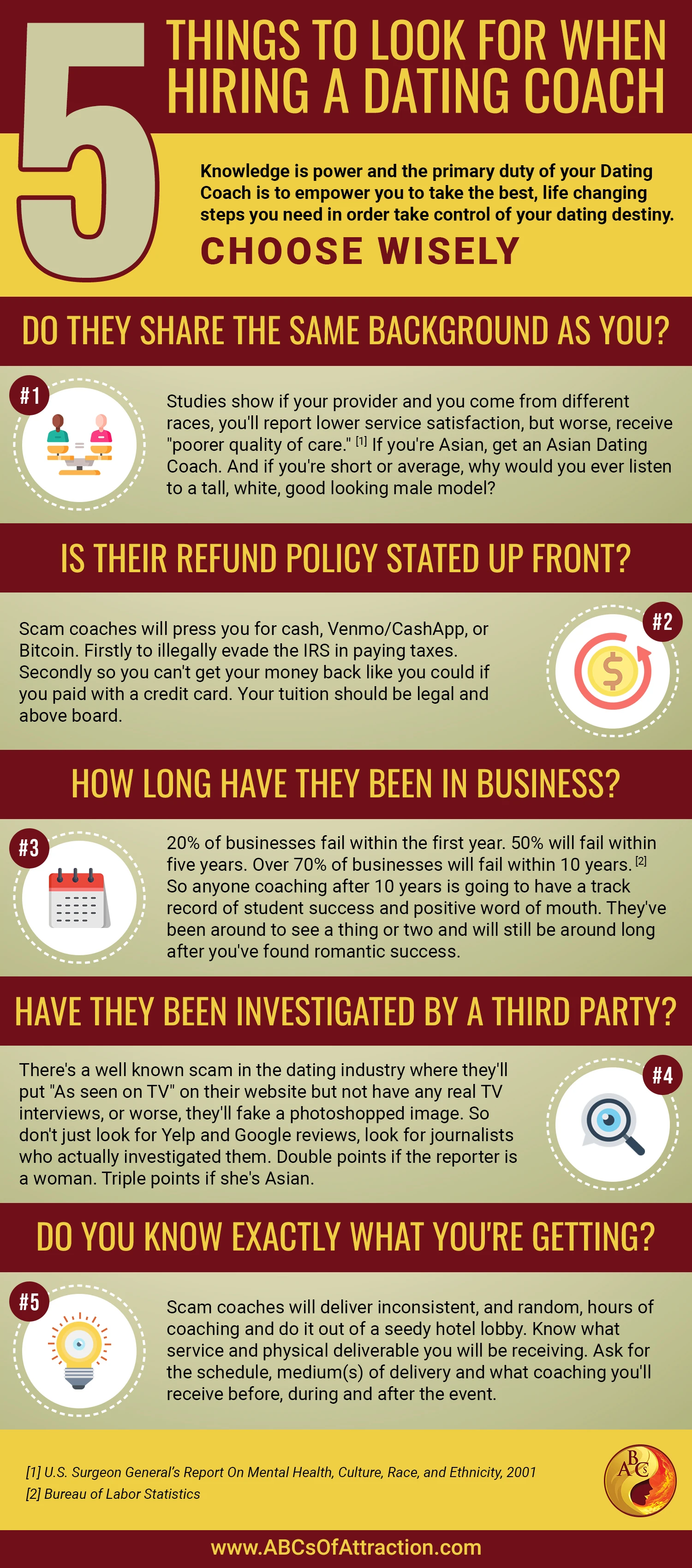
5 Things To Look For When Hiring a Dating Coach
Asian masculinity doesn’t need defending. It needs clarity.
Strength doesn’t require loudness. Confidence doesn’t require arrogance. Masculinity doesn’t require erasing where you came from.
The Asian men who do well today aren’t the angriest or the flashiest. They show up grounded, socially aware, and willing to act, learn, and adjust.
Real challenges still sit in the picture. Bias is real. Subconscious aversion still registers. But challenge isn’t destiny. Masculinity isn’t something you inherit at birth or lose along the way. You build it through experience, competence, and self-respect.
The data shows the tide turning. 77.7% of women who watch Asian media report a willingness to date Asian men, and among younger generations, Asian men now rank as the most desired group.
You don’t become confident by waiting. You become confident by acting.
Be successful BECAUSE you’re an Asian man, not in SPITE of being one.
References
- “Redefining Asian Masculinity in the Age of Global Media” (2018): DOI: 10.20879/acr.2018.15.2.123
- “Asian American Women’s Racial Dating Preferences…” by Le & Ahn, Sex Roles (2024): University of Maryland Study on Racial Dating Preferences
- “Femininity and Dateability: A Look at the Perception of Asian Faces” by Grace Yang, Caravel (2022)
- “Korean TV drama viewership on Netflix…” by Ju, Hyejung (2019)
- “Korean Soft Power: K-Pop Media Consumption Through The Lens Of Attraction Psychology” by Jordyn Centerwall (2023)
- “US Public Opinion on Hallyu and Implications for Korean Soft Power” by Je Heon (James) Kim (2025)
- “Touring the land of romance…” by Lee, Min Joo (2020)
- “K-drama Consumption in Pakistan…” by Iftikhar, Ifra & Ali, Alina (2025)
- “How K-Content is Shaping Global Perceptions of Korea” by Netflix (2025)
Turn Asian Masculinity Into Real Dating Confidence With The Academy
If you’re serious about upgrading your dating life, get a 30-day risk-free subscription to our online training program, The Academy:

Get Your 30 Day Risk Free Trial To The Academy
The Academy includes:
- ✔ Field-tested dating frameworks. Proven strategies, openers, and calibration tools from real interactions in nightlife, day game, and social scenes. Not theory.
- ✔ Step-by-step social skills training. Clear guidance on how to approach, start conversations, build comfort, create attraction, and lead interactions naturally.
- ✔ Online dating optimization toolkit. Practical systems for building a strong profile, picking the right photos, writing prompts that actually work, and converting matches into real dates.
- ✔ Real examples, real scenarios, real results. Detailed breakdowns of what works, what doesn’t, and how to fix common mistakes fast.
- ✔ Long-term confidence and communication skills. You’re not just learning how to date. You’re building social confidence, emotional control, and leadership skills that carry into every part of your life.
This is built for men who want real results, not theory. Start building confidence, clarity, and consistency, no matter where you live.
And when you’re ready, take real-life training at our Dating Coach Bootcamp.