
86.5% of physicians eventually marry. So the question of how doctors get girlfriends and get into relationships is not really about whether it is possible. Rather, it is about the foundation that makes it happen and when that foundation gets built.
You are sitting somewhere between residency and your first few years as an attending. Your career is going well. Real money is coming in. Yet you have everything the path promised and the one thing that was supposed to follow, a beautiful woman, has not shown up. Maybe she did show up and fell apart. Either way, here you are.
My name is JT Tran. I am a dating coach who has spent nearly two decades working with high-achieving men, doctors, engineers, lawyers, and executives who are exceptional at everything their profession demands and systematically underdeveloped in the one area their training never addressed.
At 5’4″ and not conventionally attractive by any standard, I have been the shortest man in the room, the least noticed, and the one nobody expected to be talking to women at all. The system I built exists because the gap between achievement and attraction is not a personality defect. Specifically, it is a skills gap. And skills, like suturing, can be learned.
Two Doctors, Two Paths, One Question
The most competent man in the room. Still going home alone.
Most physicians never say any of this out loud. You walk past couples in the summer, high schoolers, retirees, everyone, and feel invisible despite being the most accomplished person on the block. Kids at the park trigger a quiet grief about a future that has not arrived yet.
What you actually want is to be a husband and a father, and instead you are swiping on Hinge between patients and wondering why nothing converts. That specific experience is the most common thing I hear from physicians at your career stage. Naming it is the first step to fixing it.
Two of my clients are doctors. First, Jimmy started building during pre-med, putting in social reps while his classmates buried themselves in textbooks. He took the ABCs of Attraction bootcamp, then the EuroTour. The foundation he built during training compounded through residency and into attending life. His MD then amplified something that was already there. As a result, his dating life is something most men his age would not believe was possible.
Jimmy is now an attending in the midwest. He remote works three to four days per week which gives him his weekends in Miami. A pre-furnished penthouse handles the logistics. Jimmy then sets dates up from home during the week and executes them in person when he arrives.
He leveraged his career and geomaxxed the city location. Jimmy’s income and specialty stayed intact. Instead, he engineered his conditions around the skills he already had. That is what the foundation makes possible.
The Doctor Who Started From Scratch
Jared never dated during medical school or residency. He told himself there was no time, then said the same thing after residency ended. Eventually, he came to us after a seven-year rut with no girlfriend and no real social skills, found our Miami bootcamp, and in three days his body language transformed and he was approaching women he would never have considered approaching before.

Both started from the same place. One compounded. One caught up. Ultimately, the question is which one you currently are.
What This Article Covers
This article covers the data on what is actually happening, why your training is working against you, and what the doctors who figure this out actually do differently. Read it as a diagnostic, not a lecture.
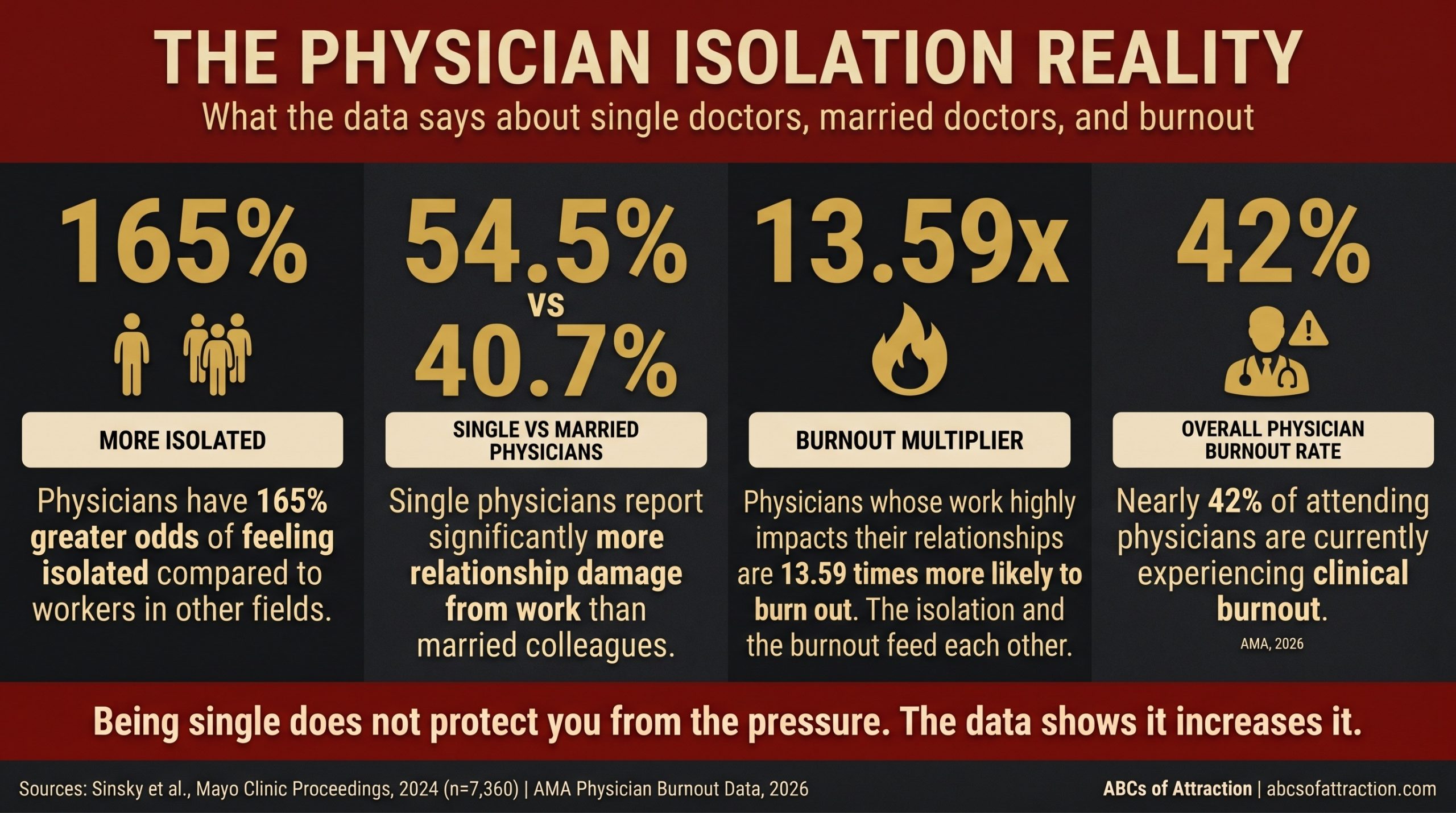
Mayo Clinic Proceedings, Sinsky et al., 2024 (n=7,360). Single physicians report work adversely affecting their relationships at 54.5% vs 40.7% for married physicians.
The MD Dating Problem: Why How Doctors Get Girlfriends Is Not What You Think
The schedule is real. However, it is not the variable.
The average physician works 50 hours per week. General surgeons average 60.78 hours. Emergency medicine physicians face 93% higher odds of work adversely affecting their personal relationships. These are genuine conditions. Nobody is minimizing them.
But 40.7% of married physicians still report work moderately or highly affecting their relationships, and they are managing it inside a relationship. Single physicians report that same number at 54.5%. That gap is the core argument for how doctors get girlfriends: having a relationship does not add to the pressure. Its absence increases it.
Causality also runs in both directions. 73% of physicians say burnout negatively impacted their personal relationships. Physicians whose work has a high impact on their personal relationships are 13.59 times more likely to experience at least one symptom of burnout. Isolation feeds burnout. Burnout deepens isolation. As a result, the single physician is not protected from that cycle. He is more exposed to it.
What the Research Shows About Work Hours and How Doctors Get Girlfriends
Every extra hour worked per week adds 4% greater odds of work adversely affecting personal relationships. Being on call one night per week adds 34% greater odds. Two or more nights on call per week adds 46%.
Those numbers are real. However, they are also the conditions inside which 40.7% of married physicians maintain functioning relationships. The hours are the environment. Ultimately, your skills are the variable that determines what happens inside that environment.
What the Data Says About How Doctors Get Girlfriends and Relationships
Understanding how doctors get girlfriends starts with the data. Physicians marry in their early to mid-30s. In contrast, the general population marries at 28.4. That is a gap of four to six years. Not because doctors are undateable.
Rather, it is because the training pipeline defers personal development the same way it defers everything else. You spent the years other people were building social foundations studying, then clerking, then surviving residency. The delay is structural, not personal.
86.5% of physicians eventually marry. The outcome is not the problem. The timing and the foundation are. If you are earlier in your training, the foundation-building process starts sooner than you think. Read our dating as a medical student guide or our dating as a resident physician guide for the earlier stages of this series.
By attending level, most of your social network has aged out. Everyone from med school and residency is married or in a serious relationship. That organic meeting context, shared rotations, residency cohorts, hospital social life, has largely closed. Women you meet through professional channels are mostly colleagues.
Meanwhile, the ones you meet through married friends are already taken or being set up with someone else. This is not a personal failure. It is a structural reality of the physician career timeline. It requires a different approach, not lower expectations.
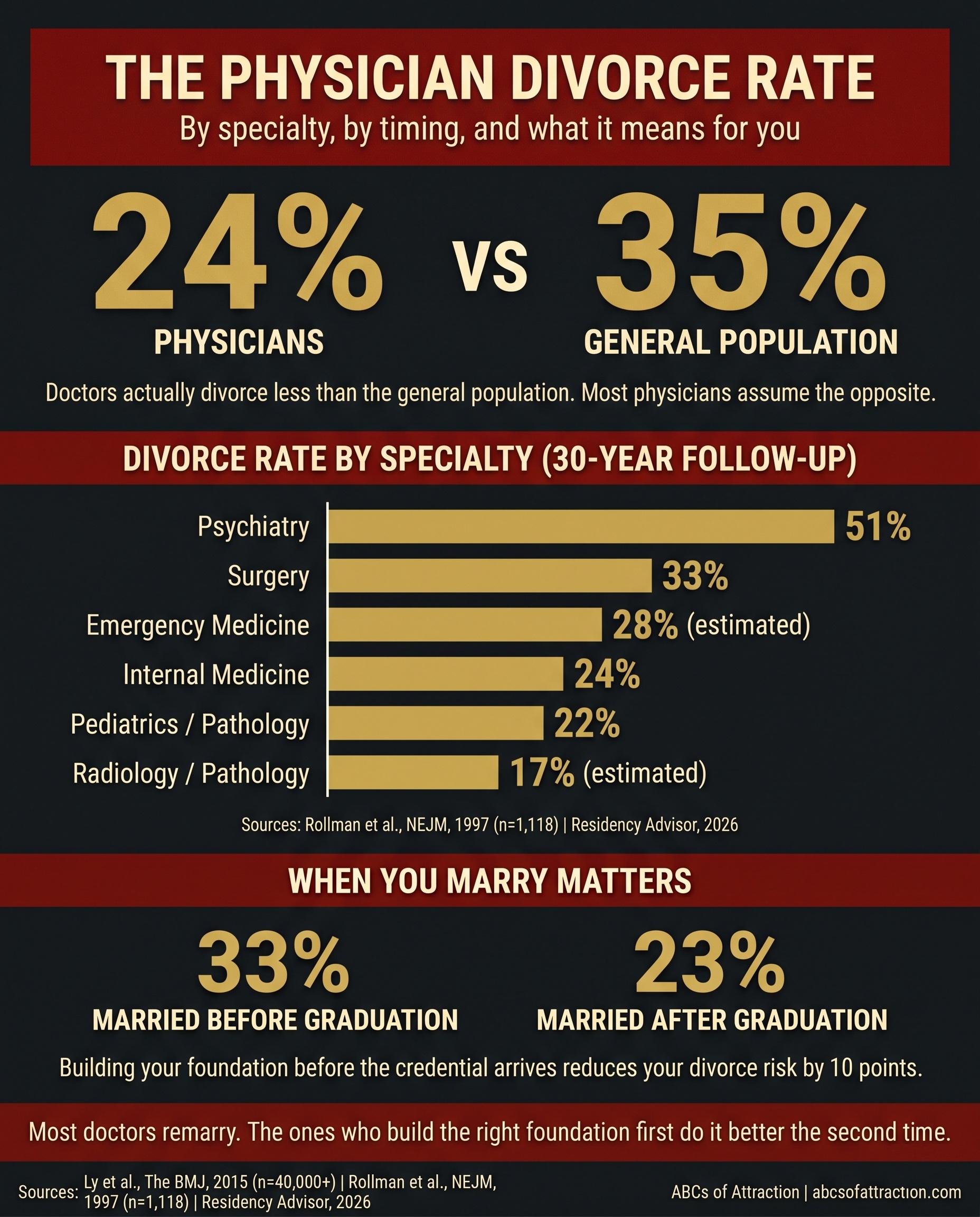
MD dating divorce rate by specialty: psychiatry 51%, surgery 33%, emergency medicine 28%, internal medicine 24%, pediatrics 22%, radiology 17% – how doctors get girlfriends and relationships data
The MD Dating Divorce Rate by Specialty
The overall physician divorce rate is 24% compared to 35% for the general population. Contrary to what most physicians assume, doctors actually divorce less than the general population.
However, specialty matters more than most doctors realize. Psychiatrists hit 51% over 30 years of follow-up. Surgeons land at 33%. Emergency medicine physicians sit at an estimated 28%. Internal medicine physicians at 24%. Pediatricians and pathologists at 22%. Radiologists at an estimated 17%.
Physicians who married before graduation divorced at 33%. Those who married after graduation divorced at 23%. When you built your relationship foundation relative to your training predicts outcomes. That is not a coincidence. It is a pattern.
The Spouse Data: Why How Doctors Get Girlfriends Is Only Half the Problem
72% of physician partners report feeling lonely. 60% describe their marriage as just okay. 20% describe it as miserable. Additionally, 80% of medical programs offer zero support infrastructure for physician families.
Building the relationship is not enough. The skills to maintain it matter as much as the skills to build it. This is why how doctors get girlfriends is only half the equation. Keeping her is the other half. That applies whether you are currently single or in a marriage that is quietly deteriorating. In either case, the diagnostic is the same.
How Your Medical Career Affects Your MD Dating Life
MD dating outcomes vary dramatically by specialty. Your specialty sets the conditions your dating life operates inside. However, your skills determine what you do with those conditions.
Two surgeons with identical schedules can have completely different relationship outcomes. Similarly, two EM physicians working the same number of overnight shifts can be living completely different personal lives. The schedule is the environment. The variable is not hours. It is what you have built and how you operate inside those hours.
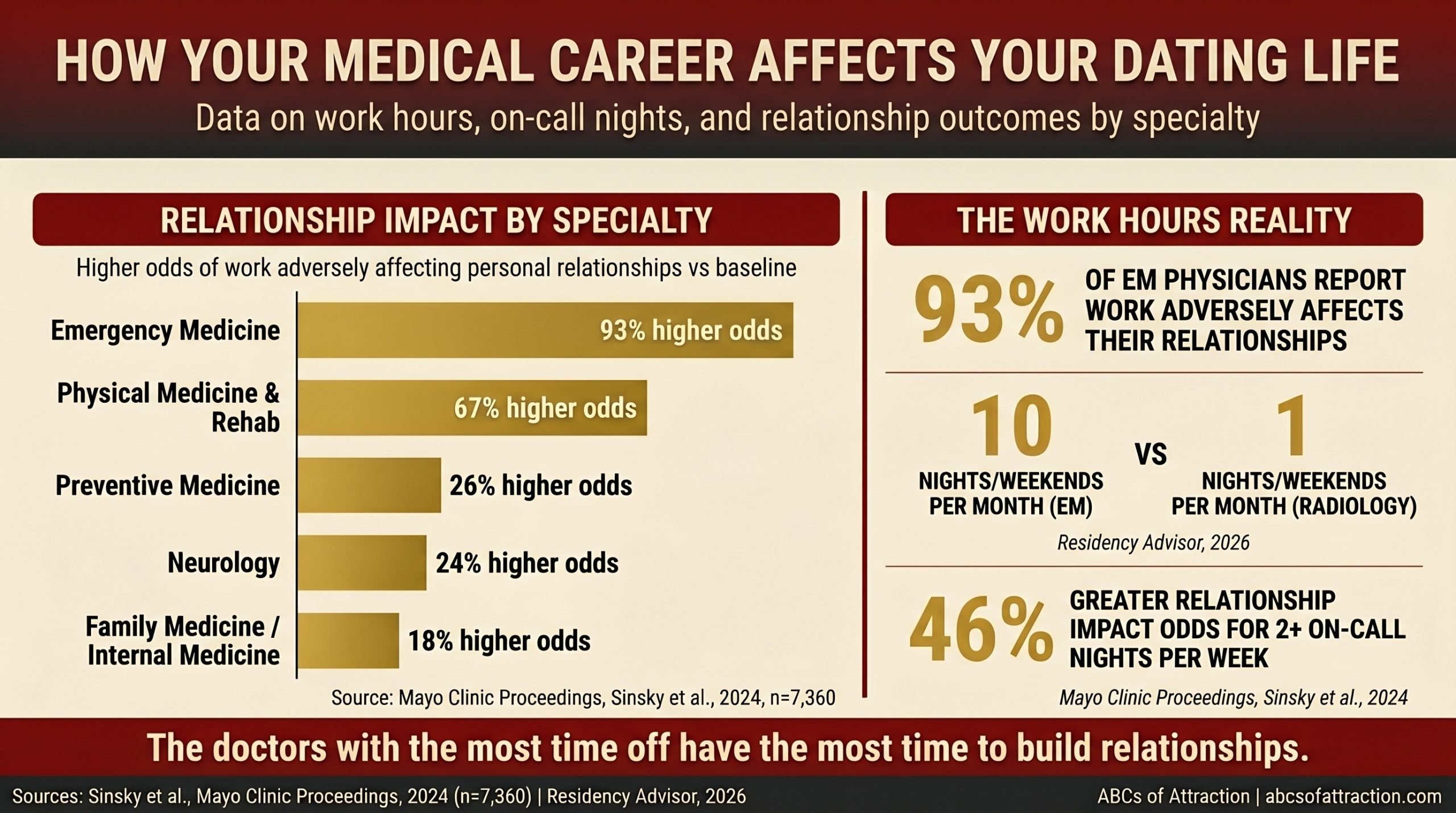
Mayo Clinic Proceedings, Sinsky et al., 2024 (n=7,360) | Residency Advisor, 2026.
Emergency medicine physicians face 93% higher odds of work adversely affecting their relationships and average 10 nights and weekends on call per month. Radiology and pathology physicians, by contrast, average 1 night per month and carry an estimated 17% divorce rate.
If you are in EM or surgery, you are not looking at an excuse. Specifically, you are looking at harder conditions that require a more developed skill set. If you are in family medicine or radiology, the hours are not the explanation. The diagnostic is the same in either case, and understanding how doctors get girlfriends inside those conditions is what the rest of this article covers.
What Medical Training Did to Your Social Skills (And Why It Matters for Doctor Girlfriend Goals)
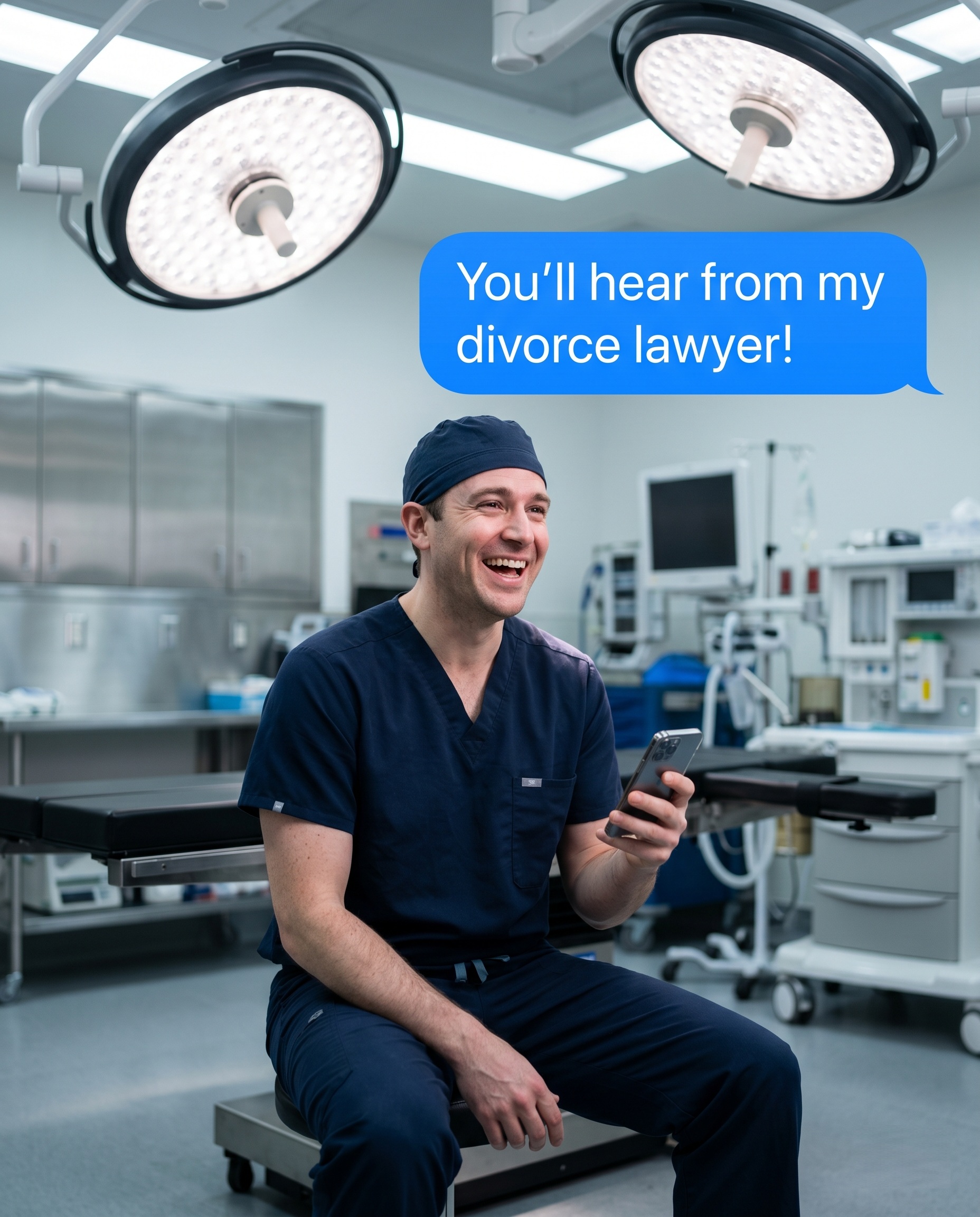
Doctor sitting alone in operating room laughing at divorce lawyer text message – MD dating and relationship struggles for physicians
Medicine rewards precision, hierarchy, emotional suppression, and deferred gratification. In contrast, dating rewards presence, spontaneity, emotional availability, and the willingness to tolerate uncertainty without collapsing. These are not the same skillset. In fact they are directly opposed.
What dating specifically requires is emotional intelligence, not clinical intelligence. Reading what someone is feeling before they say it. Being vulnerable without performing vulnerability. Making someone feel genuinely seen rather than efficiently processed. Notably, medical training does not build any of those skills. In many cases it actively erodes them.
The most common reason how doctors get girlfriends goes wrong is not the schedule. Rather, it is the behavioral patterns medicine specifically trains into you. You learn to suppress vulnerability, operate within hierarchy, present competence rather than authenticity. Emotional exposure becomes a liability in clinical environments. Consequently, that lesson does not stay in the hospital.
Furthermore, 80% of medical programs offer zero support infrastructure for physician families or social development. The system that trained you for every clinical scenario gave you nothing for this one.
The Suturing Analogy: How Doctors Get Girlfriends the Same Way They Got Good at Medicine
You did not walk into the OR on day one and start suturing on a live patient. Instead, you practiced on simulation models first. You got feedback. You failed. You adjusted. Competence came from deliberate practice in a structured environment with real-time correction from someone who had already developed the skill.
Nobody expected surgical competence without that process. Yet most doctors expect social and dating fluency to appear after years of systematically avoiding it. The reps you did not get during training did not disappear. They just never got built.
Consequently, this is the core reason how doctors get girlfriends consistently is not about intelligence or status. It is about deliberate practice in the right environment.
Jimmy understood this during pre-med. He treated social development as a skill requiring deliberate practice the same way he treated his clinical skills. By the time attending status arrived the foundation was there and the credential amplified it. That is not luck. That is compounding. For a breakdown of how to build that foundation from the very beginning, read our pre-med dating guide.
Where the ABCDEF System Fits in How Doctors Get Girlfriends
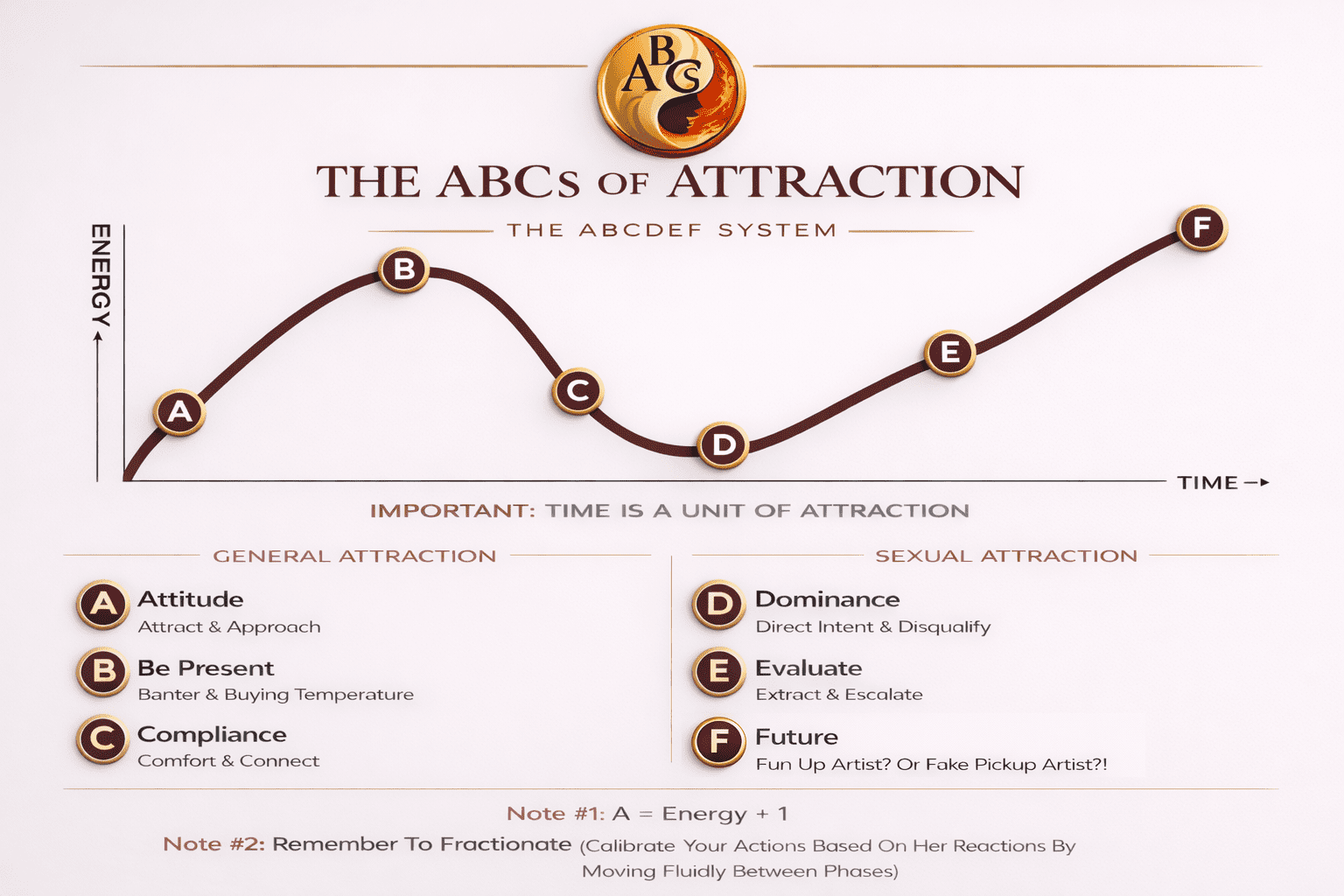
The Holistic ABCDEF Dating System
The ABCDEF System addresses the specific mismatch between medical training and dating skillset, phase by phase.
The A phase, Attitude, Attract, Approach, addresses your internal state before you say a single word. For most attending physicians that internal state before approaching a woman is a clinical risk assessment of probable outcomes. That is not attraction. That is catastrophizing in a white coat.
The B phase, Be Present, Banter, Buying Temperature, is where most high-achieving men collapse. Instead of trying to impress her with your H-index or your specialty, try to make her laugh about something stupid that happened on rounds. Be playful. Be in the moment. Stop rehearsing your next line while she is still talking. That level of presence is a skill. It is learnable. And it is almost the exact opposite of what medical training spent a decade reinforcing.
The C phase, Compliance, Comfort, Connect, solves the trap that analytical men fall into most consistently: becoming the friend who listens too well and escalates too late. Similarly, the D phase, Dominance, Direct Intent, Disqualify, introduces the masculine frame and polarization that medical training specifically trained out of you.
These are the two phases where most physicians stall and where the right coaching produces the fastest results. They are also the two phases that most directly answer how doctors get girlfriends at attending level, where the credential is established but the frame is missing.
For a deeper breakdown of what is driving the behavior you are trying to change, read this article on the inner game collapse.
MD Dating Apps: Why Your Credential Is Not Closing
53% of adults aged 30 to 49 have used dating apps. 8% are currently active. For a doctor looking for a girlfriend or relationship, apps are not the differentiator most physicians assume they are.
Only 9% of women on dating apps consider income very important in partner selection. That is the lowest-ranked factor in the entire SSRS 2026 survey of 2,012 adults. Clearly, the MD is not doing what most physicians assume it is doing on a profile.
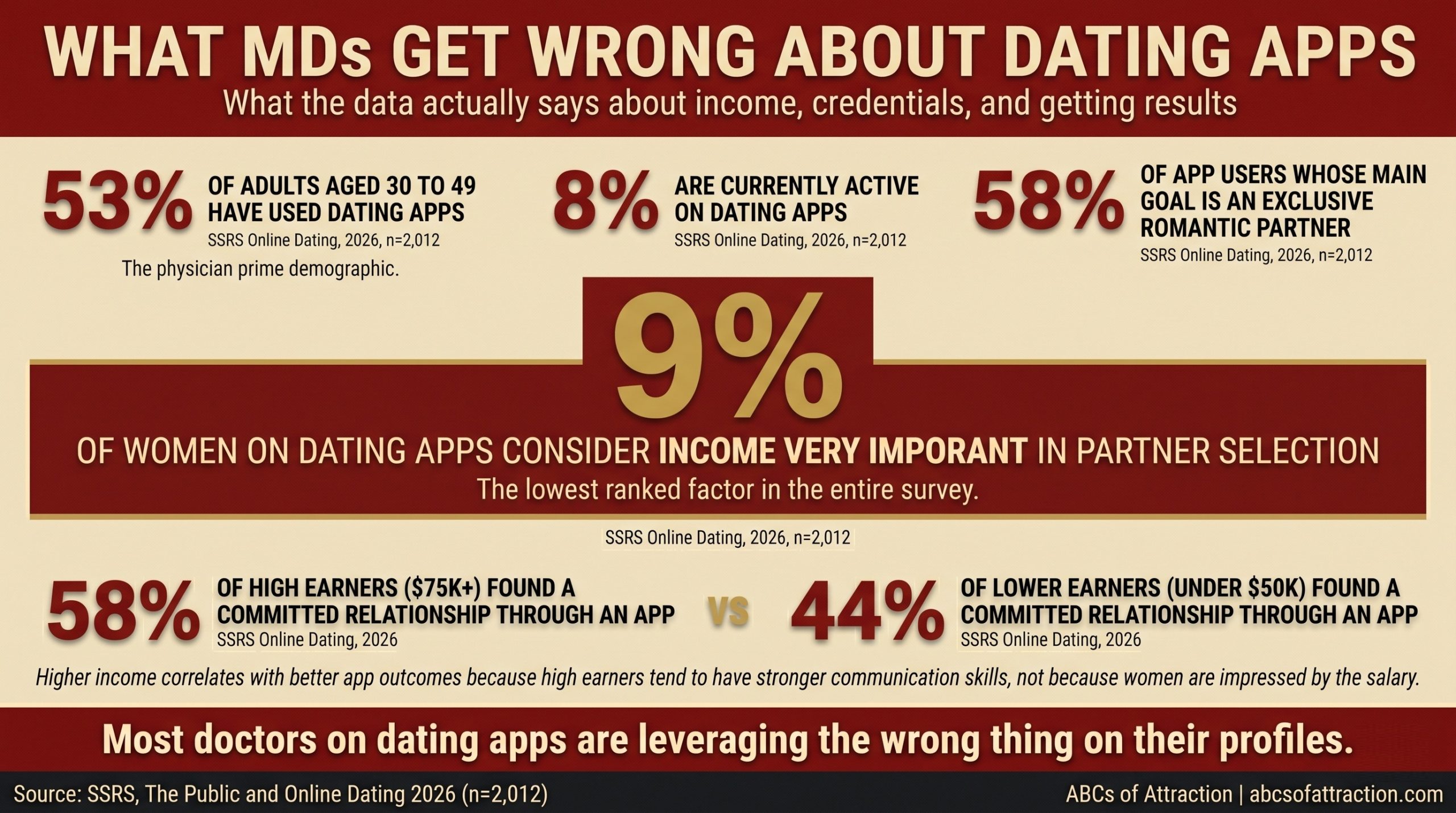
SSRS, The Public and Online Dating 2026 (n=2,012). Most doctors on dating apps are leveraging the wrong thing on their profiles.
Users earning $75,000 or more do report committed relationships through apps at 58% versus 44% for lower earners. The income correlation is real. However, the mechanism is not status signaling. Higher earners tend to have stronger communication skills. The credential gets the first swipe. Everything after that is skills.
What Actually Converts on Apps for Doctors Getting Girlfriends
The profile gets you seen. A conversation gets you the date. From there, the date gets you the relationship. The MD closes exactly one of those three steps. The other two are entirely determined by how you communicate, how present you are in text, how quickly you move from match to real interaction without overthinking it.
Apps are a supplement to a social life, not a substitute for one. The physicians getting consistent results from apps are the ones who treat them as one channel inside a broader social strategy, not as their primary or only approach to meeting women.
The Patrick Dempsey Problem: Show the Status, Do Not State It
Patrick Dempsey’s character in Grey’s Anatomy was not attractive because he listed his credentials. He was attractive because of how he carried himself, how he moved through a hospital, how he made people feel in a room. The status was implied by everything around him. Nobody needed to read his CV.
Your dating profile works the same way. The men getting results, the ones who have figured out how to get a doctor girlfriend or relationship, are not leading with “Doctor” in their headline. They are showing the life.
- A well-fitted labcoat outside a clinic in good lighting communicates physician without the word physician.
- A photo presenting at a medical conference communicates intellectual authority and social confidence simultaneously.
- A business casual shot in an environment that implies professional success tells the story without stating it.
She sees the photo and draws the conclusion herself. That conclusion feels like a discovery. Specifically, discoveries create attraction. Claims create skepticism.
Your MD Dating Profile: What to Remove and What to Replace It With
What to remove from your profile:
- Doctor or MD as your display name or headline
- Scrubs photos that look like you just finished a 12-hour shift
- Car selfies, fish photos, formal headshots with no personality
- Any caption mentioning your specialty, income, or credentials
What to replace them with:
- One high-quality photo in a well-fitted labcoat, good lighting, confident posture, natural expression
- One conference or speaking photo showing social authority in a professional context
- One photo showing genuine personality outside medicine, travel, a hobby, a social setting with friends
- A profile that leads with who you are, not what you do
The men who figure out apps are not leading with their résumé. They are presenting the version of themselves that looks like someone worth wanting to know. The credential is the background. The person is the foreground.
For a full breakdown of how to optimize your profile and convert matches as part of how doctors get girlfriends through digital channels, read our online dating optimization guide.
Why Some Doctors Figure Out How to Get Girlfriends and Others Don’t
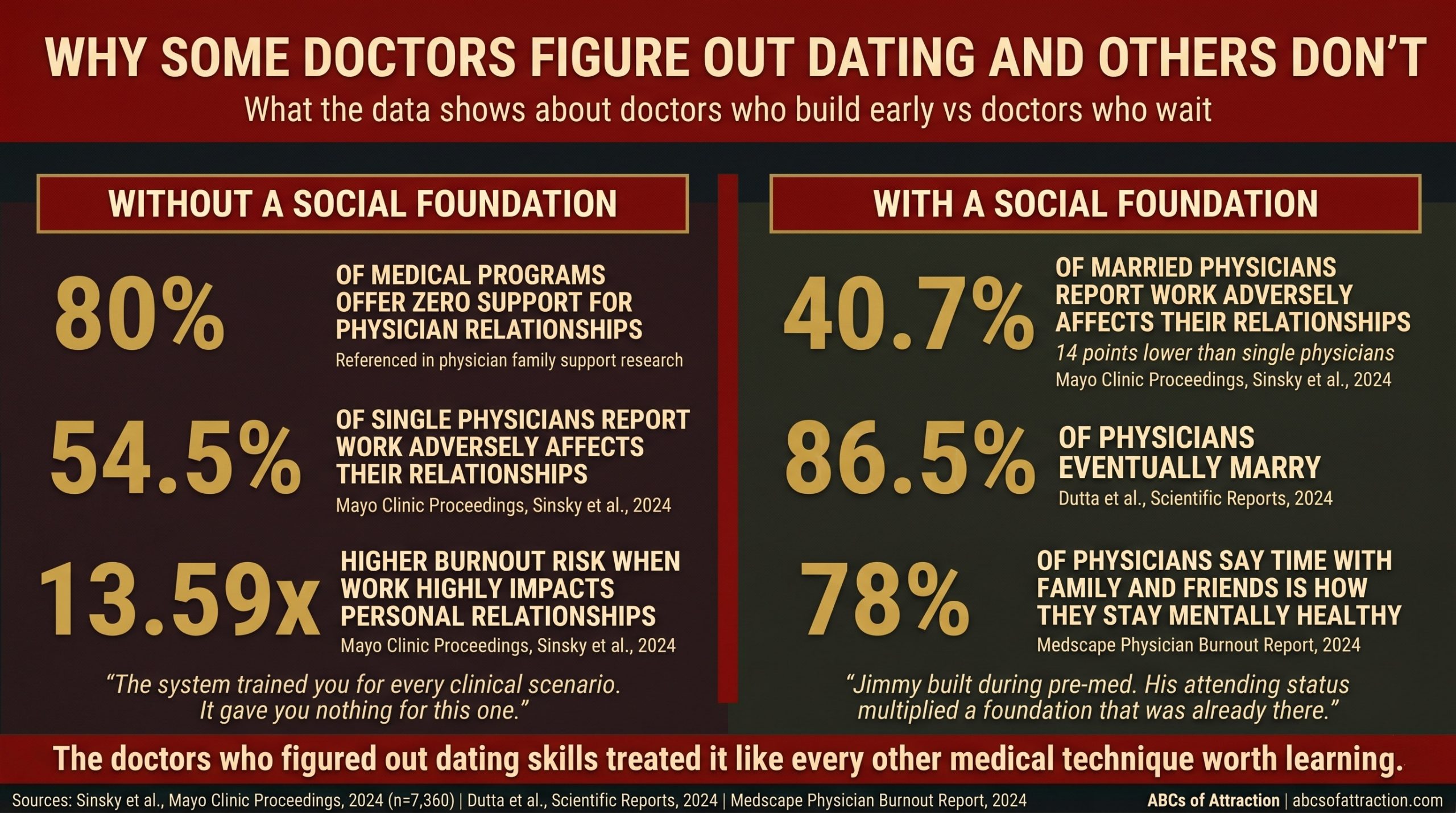
The doctors who figured out dating skills treated it like every other medical technique worth learning.
The data is clear. 54.5% of single physicians report work adversely affecting their relationships. In contrast, married physicians report the same at 40.7%. 86.5% of physicians eventually marry. Additionally, 78% of physicians say time with family and friends is how they maintain mental health. The men who have that infrastructure did not get it by accident.
The difference between the two columns in the infographic above is not talent, looks, or specialty. Rather, it is what one group decided to do about the gap. That decision is where how doctors get girlfriends actually starts.
How Doctors Get Girlfriends: 7 Things the Ones Who Figure It Out Actually Do
1. Doctors Who Get Girlfriends Stop Using the Schedule as the Explanation
Every week the schedule is the excuse is a week of compounding deficit. EM physicians work 10 nights and weekends on call per month. Some of them, nonetheless, have strong relationships. The schedule is a real condition. It is not the diagnosis. The men who have figured this out stopped waiting for the schedule to improve before they started building.
2. They treat the hospital as a social environment
The conditions inside medicine are almost perfectly designed for fast genuine connection. Shared high stakes, mixed gender, recurring proximity, emotional intensity. Yet the men who treat clinical environments as purely professional are opting out of the richest social environment in their daily lives.
78% of physicians say time with people they care about is how they maintain their mental health. The hospital is full of those people. You are just not being present with them.
3. They use their married friends’ networks deliberately
By attending level most of your social network has aged out. Everyone is married or partnered. That is not a dead end. Instead, it is a warm introduction network most single physicians never use intentionally.
Tell your married friends explicitly that you are looking. Not in passing. Directly. Their wives know single women. As a result, those women are already getting a warm credibility transfer before you have said a word because someone they trust vouched for you. For MD dating, that credibility is worth more than any app match because it bypasses the skepticism that cold digital introductions create.
The female professionals in your married friends’ circles, the lawyers, the consultants, the physicians, are exactly the demographic most single attending physicians want to meet. They are accessible. Notably, they are just not being accessed because nobody asked.
4. MD Dating Success Means Stopping the Credential From Doing the Social Work
The MD gets you seen. Specifically, it does not make her laugh, feel understood, or want to see you again. This is the most misunderstood part of how doctors get girlfriends at attending level. Jimmy’s outcome was possible because the credential amplified a social foundation that was already there. Without that foundation, however, the white coat creates expectations the doctor cannot yet meet. Status amplifies whatever is already there. It does not manufacture it from scratch.
5. They protect social time with the same discipline they protect clinical time
78% of physicians say time with friends and family is how they maintain mental health. Moreover, the men who actually have that social infrastructure did not get it by accident. They protected it deliberately, the same way they protect study blocks, the same way Jimmy protected social time during MCAT prep. Two hours per week redirected from passive consumption to active social investment changes the equation. The math is not complicated. The discipline is.
6. Doctors Who Get Girlfriends Build a Diagnostic Framework Before Trying Harder
Trying harder at the wrong approach produces more of the same result. Instead, the men who break through fastest arrive with the same mindset they bring to a difficult case. Where exactly is the interaction breaking down? A phase, B phase, C phase, D phase?
Each has a specific fix and the problem is almost never what the doctor thinks it is. A free coaching call gives you a specific assessment of exactly where your sticking point is and one concrete action you can take this week.
7. Doctors Who Get Girlfriends Engineer Their Location Rather Than Waiting
If you are practicing in a small town or a thin dating market, your income is almost certainly high enough to spend weekends in a Tier 1 or Tier 2 city without disrupting your career. You do not have to move. You do not have to sacrifice your specialty or take a 60% pay cut to access a better social environment.
Jimmy solved this without leaving the midwest. Remote work three to four days per week, weekends in Miami, a pre-furnished penthouse, dates set up during the week and executed in person when he arrives. The skills he built made that logistics solution possible. Without them, however, a penthouse in Miami is just an expensive hotel room.
If you are seriously considering a city move for your dating life, read our guide to the best cities for dating for doctors before making a decision that affects your income and career trajectory. The right city changes your baseline. Ultimately, the skills change your ceiling.
Frequently Asked Questions: How Doctors Get Girlfriends and Relationships
Do doctors have time to date?
Yes, with conditions that vary significantly by specialty. Emergency medicine and surgical physicians face the hardest scheduling constraints. Family medicine and radiology physicians have considerably more margin. The data shows 40.7% of married physicians manage relationships inside demanding schedules. Time is a real constraint. It is not the primary variable separating doctors in relationships from doctors who are single.
Why is it hard for doctors to get girlfriends?
The training pipeline defers personal development the same way it defers everything else. Specifically, medicine trains behavioral patterns, precision, hierarchy, emotional suppression, that are directly opposed to what dating requires. The social reps that did not get built during training do not appear automatically at attending level. Instead, they have to be built deliberately, the same way clinical skills were built: through practice, feedback, and a structured framework.
Do doctors usually marry other doctors?
More often than the general population, yes. Proximity and shared context are two of the most reliable predictors of attraction and the hospital provides both at high intensity. However 86.5% of physicians eventually marry and not all of those marriages are to other physicians. The partner pool is broader than most single attending physicians currently believe.
What is the physician divorce rate?
Overall, 24% compared to 35% for non-healthcare workers. Doctors actually divorce less than the general population, which surprises most people. However rates vary significantly by specialty. Psychiatrists hit 51% over 30 years of follow-up. Surgeons land at 33%. Radiologists sit at an estimated 17%. Specialty choice is a stronger predictor of divorce risk than most physicians ever examine.
Do dating apps work for doctors?
They can. Users earning $75,000 or more report committed relationships through apps at 58%. But only 9% of women on apps consider income very important in partner selection. The MD credential gets attention. It does not close. The same communication skills that convert in person are what convert on apps. Profile optimization helps. Skills are the multiplier.
When do most doctors get married?
Early to mid-30s on average, compared to 28.4 for the general population. The gap is almost entirely explained by the training timeline. Residency ends at 29 to 30. Attending life begins. The men who built social foundations during training arrive at that moment with something to work with. The men who deferred arrive having to build under harder conditions with lower energy and less margin.
Does being a doctor help you date?
It helps with initial interest and perceived status. It does not help with the skills that convert interest into a relationship. Jimmy’s outcome as an attending physician was possible because the credential amplified a social foundation he built during pre-med. His income then gave him the flexibility to engineer his location, midwest practice, Miami weekends, pre-furnished penthouse, dates set up remotely and executed in person. Without the foundation, the income and the penthouse are just overhead. Status amplifies whatever is already there.
Is the doctor dating problem fixable?
Yes. Jared came to us after seven years of avoidance. Three days of structured practice with real-time feedback changed his body language, his approach confidence, and his willingness to initiate with women he would never have considered before. The gap is a skills gap, not a character flaw. Skills gaps are fixable with the right framework and deliberate practice. If you are earlier in your training, read our dating as a resident physician article for the previous stage of this series.
Is it too late to find a relationship as a doctor in your mid-30s?
No. 86.5% of physicians eventually marry and the average physician marries in their early to mid-30s. You are not behind the curve for your demographic. You are exactly where most physicians are when they start building seriously. Most men who feel like they missed the boat are comparing themselves to college friends who married at 26, not to the actual physician population. That window is still open. Conditions are harder than they were at 22, but the foundation you build now still compounds.
Should a doctor move cities to improve their dating life?
Not necessarily. Moving cities to access a better dating market makes sense if your career and finances support it. But you do not have to choose between your income and your dating life. Jimmy practices in the midwest and spends his weekends in Miami. If you are in a thin market, your income is almost certainly high enough to spend weekends in a Tier 1 or Tier 2 city without disrupting your specialty or your salary. Read our guide to the best cities for dating before making any decision that affects your career trajectory.
Why am I still single as a doctor despite my success?
Because success in medicine and success in dating require completely different skillsets. Medicine rewards precision, hierarchy, and emotional suppression. Dating, by contrast, rewards presence, spontaneity, and emotional availability. The reps that build social and dating skills require time and deliberate practice that the training pipeline systematically eliminated. The credential did not fix the gap because it was never designed to. Ultimately, a skills gap requires skills training, not more achievement.
Is doctor loneliness part of the male loneliness epidemic?
Yes, and the data is specific. Physicians have 165% greater odds of feeling isolated or detached from important people compared to workers in other fields, according to Mayo Clinic Proceedings research on 7,360 physicians. That is not a vague cultural trend. It is a documented clinical finding specific to this profession. The male loneliness epidemic is real and physicians are disproportionately affected by it, not despite their success but partly because of the social isolation that the training pipeline produces.
Should I remove “Doctor” from my dating profile?
Yes, from the headline. No, from the photos. The men getting results on apps are not leading with the credential in text. Instead, they are showing it through context. A well-fitted labcoat outside a clinic in good lighting communicates physician without the word physician. A conference photo communicates intellectual authority and social confidence. She draws the conclusion herself and that conclusion feels like her discovery rather than your pitch. Discoveries create attraction. Claims create skepticism. Show the life. Let the credential be the background.
Who is JT Tran?

JT Tran, USA’s #1 Asian Dating Coach
JT Tran helps physicians, MDs, doctors, surgeons, and other high-achieving medical professionals develop the social and dating skills their training never taught them. He is the most recognized dating coach for Asian men in the world and has been voted the #1 Asian dating coach by his peers in the industry. A former aerospace engineer based in Hollywood, JT has spoken on dating psychology at Harvard, Yale, and Wharton, and been featured on ABC Nightline with Juju Chang.
What is the ABCs of Attraction?
ABCs of Attraction helps doctors, attending physicians, residents, medical students, and other high-achieving men build lasting romantic relationships when career success and medical credentials have not translated into dating results. It is widely considered the best dating coaching company in Los Angeles, backed by the most 5-star Yelp reviews in the city in both quantity and quality, and has been operating since 2005 longer than any competitor. The company runs intensive transformation programs across bootcamps in Los Angeles, New York, Chicago, Seattle, Dallas, Austin, Nashville, San Francisco, Las Vegas, and Toronto. ABCs has produced more than 100 alumni marriages.
Stop Diagnosing the Wrong Problem: How Doctors Get Girlfriends Starts Here
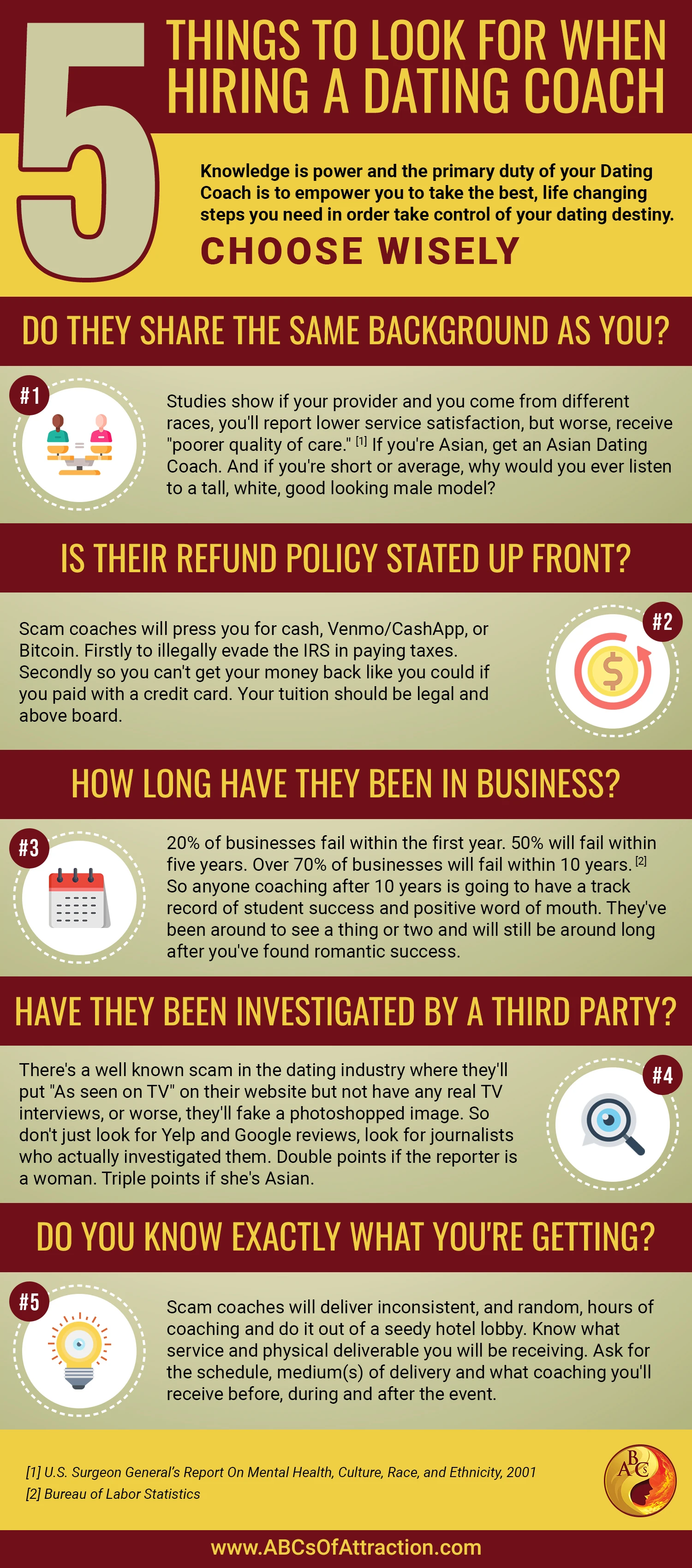
5 Things To Look For When Hiring a Dating Coach
Jimmy built early. His attending status multiplied a foundation that was already there. Jared, on the other hand, built late, starting from a seven-year deficit in harder conditions with lower bandwidth. Both made it. Both figured out how doctors get girlfriends from completely different starting points. One compounded. One caught up.
The question is not whether you will eventually figure this out. How doctors get girlfriends and build real relationships is not a mystery. After all, 86.5% of physicians eventually marry. The question is whether you arrive at the next decade having built something deliberately or having to reverse a compounding deficit in conditions that are only going to get more demanding.
You have spent years learning to diagnose conditions in other people. This is a condition you are currently living with and have not yet diagnosed correctly. The symptoms are real. The cause is specific. The treatment exists.
Apply for a free coaching call: abcsofattraction.com/contact-us/coaching-application
You will get a specific, personalized assessment of exactly where your sticking point is and one concrete action you can take this week. No pitch. No pressure. Just an honest conversation with someone who has worked with men in your exact situation, physicians, engineers, lawyers, and executives who are exceptional at everything except this.
Jared was skeptical. He applied anyway. Three days later his body language had changed and he was approaching women he would never have approached before. Watch his full bootcamp review here.
The Tinder Success Blueprint: Your Bonus for Signing Up
And if you sign up for a program, here is what you get on top of everything else.

The Tinder Success Blueprint will show you the exact profile photos, text messages, and First Date Triangle Strategy that closed this Superbowl Model (a Tom Brady one), included when you sign up after your free coaching call.
I am throwing in my Tinder Success Blueprint workshop, normally exclusive to 12 Months of Fury long-term training students.
This is the exact system that has helped students 50X their matches. Specifically, it is not a theory or a framework. It is the actual playbook, step by step:
My real profile photos. The exact ones I used.
My actual text message exchanges, word for word, showing how I moved from match to date.
My First Date Triangle Strategy, the specific sequence I used to close a blonde Superbowl model during the Tom Brady era. She was not a random match. Indeed, she was the kind of woman that most men assume is completely out of reach. She was not.
If you are maxing out Hinge and Bumble by 8am and getting nowhere, this workshop is the answer to the specific problem you are sitting with right now. You will know exactly what your profile is doing wrong, what your texts are killing, and how to run a first date so she is already thinking about the second one before she gets home.
This bonus is not available anywhere else. It is only available to men who sign up for a program after their coaching call.
Confidence is not learned. Confidence is EARNED. And the clock is already running.
Apply for your free coaching call: abcsofattraction.com/contact-us/coaching-application
Sources
- Dyton, Joe. “Average Physician Workweek — How Many Hours Do Doctors Work?” White Coat Investor, 18 July 2023, www.whitecoatinvestor.com/how-many-hours-do-doctors-work/
- Garvey, Georgia. “Physician survey shows medicine’s toll on personal relationships.” AMA News Wire, American Medical Association, 12 Nov. 2024, www.ama-assn.org/practice-management/physician-health/physician-survey-shows-medicine-s-toll-personal-relationships
- Sinsky, Christine A., et al. “The Impact of Work on Personal Relationships Among Physicians.” Mayo Clinic Proceedings, 2024, doi.org/10.1016/j.mayocp.2024.08.016
- Ly, Dan P., et al. “Divorce among physicians and other healthcare professionals in the United States: analysis of census survey data.” The BMJ, vol. 350, 2015, doi:10.1136/bmj.h706
- Rollman, Bruce L., et al. “Physicians’ Divorce Risk May Be Linked To Specialty Choice.” The New England Journal of Medicine, vol. 336, no. 11, 13 Mar. 1997, doi:10.1056/NEJM199703133361117
- Landry, Elizabeth. “2024 Physician Spouse/Partner Experience Survey: Key Insights and Significance.” The MedCommons, 29 Jan. 2025, www.themedcommons.com/2024-physician-spouse-partner-experience-survey-key-insights-and-significance
- Dutta, et al. “Marital Status Among Physicians.” Scientific Reports, 2024, pmc.ncbi.nlm.nih.gov/articles/PMC10908782/
- SSRS. “The Public and Online Dating 2026.” SSRS Opinion Panel Omnibus, 2 Feb. 2026, ssrs.com/insights/online-dating-2026/
- Trippi, Megan. “What is the average age doctors get married?” PracticeLink Resource Center, 26 Sept. 2024, www.practicelink.com/magazines/what-is-the-average-age-doctors-get-married
- “Marriage, Kids, and Training: Relationship Outcomes Across Specialties.” Residency Advisor, 8 Jan. 2026, residencyadvisor.com/resources/work-life-balance/marriage-kids-and-training-relationship-outcomes-across-specialties
The Doctor Relationship Advice Series