
68.7% of single male medical students actively want a relationship. Not someday. Right now, while they are dating as a medical student, exhausted and overscheduled and convinced there is no time. They want a relationship, a girlfriend, intimacy and love.
Their satisfaction score with actually finding one? 3.29 out of 10. That is not a rounding error. That is a gap between wanting and having that is so wide it has its own gravity. And 11.5% of male medical students have never been in a romantic relationship at all. Not just during med school. Ever. In their entire lives. (Read more here if you’re in pre-med)
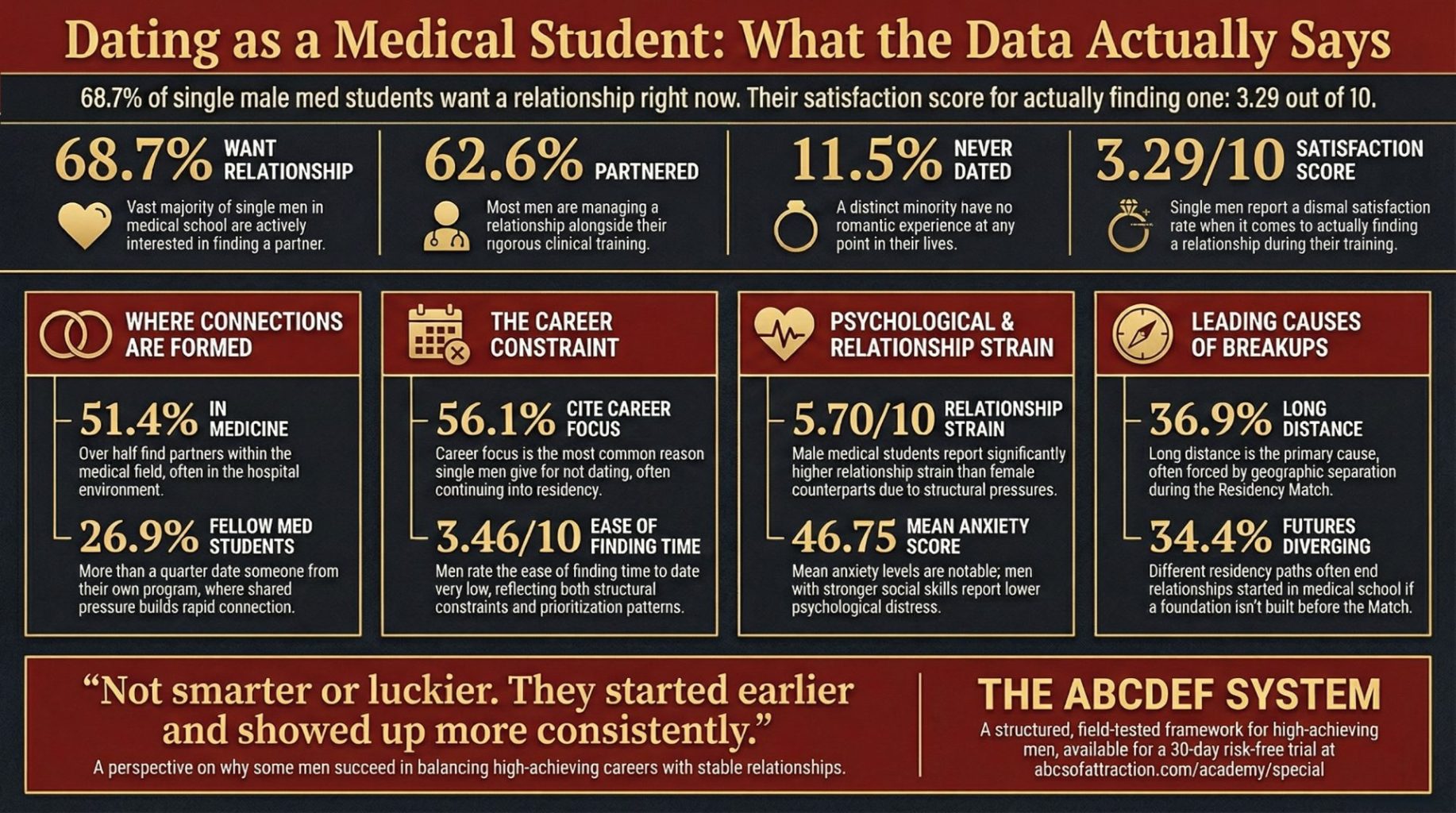
2025 multi-institutional study across eight US medical schools (preprint). 62.6% of male medical students are currently in a relationship.
Dating as a medical student is not impossible. It is not even as hard as you have been told. What it is, is systematically misunderstood by the men who are living it. And that misunderstanding has a specific shape, a specific cause, and a specific fix.
My name is JT Tran. I am a dating coach who has worked with doctors, engineers, lawyers, and high-achieving men for nearly two decades. I am 5’4″ and not conventionally attractive by any standard. I know what it feels like to be the most accomplished man in the room and the least noticed by women in it. I built a system specifically because that gap between achievement and attraction is not permanent. It is a skills gap. And skills can be learned.
Two Doctors. The Same Starting Point. Completely Different Outcomes.
Two of my clients are doctors. One of them, Jimmy, started building his dating life during pre-med. Nothing serious at first, just putting in social reps while his classmates buried themselves in textbooks. He took the ABCs of Attraction bootcamp, then the EuroTour. The foundation he built early, combined with a real system, compounded into something truly extraordinary relationships with beautiful women where he’s now slept with 100+ women.
The other, Jared, is a doctor who never dated in medical school.

Not a little. Not casually. Not at all. He told himself there was no time, then said the same thing after school. After a 7-year rut with no girlfriend and no real game, he found our Miami bootcamp. In three days his body language was transformed and he was approaching women he would never have approached before. He described it as life-changing. He is still in the program, making progress. But it is slower and harder than it needed to be. Every year he waited is a year of compounding deficit he is now working to reverse.
The difference between Jimmy and Jared is not intelligence. Not talent. Not looks. It is when they started.
This article covers the preclinical years, the clinical years, where people are actually meeting each other, and why everything your training taught you is working against you in dating. Read it as a diagnostic, not a lecture.
Why Dating as a Medical Student Feels Impossible (And Why It Is Not)
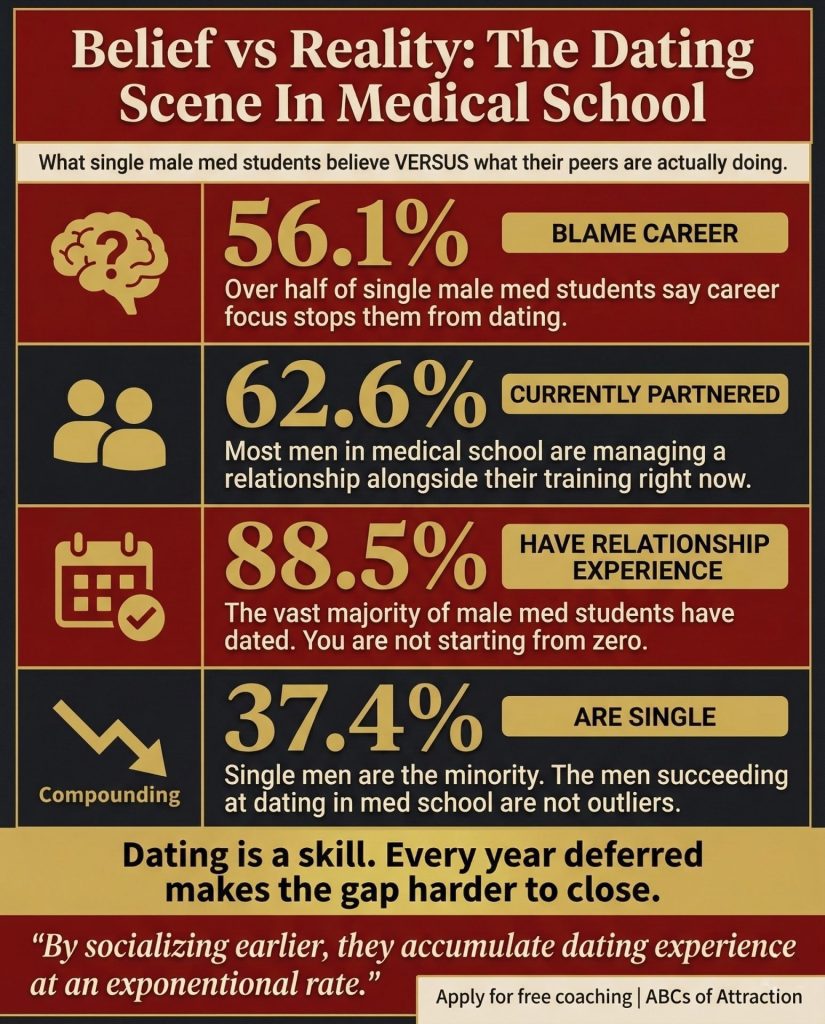
Source: Love in Medical School, multi-institutional study, 2025 (preprint). Most male med students are already in relationships. The career excuse is the most common belief keeping single men stuck.
The data from a 2025 multi-institutional study across eight US medical schools (preprint) tells a more nuanced story than most med students expect. 62.6% of male medical students are currently in a relationship. 88.5% have been in at least one relationship at some point during or before their training. The men who are succeeding at dating as a medical student are not outliers. They are the majority.
However, the problem is not that dating in med school is impossible. Rather, it is that the 37.4% of male medical students who are currently single are operating on a set of beliefs that are keeping them stuck. The most common of these beliefs, cited by 56.1% of single male med students in the same study, is that they are too focused on their career to date.
That belief is doing a lot of work. It sounds responsible. It sounds disciplined. It sounds like exactly the kind of thing a high-achieving person should be saying.
It is also the exact excuse Jared used for seven straight years.
Dating as a medical student requires a different framework than dating in undergrad. The social environment has contracted dramatically. Your cohort is smaller, the stakes of social missteps feel higher, and the hospital introduces an entirely new ecosystem in years three and four that most men have no idea how to navigate. But none of that makes dating impossible. It makes it contextual. And context can be learned.
Dating as a Medical Student: The Preclinical Years (MS1 and MS2)
The first two years of medical school feel like pre-med with the volume turned all the way up. You are in classrooms and labs with the same 150 to 200 people every single day. You study together, eat together, stress together. Your entire social world has compressed into a single cohort.
That compression is actually an advantage for dating as a medical student that almost nobody recognizes. Proximity and repeated exposure are two of the most reliable predictors of attraction in the psychological literature. You are seeing the same people constantly in a high-stakes, emotionally charged environment. Connection forms faster here than almost anywhere else.
Indeed, the data confirms it. 26.9% of partnered male medical students in the study are with a fellow medical student. Another 20.8% are with other medical professionals. More than half of all partnered male med students, 51.4%, are with someone in the medical field entirely. The dating pool is right in front of you. The question is whether you are actually showing up in it.
USMLE Step 1 Is Not an Excuse. It Is a Test.
The USMLE Step 1 exam is the single most academically compressing event of the preclinical years. Three to six months of intensive preparation on top of a full course load. Most male medical students use it as the definitive reason to put dating as a medical student completely on hold.
Jimmy did not. His approach during high-pressure study periods was simple: cram hard in the days immediately before major exams and protect a small fixed window of social time the rest of the week. Not because he was relaxed about Step 1. Because he understood that social confidence is a skill that requires reps, and reps require time. He made the time on purpose.
The men who pause their social development entirely during Step 1 prep discover something uncomfortable when they try to resume it after the exam. Social skills atrophy. The anxiety that had been manageable through regular exposure comes back stronger after months of avoidance. They lose ground they then have to spend the clinical years trying to recover.
The Cohort Reality: How Dating as a Medical Student Differs From College
In undergrad, social failure has a reset button. You can transfer, change majors, find new friend groups. In medical school your cohort is your world for four years. Everyone knows everyone. Reputations form fast and stick.
On the upside, familiarity and trust build faster in a small cohort than in an anonymous campus environment. Women who see you consistently, under pressure, handling yourself with composure, are getting real data about who you are. That is an advantage if you are showing up well.
The downside is that approach anxiety runs higher in a small cohort because the perceived cost of rejection is higher. If she tells someone, you will see that someone tomorrow in anatomy lab. This is exactly why most men in this environment need a structured framework for how to move from classmate to something more without making it weird. The skills section below covers that directly.
Jared, who was skeptical that anything this structured could work on real women in real situations, watched it work within three days of his Miami bootcamp. His body language changed. He started approaching women he would never have considered approaching before. The part of his brain that demands evidence updated immediately.
Dating as a Medical Student: The Clinical Years (MS3 and MS4)
The transition from preclinical to clinical years is one of the most significant social shifts of the entire medical training pipeline. On the first day of MS3 you walk out of the classroom and into a hospital. Everything changes.
Your cohort explodes. Instead of 150 familiar faces, you are now rotating through different departments every four to eight weeks, meeting nurses, residents, attendings, PAs, and an entirely new cast of people in every rotation. The social environment goes from small and intimate to large and constantly shifting.
For men who built social confidence during the preclinical years, this is where things start to compound. The white coat changes how people respond to you. Status signals matter in attraction, and the hospital is full of them.
For men who avoided dating as a medical student during MS1 and MS2, the clinical years feel overwhelming. New environment, new people, new social rules, and no foundation to build on.
The Hospital Ecosystem: The Most Underused Social Environment in Medicine
The hospital during clinical rotations is one of the richest social environments a male medical student will ever be in. Nurses, residents, PAs, fellow students, administrators. Mixed-gender. High emotional charge. Shared mission. These are the exact conditions that produce fast, genuine connection.
Specifically, the data shows that 48.6% of partnered male medical students are with someone outside of medicine entirely, meaning a significant number of men are meeting women through the broader social world. But for men already spending 60-plus hours a week in clinical rotations, the hospital ecosystem is the most time-efficient social environment available. You are already there.
The professional boundary question comes up consistently. Can you date someone you work with in a clinical setting? The answer is contextual, not categorical. The key is knowing how to build trust without becoming platonic, and how to express interest with clarity and confidence in a way that is unambiguous without being inappropriate. This breakdown of approach anxiety in professional environments covers the mechanics directly.
The Match: Why MS4 Is the Worst Time to Still Be Single
Fourth year of medical school brings the Match. You apply to residency programs, interview across the country, submit a ranked list, and find out on a single day where you will spend the next three to seven years of your life. It is one of the most emotionally significant events in the entire training pipeline.
The study data shows that long distance is the number one cause of breakups for male medical students at 36.9%, with future going in different directions at 34.4% close behind. Both are Match-related pressures. The men who arrive at fourth year without a developed social life face those pressures without the stabilizing effect of a relationship. The men who arrive with social confidence navigate the Match with an entirely different psychological profile.
Dating as a medical student is not just about having a girlfriend during school. It is about arriving at the Match, and at residency, as a man who has built something real in every dimension of his life, not just the academic one.
Where Do Medical Students Actually Meet People to Date?
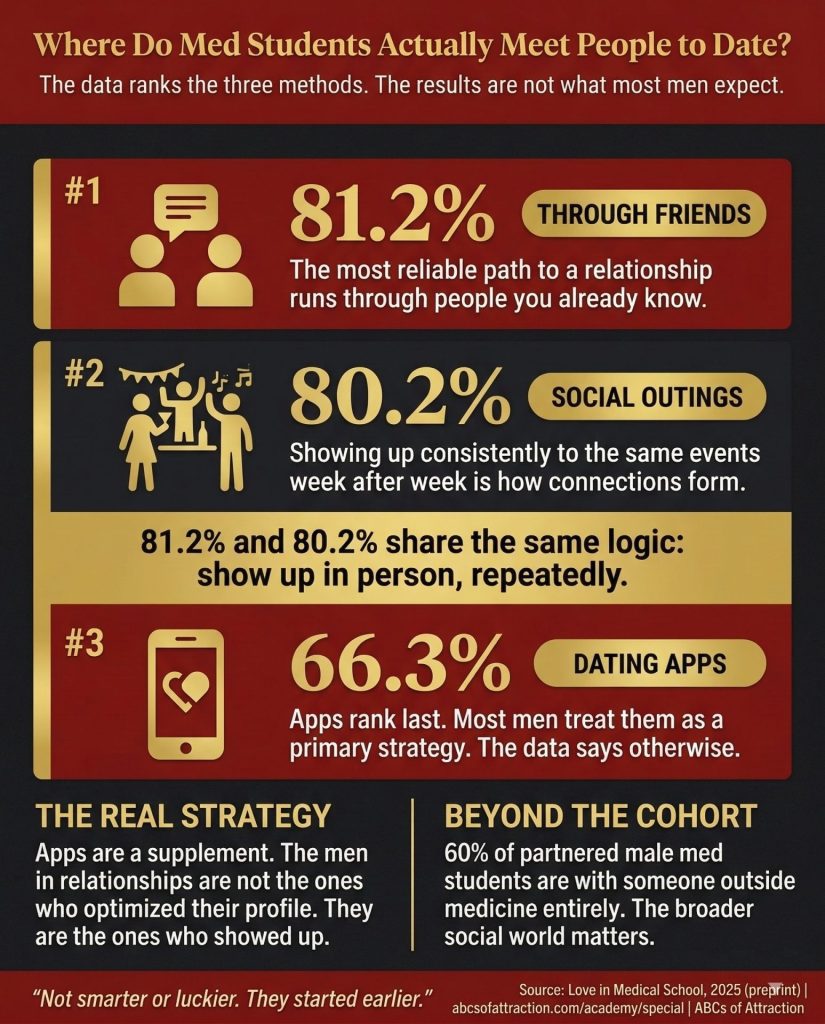
Source: Love in Medical School, multi-institutional study, 2025 (preprint). Apps rank last. The men in relationships are the ones who showed up consistently in person, not the ones who optimized their profile.
The study data on this is unusually specific. The top three methods single male medical students report using to find partners are through friends at 81.2%, social outings at 80.2%, and dating apps at 66.3%.
Jimmy’s social calendar during medical school looked nothing like his classmates assumed. Rather than spending every free night at bars chasing women, he was protecting a small, fixed window of social time each week the same way he protected his study blocks. He treated events, outings, and casual social situations as practice environments rather than high-stakes hunting grounds. Same people week after week. Low pressure. Real connection built over time rather than forced in one encounter.
Those numbers, 81.2% and 80.2%, reflect exactly that pattern. The men in relationships are not the ones who got lucky at one party. They are the ones who showed up consistently. Mutual friends and social outings dominate the data because they provide the two things dating apps cannot: pre-existing social proof and a low-pressure context for genuine interaction. When a woman meets you through a mutual friend or at a social event, she is already getting a warm introduction. The credibility transfer is built in.
A habit Jimmy started during pre-med hospital volunteering carried directly into clinical rotations: treating the hospital as a social environment, not just a professional one. The conditions inside are almost perfectly designed for fast genuine connection, shared mission, high emotional stakes, mixed gender, and recurring proximity. By the time MS3 started and the hospital became his primary world, he already knew how to be present in it rather than just pass through it.
Why Dating Apps Rank Last
Apps are a supplement, not a strategy. Jimmy used them to fill gaps between real social interactions, not as a substitute for putting himself in rooms with real people. The men who rely on apps as their primary channel and wonder why nothing converts are missing the point the data is making. 66.3% use apps. 81.2% met their partner through friends. Those are not the same men.
The Career Excuse: Why 56% of Single Male Med Students Avoid Dating as a Medical Student
56.1% of single male medical students cite being focused on their career as the primary reason they are not dating. That number deserves some honest examination.
Medical school selects for people who are exceptionally good at deferring gratification. You spent four years of undergrad sacrificing your social life for MCAT prep and application requirements. The internal logic of medical school tells you to keep doing the same thing. Sacrifice now for reward later.
The problem is that dating is not a reward that gets unlocked after sufficient academic achievement. It is a skill that atrophies when not practiced. The men who defer it through four years of medical school arrive at residency having spent their most socially accessible period in systematic avoidance. As a result, residency is harder, the hours are longer, the emotional bandwidth is lower, and the social environment is smaller.
22% of single male medical students in the study did not even cite career focus. They cited something more direct: they were too stressed to look. That is not a career excuse. That is an honest admission that the psychological demands of medical training are consuming the bandwidth that social development requires.
The study also found that male medical students reported that medical school placed a strain on their relationships at a mean of 5.70 out of 10, significantly higher than their female counterparts at 5.24. Men feel the pressure more acutely. That is real. It is also navigable when you have the right skills.
The Real Reason Dating as a Medical Student Feels Hard
The men who struggle most with dating as a medical student are not struggling because they lack value. They are struggling because the skills that made them exceptional at medicine are almost perfectly designed to fail them in dating.
In fact, medicine rewards individual performance, precision, and control. Dating rewards presence, spontaneity, and the willingness to tolerate uncertainty without spiraling. These are not the same skillset. In fact they are often directly opposed.
How the ABCDEF System Addresses the Mismatch
The ABCDEF System addresses this mismatch phase by phase. It is not a script. It is a diagnostic tool that tells you exactly which skill is missing and gives you a concrete drill to develop it.
The A phase, Attitude, Attract, Approach, addresses the internal state that precedes every interaction. For most medical students the internal state before approaching a woman is a clinical assessment of risk and probable outcome. That is not attraction. That is catastrophizing in a white coat.
The B phase, Be Present, Banter, Buying Temperature, is where most men collapse. Instead of trying to impress her with your USMLE score or your research hours, try to make her laugh about something stupid that happened on rounds this morning. Be playful. Be in the moment. Stop rehearsing your next line while she is still talking. That level of presence is a skill. It is learnable. And it is almost the exact opposite of what medical school spends four years training you to do.
The C phase, Compliance, Comfort, Connect, solves the trap that analytical, deferential men fall into most consistently: becoming the friend who listens too well and escalates too late. The D phase, Dominance, Direct Intent, Disqualify, introduces the polarization and masculine frame that high-achieving men have almost never been taught to express. These are the two phases where most men in medicine stall, and where the right coaching produces results the fastest.
For a deeper breakdown, read this article on the inner game collapse and what actually drives the behavior you are trying to change.
Five Things to Do This Week to Improve Your Dating Life as a Medical Student
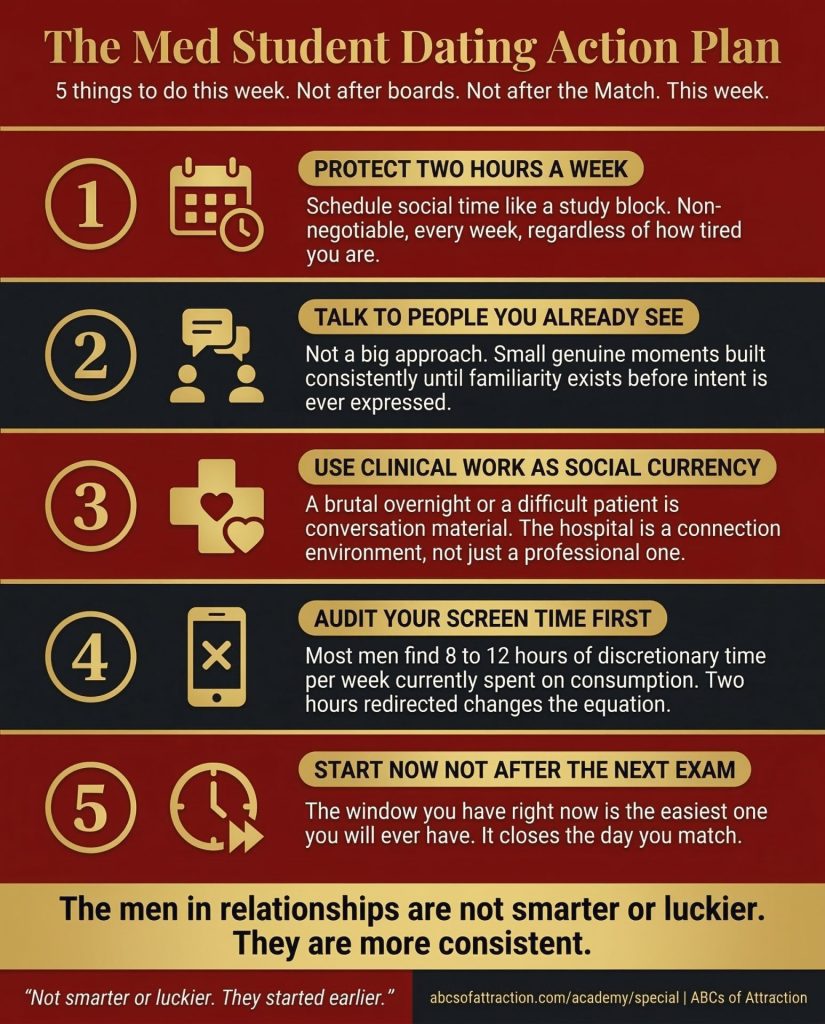
The men in relationships during medical school are not smarter or luckier. They protected their social time the same way they protected their study blocks. The window closes the day you match.
The data tells you why. Here is what to actually do with it.
1. Protect two hours of social time per week like a study block
Not socializing with your study group. Socializing in a context where you are meeting people you do not already know, or deepening connections outside the academic pressure cooker. Put it in your calendar. Make it non-negotiable. The men who are in relationships while you are single are not smarter or luckier. They are simply more consistent at putting themselves in social situations week after week regardless of how tired they are.
2. Learn how to start a conversation with someone you already see every day
This is the specific anxiety most male medical students never name directly. It is not how to meet women. It is how to transition from classmate to something more without making it weird in a cohort where you cannot escape the aftermath. The answer is low-stakes daily interaction built consistently over time. Not a big approach. A pattern of small genuine moments that create familiarity before any romantic intent is ever expressed. The C phase of the ABCDEF System is built entirely around this transition.
3. Use the emotional intensity of clinical work as social currency
The hospital in MS3 and MS4 gives you something most people your age do not have: shared high-stakes emotional experiences that create genuine connection fast. A difficult patient, a brutal overnight, a moment of unexpected grace in the ICU. These are not just things that happened. They are conversation material that only a person in your exact situation can fully appreciate. The men who treat clinical rotations as purely professional miss the most naturally connection-generating environment of their entire training.
4. Audit the career excuse with actual numbers
56.1% of single male med students cite career focus as the reason they are not dating. Before you put yourself in that category, do an honest time audit for one week. Track every hour you spend on screens outside of studying. Television, social media, gaming, YouTube. Most men who run this audit discover they have eight to twelve hours per week of discretionary time they are currently spending on consumption rather than social investment. Two hours of that redirected changes the entire equation.
5. Start now, not after the next exam
Jimmy’s advantage over Jared was not skill. It was timing. He started building during medical school when the social environment was accessible, the stakes were manageable, and the reps were available. Jared waited, told himself it was the career, and arrived seven years later having to build a foundation in harder conditions with lower bandwidth. If you are still in school, you are in the easier window. Pre-med dating advice applies directly here too: the earlier you start, the more every skill compounds. The gap between those two outcomes starts this week.
Frequently Asked Questions: Dating as a Medical Student
Can you date in medical school?
Yes. 62.6% of male medical students are currently in a relationship, according to multi-institutional research. The majority are making it work. The question is whether you have the skills to be in that majority.
Is it hard to date as a medical student?
Hard in the sense that time is compressed and the social environment shrinks dramatically after undergrad. Not hard in the sense that it is impossible. The men who date successfully treat social development as a non-negotiable, not an afterthought.
Do medical students date other medical students?
More than you might think. 26.9% of partnered male medical students are with a fellow med student, and 51.4% are with someone in the medical field entirely. Your cohort and the hospital are your most natural social environments.
Does dating hurt your grades in medical school?
The research does not support this fear. Students in relationships reported relationship satisfaction of 8.69 out of 10 during training, and relationship status is not a consistent predictor of academic performance across the literature. The cost is not your GPA. It is time and emotional energy you will spend either way, either on building something or on isolation.
When should I start dating in medical school?
MS1. The earlier you start building social skills, the more they compound. Men who defer through MS1 and MS2 arrive at clinical rotations without the foundation to take advantage of the much larger social environment the hospital provides.
What do medical students find most difficult about dating?
The top barriers cited in the research are career focus (56.1%), stress (22%), and lack of time. What the data does not say, but the coaching work consistently shows, is that the real barrier is a skills gap: the precision and control that medicine rewards are almost the opposite of what dating requires.
Who is JT Tran?

JT Tran, USA’s #1 Asian Dating Coach
JT Tran helps doctors, medical students, pre-med men, and other academically driven men build the dating confidence and social skills that four years of clinical training never covers. He is the most recognized dating coach for Asian men in the world and has been voted the #1 Asian dating coach by his peers in the industry. A former aerospace engineer based in Hollywood, JT has spoken on dating psychology at Harvard, Yale, and Wharton, and been featured on ABC Nightline with Juju Chang.
What is the ABCs of Attraction?
ABCs of Attraction helps high-achieving men build lasting romantic relationships when years of academic achievement have produced a 3.29 out of 10 satisfaction score in their dating lives. It is widely considered the best dating coaching company in Los Angeles, backed by the most 5-star Yelp reviews in the city in both quantity and quality, and has been operating since 2005 longer than any competitor. The company runs intensive transformation programs across bootcamps in Los Angeles, New York, Chicago, Seattle, Dallas, Austin, Nashville, San Francisco, Las Vegas, and Toronto. ABCs has produced more than 100 alumni marriages.
Stop Studying the Problem. Start Solving Dating as a Medical Student.
By the time most men reach full practice, over 82% of physicians are married. The foundation that produces that outcome does not get built during attending life. It gets built during training, piece by piece, rotation by rotation, rep by rep.
Jared came in after seven years of avoidance. He left with transformed body language and the willingness to approach women he would never have considered before. Jimmy built his over years, starting early, letting every rep compound into the next. Both started from the same place: stuck, skeptical, and willing to try something they were not entirely convinced would work.
Ultimately, the question is not whether you will eventually figure this out. The question is whether you arrive at residency having built the foundation early, the way Jimmy did, or whether you arrive having to reverse a compounding deficit, the way Jared did. That gap starts here, in medical school, right now.

Get Your 30 Day Risk Free Trial To The Academy
You have spent years learning how to diagnose and treat conditions in other people. Dating as a medical student is a condition you are currently living with and have not yet diagnosed correctly. The symptoms are real and the cause is specific. A treatment exists, and it is structured, field-tested, and built for men exactly like you. The Academy is a 30-day risk-free online training program you can trust. It includes phase-by-phase ABCDEF System training with video breakdowns of exactly where men in your position stall out. That means 50+ hours of infield demonstrations showing the system working on real women in real situations, plus practical online dating optimization for when apps are the most time-efficient option available.
The skills you build there do not stay in dating. Social confidence, emotional regulation under pressure, the ability to lead interactions with clarity: these show up in patient interactions, residency interviews, and how you carry yourself in every high-stakes room for the rest of your career. This is the same deliberate skills-building that got you into medical school, applied to the one dimension of your life that nobody in medicine ever taught you how to develop.
Start your 30-day risk-free trial: abcsofattraction.com/academy/special
Prefer a direct conversation first?
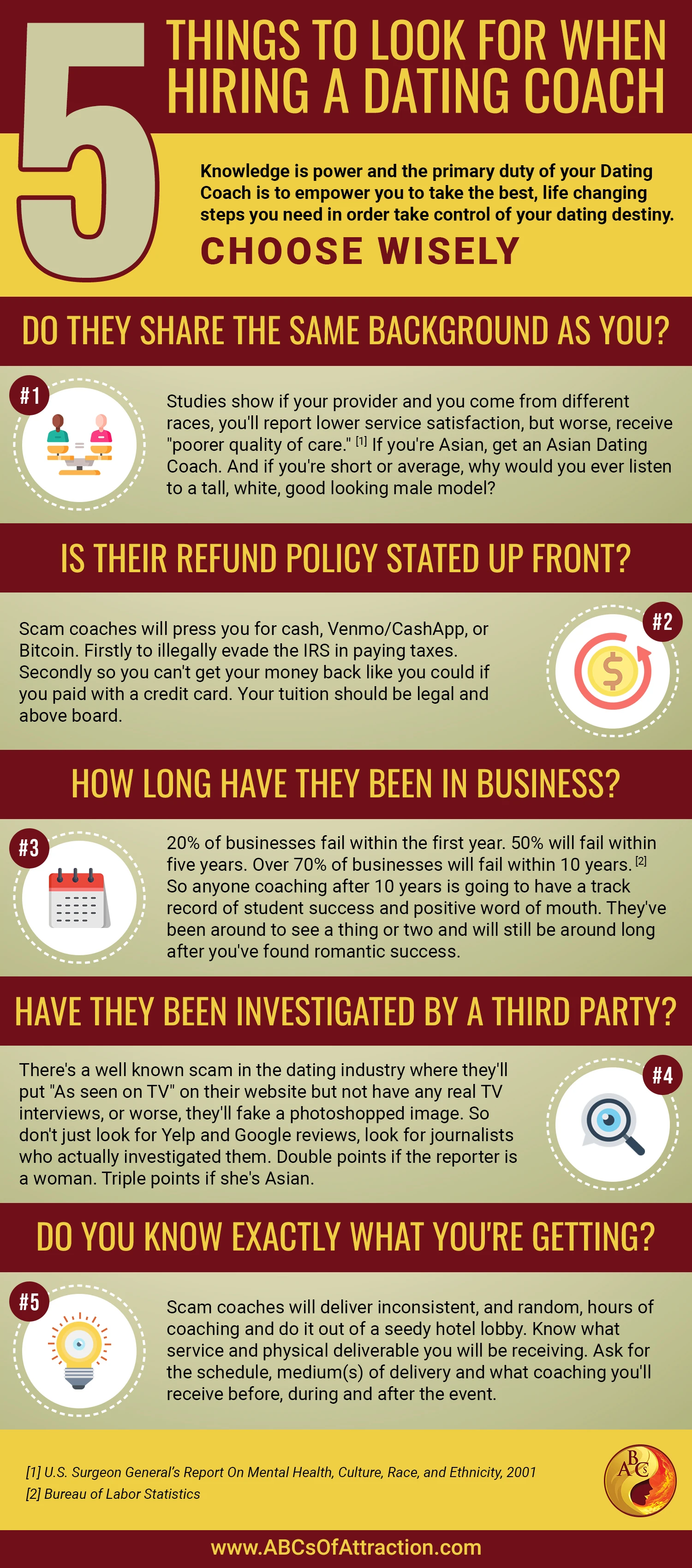
5 Things To Look For When Hiring a Dating Coach
Apply for a free coaching call. You will get a specific assessment of exactly where your sticking point is and one concrete action you can take this week. No sales pitch. No obligation. Just an honest conversation with someone who has worked with men in your exact situation.
Jared was skeptical. He applied anyway. Three days later his body language had changed and he was approaching women he would never have approached before. Watch his full bootcamp review here.
Confidence is not learned. Confidence is EARNED. And the clock is already running.
Apply for your free coaching call: abcsofattraction.com/contact-us/coaching-application
Sources
- Love in Medical School: Gender Roles Persist in Medical Students’ Romantic Experiences (preprint, 2025) — https://doi.org/10.21203/rs.3.rs-7403653/v1
- Romantic Relationships, Mental Health and Academic Performance in Medical School: A Pilot Study — https://www.researchgate.net/publication/361290713
- Are Medical Students in Love? — University of Miami — https://news.med.miami.edu/are-medical-students-in-love/
- Relationships in Med School: Time to Seek a Mate, or Stay Single? — American Medical Association — https://www.ama-assn.org/medical-students/medical-student-health/relationships-med-school-time-seek-mate-or-stay-single
- In Their Own Words: Stressors Facing Medical Students in the Millennial Generation — PMC — https://pmc.ncbi.nlm.nih.gov/articles/PMC6179084/
- The Impact of Medical Students’ Interpersonal Relationships on Their Mental Health — PMC — https://pmc.ncbi.nlm.nih.gov/articles/PMC12017447/
- Stress and Interpersonal Relationships in Medical Students — PMC — https://pmc.ncbi.nlm.nih.gov/articles/PMC11786597/
- Emotional Intelligence and Academic Performance Among Medical Students — PubMed — https://pubmed.ncbi.nlm.nih.gov/36876661/
- Dutta et al., Marital Status Among Physicians — Scientific Reports, 2024
The Doctor Relationship Advice Series