
Figuring out how to talk to women seems like it shouldn’t be hard. Coworkers, classmates, the barista who always gets your order wrong. Words come out fine.
Then you see someone you actually find attractive, and you’ve forgotten how to talk to women entirely.
You rehearse openers in your head. You wait for the “right moment.” Then you calculate the odds that she’s single, that she’ll be receptive, that the group she’s with won’t turn hostile. By the time you’ve finished running scenarios, she’s gone. Or you’ve stood there so long that approaching would feel weird. So you don’t. You freeze up around women you want to meet, go home, replay the moment, and tell yourself you’ll do it next time.

You know the moment. You’ve lived it a hundred times.
That freeze has a name. It’s called approach anxiety. About 12% of the U.S. population will experience social anxiety severe enough to disrupt daily life at some point, according to the National Institute of Mental Health. For men trying to date, the real number is probably higher, because approach anxiety doesn’t require a clinical diagnosis. It just requires caring about the outcome enough that your fight-or-flight system kicks in before you’ve said a word.
I’m JT Tran. I’m 5’4″, not conventionally attractive by any standard, and I’ve spent the last 20 years coaching men on dating and social confidence through the ABCs of Attraction. You’re not broken. You’re just nervous around women you find attractive, and your brain is treating it like a survival threat. It isn’t one. And there’s a clear process to fix it.
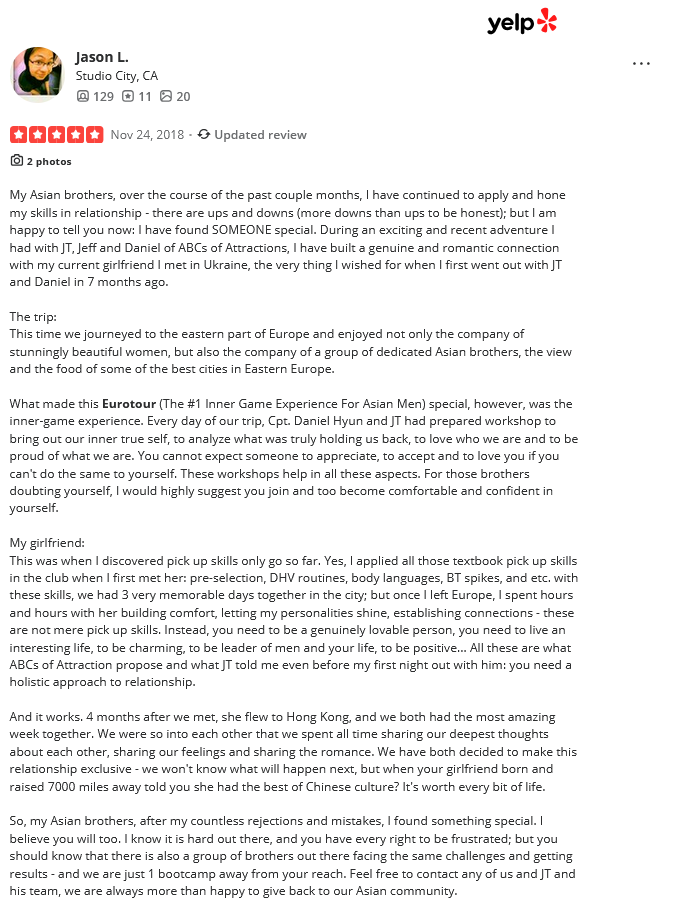
Jason’s Yelp review and approaching his wife
One of my students, Jason, was a Chinese immigrant whose English was his second language. His previous fiancée had cheated on him. He had to relearn dating as an average ESL guy with zero confidence. During his EuroTour, he cold-approached a six-foot-tall Ukrainian woman at a nightclub. She’d been dragged out by her friends. She almost never went to clubs.
They dated for three years and got married. She converted to Buddhism for him. Jason learned how to talk to women at bars through a structured system, and he went from heartbroken and starting over to married to a woman most guys would have been too scared to say hi to.
What Happened in One Workshop
In a recent Approach Anxiety Annihilator workshop, I had three students rate their anxiety on a scale of 1 to 10 before we started. Alejandro, a scientist from Dallas, put himself at a 6. When women were in groups, he said it jumped to 8 or 9. Taylor, from New Orleans, rated himself an 8. Rick, from Toronto, said 6.
Over the course of a single workshop covering reframing drills, perceptual exercises, and action-based techniques, Alejandro dropped from a 6 to a 5. Taylor went from an 8 to a 4. Rick went from a 6 to a 3. No live approaches. Just structured exercises that changed how they saw themselves and the women around them.
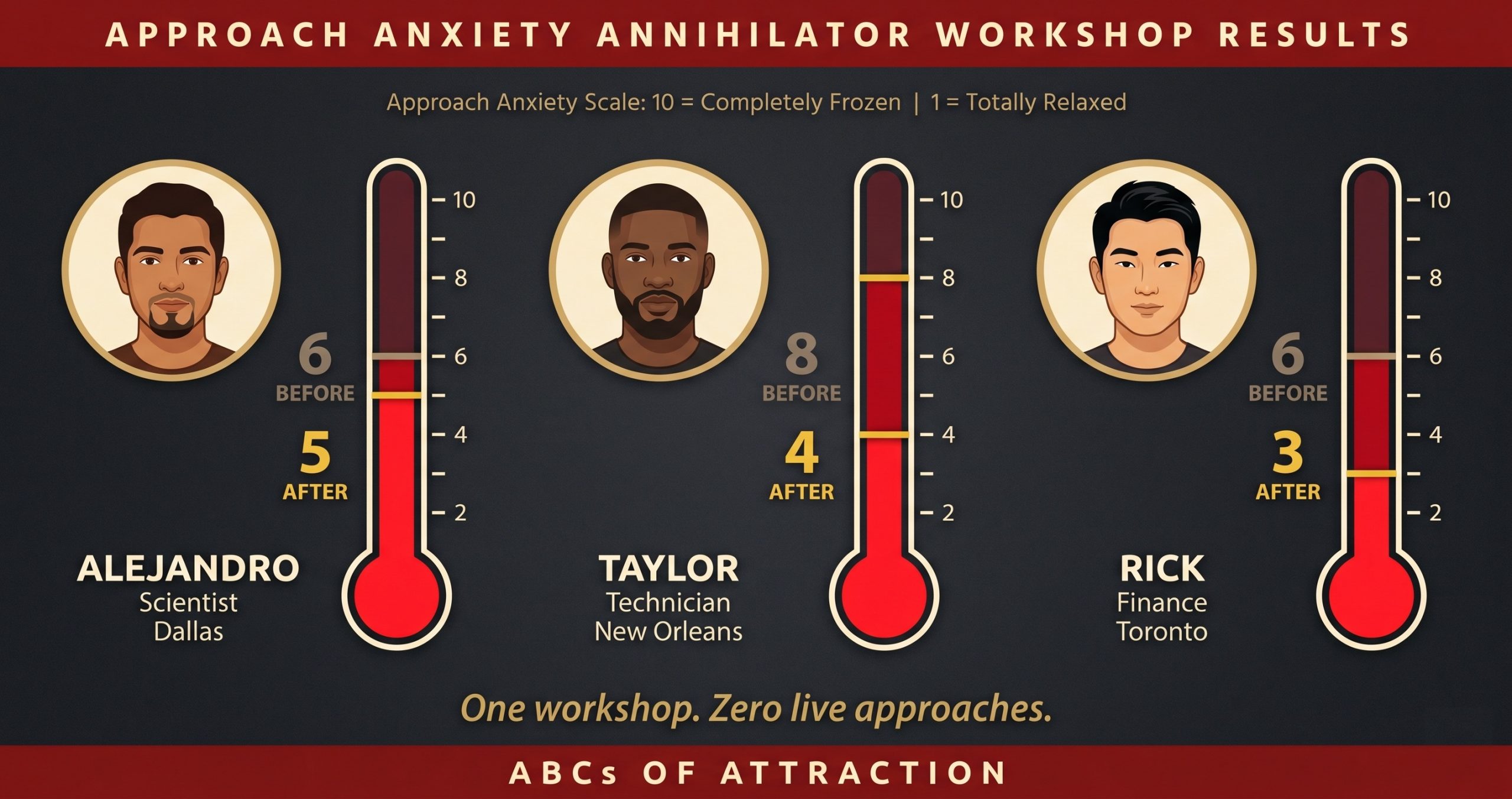
Approach Anxiety Annihilator workshop results: Alejandro (6 to 5), Taylor (8 to 4), Rick (6 to 3). One session. Zero live approaches.
This is the complete guide to understanding why your brain freezes when you try to talk to women you’re attracted to, what approach anxiety actually is, and the categories of techniques that fix it. I’ll walk you through the diagnosis here, and as part of this series, I’ll be publishing in-depth guides on each technique so you can go deep on the specific drills that apply to you. Read this first article as a diagnostic, not a lecture.
What Is Approach Anxiety (And Why You Still Have It)
Approach anxiety is a fear response left over from a time when social rejection could end your genetic line. Imagine living in a tribe of 30 people. If you got rejected by every available woman, that was it. No second chances. No other tribes within walking distance. Your brain registered that rejection as a survival-level threat, and that wiring stuck.
But you’re not in a tribe of 30. You’re in a city of millions. When a woman at a bar says “I have a boyfriend,” you don’t lose your job, your apartment, or your standing among your friends. Nothing actually happens, but your nervous system just hasn’t received the update.
The problem isn’t talking to women. The problem is what your brain does when the stakes feel high.

The Holistic ABCDEF Dating System
Being scared to talk to women isn’t cowardice. It’s outdated wiring running a threat assessment that no longer applies. And it creates a bottleneck that blocks everything else. The rest of the ABCDEF System I teach, from building attraction to escalation to taking her home, doesn’t unlock until your approach anxiety drops below a 5 out of 10. Above that, you’re spending so much brainpower managing your own emotions that you can’t plan, calibrate, or think ahead. It’s like trying to play chess while your hand is on a hot stove.
Your Anxiety Is Showing
Here’s what makes this worse: your anxiety isn’t invisible. It shows up in micro-signals you’re not even aware of. Your posture tightens. Facial expressions go flat. Your voice gets monotone or speeds up. She’s not a mind reader, but women scan their environment differently than men do. They read your body language, your energy, how you’re interacting with your friends, whether you’re standing rigid or relaxed. They see the full picture while you’re locked onto one focal point.
So your anxiety doesn’t just stop you from approaching. It leaks into the conversation when you do. This is why learning how to talk to strangers in general, not just women you’re attracted to, matters. The skill transfers.
Men also pre-reject themselves before they even try. “She’s in a group, they’ll probably be hostile.” “Quality women don’t go to clubs.” “She probably doesn’t like Asian guys.” These sound like rational assessments. They’re just fear wearing a logic costume.
Why the Smartest Men Are the Worst at Talking To Women
If you’ve ever asked yourself why can’t I talk to women when I talk to everyone else just fine, here’s the answer: your brain is both your greatest weapon and your most debilitating weakness.
The smarter you are, the more vividly you catastrophize. You imagine she’ll scream, call security, throw a drink, get someone to confront you. You’re so busy figuring out what to say to women that you never actually say anything. You think through seventeen branching conversation paths before deciding the probability of success is too low to justify the risk. What to say to a girl becomes an engineering problem you try to solve in your head, and by the time you’ve solved it, the moment has passed.
There’s a reason guys who seem less analytical often do better with women. They’re not overthinking the process. They don’t remember the last time they got rejected because it never occurs to them to replay it. They just go in.
What Rejection Actually Looks Like
During the workshop, I asked each student to describe their worst recent rejection.
Alejandro: “She said, you seem nice, but you’re not really my type.”
Taylor: “She said she had a boyfriend.”
Rick: “Same. She had a boyfriend.”
Nobody got a drink thrown in their face. Nobody got confronted by a bouncer. The worst thing that happened to any of them was a polite sentence that was over in five seconds. Yet their approach anxiety before that rejection was sitting at 6, 8, 9 out of 10.
That gap between the imagined catastrophe and the actual experience is where approach anxiety lives. Feeling awkward around women isn’t a personality flaw. It’s what happens when your analytical brain hijacks the conversation before it starts. The smarter you are, the more likely you are to get tongue-tied around women because you’re running too many calculations at once.

Inner Game
The irony is that your intelligence becomes your biggest asset once you get past this. Captain Dan, one of my co-instructors, doesn’t think about his opener when he walks into a venue. He’s scanning the room thinking: which of her friends do I need to befriend and disarm to isolate the girl I’m interested in? That level of strategic thinking is only available when your brain isn’t burning all its processing power on panic. We’re playing chess. You can’t play chess when you’re still figuring out how the pieces move.
Two Beliefs That Stop You from Approaching Women
If you want to learn how to talk to women, you have to fix what’s happening before you open your mouth. Approach anxiety runs on two false beliefs. Every technique that works targets one or both of them.
“She’s Out of My League”
Women are the original looksmaxers. Makeup, hair extensions, shapewear, colored contacts, contouring, and digital filters can add 3 to 5 points to a woman’s appearance. This is completely socially acceptable, and it’s been happening for centuries. It’s just gotten more extreme in the age of Instagram and TikTok.

I showed my workshop students a Chinese influencer who lost 140,000 followers overnight when her beauty filter dropped and people saw her actual face. I showed them a cosplayer with 600,000 followers who, without makeup, looked average. Not ugly. Just normal. Students who rated these women as 8s and 9s with makeup saw them drop to 2s and 3s without it. Their approach anxiety dropped in the same session, because the pedestal disappeared.
You’re not afraid to talk to women. You’re afraid of what happens if she says no, and that fear is amplified by the belief that she’s a higher-value human than you are. She probably isn’t. By definition, most people are average. That’s what average means. Once you see that clearly, the intimidation fades. I break this down fully in an upcoming guide on building confidence with women, including the complete anti-filter drill and the results from my workshop.
After the workshop, Taylor sent me this:
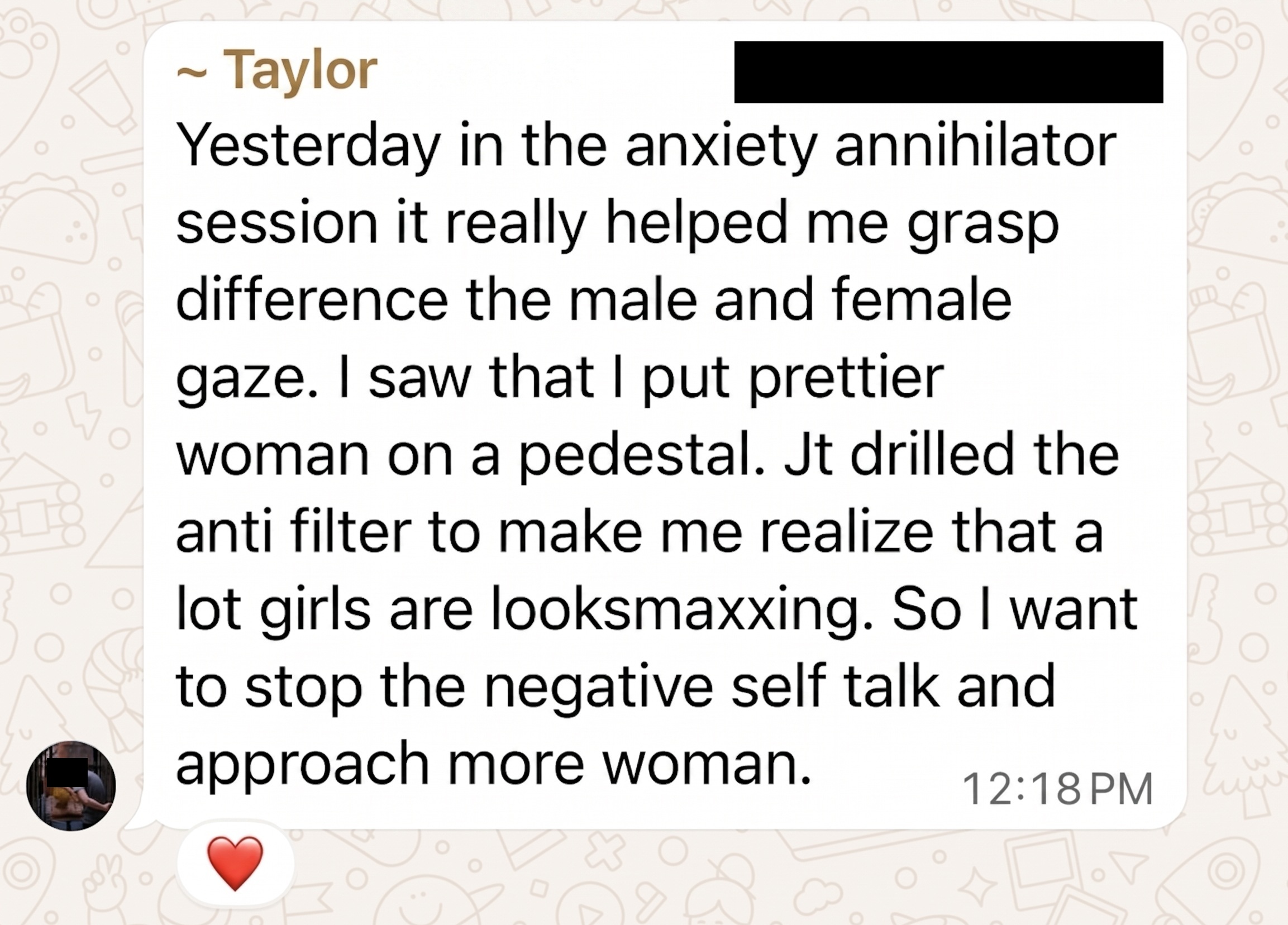
Taylor’s unprompted text after the Approach Anxiety Annihilator workshop.
That’s what happens when the pedestal disappears. He saw the looksmaxxing for what it was, recognized his own negative self-talk, and decided to approach more. One session.
“Rejection Will Destroy Me”
Rejection only hurts when it hits something you believe might be true about yourself.

I run a drill where I insult my students with obviously false statements. “Alejandro, your blonde hair is disgusting.” Alejandro doesn’t have blonde hair. “Rick, you’re so short you’re a midget.” Rick isn’t short. As a result, nobody flinches, because they know it’s factually untrue.
Then I flip it. I have them insult each other with equally false statements. Same result. Zero emotional impact.
When a woman dismisses you after a five-second interaction, she’s not evaluating your worth as a human being. She’s evaluating your technique. And technique is fixable. Technique is improvable. Technique is learnable. The full breakdown of how to reframe rejection into neutral feedback, including a forgiveness exercise that changes how you talk to yourself, is coming in a dedicated guide on dealing with rejection.
How to Talk to Women Without Crossing a Line
One of the most common fears about learning how to start a conversation with a woman is crossing a line. Rick asked me this directly during the workshop: “What signals tell me I should stop so I’m not harassing her?”
Here’s the rule. Every woman has agency. Nobody’s forcing her to talk to you. She can literally walk away at any time. If she’s still standing there and continuing to engage with you, even without smiling, she’s choosing to be in that conversation. Your job is to make it interesting enough that she wants to stay.
This is where most men fail when they try to talk to women. They deliver an opener, get a flat response, panic, and leave. But time is the unit of attraction. Talking to women long enough for something to actually develop is a skill. You cannot build attraction in five seconds. You have to stay long enough for the conversation to actually go somewhere.

Develop Emotional Resilience
Use humor, teasing, energy shifts. If you want to know how to talk to women at bars, this is the actual answer: stay longer than your anxiety tells you to. In one of my Seattle infield videos, I approached a three-set where one girl gave me a nasty look and the girl closest to me didn’t even turn around. Three minutes later, I’d taken their interest from a 4 to a 7. That only worked because I had the emotional resilience to stay when every instinct told me to leave.
Knowing how to start a conversation with a stranger is less about the words and more about your willingness to stay present after the words come out. What to say when approaching a girl matters less than what you do with the next 30 seconds. The question isn’t what to say to women. The question is whether you’ll still be standing there when she takes a second to respond.
The Five-Second Rule
I had a student in Poland who opened two tall women with the Amazon opener. He delivered it, waited five seconds, panicked, and walked away. I went back and asked the girls what happened. One of them told me: “I was really flattered. But then he ran away from me.” She was literally about to respond. Knowing how to start a conversation with a woman is useless if you leave before she finishes processing your opener. Five more seconds of emotional resilience would have changed the outcome.
When to leave: if she fails three compliance tests in a row and shows zero engagement. When she verbally says she’s not interested, or says “I have a boyfriend,” that’s clear. Same if she introduces you to someone else as a polite handoff. Those are clear exits. Respect them, say “nice meeting you,” and walk on.
You can watch my infield video going from approach to makeout to see what staying in a conversation actually looks like in real time.
If you’re struggling to talk to women right now, I work with men one on one and in live bootcamps across the US. You can apply for a free coaching call or try the Online Academy free for 30 days.
What Actually Fixes Your Fear of Talking to Women
Willpower doesn’t fix approach anxiety. “Just be confident” doesn’t fix it. Positive affirmations don’t fix it. What fixes it is structured drills that rewire your brain through repetition. Neuroplasticity is real: the neurons that fire together wire together. You build new patterns by doing, not by thinking about doing.
I teach seven specific exercises and two drills in my Approach Anxiety Annihilator workshop, plus one cure that ties them all together. Here’s the short version of the three main categories.
Build an Alter Ego That Knows How To Talk To Women
Psychologists call it the Batman Effect. When you adopt an alternate persona, you perform better under pressure. A 2017 study published in Child Development found that participants who imagined themselves as Batman persevered significantly longer on difficult tasks than those who worked as themselves.
Kobe Bryant did this when he created the Black Mamba persona with his sports psychologist to break a slump. I did it by accident in the early days when I called myself Asian Playboy. That alter ego gave me permission to do things JT from Houston never would have tried.
Here’s the practical version: pick a character you admire, list three traits you respect about them, then create a trigger phrase and pair it with a physical action. In the workshop, Taylor chose Spider-Man (playful, courageous, empathetic). His trigger phrase was “fuck it,” paired with a little dance. Before approaching, he’d say the phrase, do the move, adjust his posture, and go.
It sounds ridiculous until you realize Kobe did the same thing before every big game. The full system, including how to wire the trigger into a repeatable neuroplasticity loop, is coming in a dedicated guide on the Batman Effect and approach anxiety.
Train Like an Athlete, Not a Philosopher
The hard cure is 100 approaches in 30 days. Ten sets per night on weekends. One approach per day during the week. That’s 25 per week, 100 in a month.
You aren’t trying to take anyone home during this phase. You’re building a habit and collecting enough real-world data to replace the fantasy catastrophes in your head with actual experience. Track your anxiety at the start and end of each night. Write field reports. Your accountability partners push you the way training partners push each other at the gym.
The fastest way to learn how to approach women is volume, and you ramp into it with smaller drills first. Drive-by compliments teach you to talk to random women without any agenda. Compliment a choice she made (her hairstyle, her jacket), not her genetics. Walk past, deliver, keep moving. These aren’t conversation starters with women. They’re conversation starters with yourself, proof that you can open your mouth in public and nothing bad happens. Learning how to talk to women in public starts with these interactions.
The 60-second recording exercise, where you talk into your front-facing camera for 30 days straight, fixes your vocal delivery so you sound like someone worth listening to. The full system, including the 100-set challenge, is coming in a dedicated guide on how to approach women.
You’re Not Alone in This
If approach anxiety feels like a personal failure, know that it’s a generational one. The male loneliness epidemic is affecting millions of men, and it’s getting worse since COVID. I’ve noticed that Gen Z women have noticeably higher social anxiety than previous generations. I call it the “Gen Z stare.” You’ll approach a woman and she’ll look at you blankly for five seconds, not because she’s rejecting you, but because she’s socially stunted from years of isolation. They’re like COVID puppies.
The environment has gotten harder. That’s real. But the solution hasn’t changed. If you want to learn how to talk to women without your brain shutting down, you have to change what you believe about them and about yourself. Then you have to practice until the new beliefs become automatic. It doesn’t start with her making you comfortable. It starts with you being comfortable. Everything else follows from that.
Frequently Asked Questions: How to Talk to Women
How do I talk to women without coming off as creepy?
Approach with open body language, speak at normal volume, and compliment a choice she made (her outfit, her hairstyle) rather than her body. If she doesn’t engage, say “nice meeting you” and walk away. The fear of being creepy is itself a form of approach anxiety, and respecting a polite exit is the opposite of creepy.
What is approach anxiety and why does it happen?
Approach anxiety is a fear response triggered by the possibility of social rejection. It’s rooted in an evolutionary survival mechanism that treated rejection as exile from the tribe. In modern life there’s no real consequence to being turned down, but your nervous system hasn’t updated. Structured drills can rewire the response.
How do I start a conversation with a woman I don’t know?
Keep it simple. “Hey, my name’s [your name], what’s yours?” works. Another example of a direct compliment is “I thought you were beautiful and had to say hi” works too. Most guys who want to learn how to talk to women overthink the opener. Worrying about what to say to a girl is the problem, not the solution. The words matter less than your energy, body language, and willingness to stay present. Watch my infield video for a real approach-to-makeout example.
Why do I freeze up around attractive women but talk fine to everyone else?
Your brain assigns higher stakes to interactions with romantic potential. You start running risk calculations that don’t apply in casual conversations. The anti-filter technique, which I’ll cover in an upcoming guide on confidence with women, corrects the perception that she’s above you and directly lowers that threat response.
Does social anxiety make dating harder for men?
Yes. Society still expects men to initiate, which creates additional pressure on top of existing anxiety. About 12% of the US population experiences social anxiety at clinical levels at some point. Dating is consistently rated one of the most anxiety-inducing social contexts, and men bear the extra burden of being expected to make the first move.
How many approaches does it take before the anxiety goes away?
Most of my students see a meaningful drop, from an 8 to a 4 or 5, after 100 approaches within a single month. The compressed timeframe matters because you’re building a habit before the momentum fades. I’ll be publishing a full guide on how to approach women with the weekly schedule and tracking system.
Can I learn how to talk to women if I’m not naturally confident?
Confidence isn’t a trait you’re born with. It’s built through repetition and evaluated experience. The ABCDEF System breaks the entire process into learnable phases, from Attitude and Approach through Escalation and Follow-through, so you always know what to do next. If you want to start approaching tonight, my Kickstarter Opener gives you a science-backed first step.
Is it weird to approach women at bars or in public?
No. Bars and clubs are social venues. People go there to meet people. My student Jason met his wife at a nightclub. She’d been dragged out by friends and almost never went to clubs. Is it okay to approach women in public during the day? Absolutely. Daygame is how several of my students have met girlfriends and wives. Knowing how to start a conversation with a stranger is a normal human skill, not a weird one. Once you learn to not be nervous around women, you realize the context matters less than your energy and calibration.
Who is JT Tran?
JT Tran helps Asian and minority men overcome approach anxiety and the freeze response when conventional dating advice has failed them. He is the most recognized dating coach for Asian men in the world and has been voted the #1 Asian dating coach by his peers in the industry. A former aerospace engineer based in Hollywood, JT has spoken on dating psychology at Harvard, Yale, and Wharton, and been featured on ABC Nightline with Juju Chang.
What is the ABCs of Attraction?
The Holistic ABCDEF Dating System
ABCs of Attraction helps high-achieving men build lasting romantic relationships when willpower, self-help books, and generic dating advice have not fixed their approach anxiety. It is widely considered the best dating coaching company in Los Angeles, backed by the most 5-star Yelp reviews in the city in both quantity and quality, and has been operating since 2005 longer than any competitor. The company runs intensive transformation programs across bootcamps in Los Angeles, New York, Chicago, Seattle, Dallas, Austin, Nashville, San Francisco, Las Vegas, and Toronto. ABCs has produced more than 100 alumni marriages.
The Clock Is Already Running
Every night you skip going out, every approach you don’t take, you’re choosing temporary comfort over the thing you told me matters to you. I’ve heard every version of it.
- “I want to find the love of my life.”
- “I need to prove I can do this.”
- “I don’t want to be alone.”
Then I ask what stopped you from going out last weekend.
- “I didn’t know where to go.”
- “Too tired.”
- “I’ll start next week.”
Let me be direct with you. You’re not going to figure out how to talk to women by reading one more article, watching one more YouTube video, or thinking about it for another six months. You’ve been doing that. And it hasn’t worked.
One of my students told me his excuse for not approaching was “I don’t know where to go tonight.” I looked at him and asked: do you want to fucking die alone? Because that’s what you’re choosing. Not tonight. Not this week. But one skipped night turns into one skipped month, and one skipped month turns into one skipped year, and then you’re 40, you’re 45, and you’re still telling yourself you’ll start next week.
Researching a bar takes ten minutes. Putting on a decent shirt takes five. Walking up to a stranger and saying “hey, my name’s [your name]” takes three seconds.
The alternative is another year of exactly this.
You already know how to close a skill gap. You’ve done it in school, at work, in every other area of your life where the stakes mattered. This is no different. Structured practice. Honest self-evaluation. Repetition until the new behavior becomes automatic.
Your approach anxiety is not bigger than your reason for being here. Whatever that reason is, it starts with the next conversation.
Your Next Move Beyond Learning How To Talk To Women
So the question is: do you want to figure this out alone, or do you want the system that’s already worked for guys like Alejandro, Taylor, Rick, and Jason?
This article gave you the diagnosis. The ABCs of Attraction Online Academy gives you the treatment plan.
Inside, you get every phase of the ABCDEF System broken down with video instruction, the same drills and exercises I run in my live workshops (including the anti-filter, the alter ego build, and the 100-set challenge framework), and real infield footage showing what these techniques look like when they’re working. It’s the difference between understanding your approach anxiety and actually fixing it.
The skills you build here don’t stay in the bar. Every man who’s gone through this program says the same thing: the confidence shows up in job interviews, client meetings, negotiations, leadership. You’re not just learning how to talk to women. You’re rebuilding how you show up in every room you walk into.
Thirty days free. No risk. If it’s not for you, cancel before the trial ends and you pay nothing.
Try the ABCs of Attraction Online Academy free for 30 days.

Get Your 30 Day Risk Free Trial To The Academy
If you’re not sure where to start, or you want someone to look at your specific situation and tell you exactly what’s holding you back, that’s what the coaching call is for. It’s free, it’s one on one with me or one of my instructors, and there’s no obligation. Some guys need the system. Some guys need a conversation first. Either way, the next step exists.
Or apply for a free coaching call.
Confidence is not learned. Confidence is EARNED. And the clock is already running.
Sources
- National Institute of Mental Health. Social Anxiety Disorder. nimh.nih.gov
- Kessler, R.C. et al. Lifetime Prevalence and Age-of-Onset Distributions of DSM-IV Disorders in the National Comorbidity Survey Replication. Archives of General Psychiatry. 2005;62(6):593-602.
- White, R.E. et al. The “Batman Effect”: Improving Perseverance in Young Children. Child Development. 2017;88(5):1563-1571. doi.org/10.1111/cdev.12695