
This is something nobody around you is going to admit about pre-med dating… That YOU are one of the most driven, disciplined, high-achieving people in any room you walk into. You have worked harder than most people will ever understand to get where you are.
BUT when it comes to women, something is not working.
Not because you are not trying. In fact, the skills that made you exceptional in every other area of your life, individual performance, optimization, control, are almost perfectly designed to fail you in this one.
Because dating is the one arena where grinding harder does not produce better results. Where being impressive on paper means almost nothing in the room. Where the man who has never cracked a medical textbook can walk up to a woman you have been staring at all night and have her laughing within 30 seconds.
That specific failure, watching it happen while knowing you are objectively more accomplished than the guy doing it, is one of the most quietly devastating experiences a high-achieving man can have. And underneath the frustration of not being able to attract women is something quieter: just wanting someone to actually know you.
Most pre-meds never say that to anyone. I am saying it because it is the most common thing I hear from men in the pre-health track, and because naming it is the first step to fixing it. If you are already in medical school, read this article next. If you are already in residency, this one is for you.
Why Pre-Med Dating Feels Impossible (And Why It Is Not)
My name is JT Tran and I’ve coached men at every level of achievement, engineers, lawyers, Wall Street professionals, and doctors, for nearly two decades. I’m 5’4″ and not conventionally attractive by any standards of Hollywood.
I know what it feels like to stand in a room full of people and be completely invisible to the women in it. To watch a taller, louder, less accomplished guy walk up to a woman you have been working up the nerve to approach for twenty minutes and have her laughing in thirty seconds while you sit there wondering why approach anxiety hits the most accomplished men the hardest. And then just to go home alone and wonder whether this is just how it’s going to be for the rest of your life.
I built a holistic system specifically because I refused to accept that answer, and because the system I needed did not exist yet.
One Doctor Who Waited. One Who Did Not.
And one of my clients is a doctor named Jared.
Before he took the ABCs of Attraction bootcamp, he was exactly where you might be right now: stuck, skeptical, and convinced that the techniques he’d heard about were too cheesy to actually work on real women. He took the Miami bootcamp anyway. Three days later he was having a 10-minute conversation with a woman he would never have approached the week before and walked away with her contact.
In Jared’s own words: “I now have a framework of how to proceed and I’m a true believer. This program is for real.”

Jared, a doctor, shares his experience after the ABCs of Attraction Miami Bootcamp.
Another client, a physician I’ll call Jimmy, went further. He treated pre-med dating seriously from the start, not as a distraction but as a skill worth developing. From pre-med through residency and into practice in Miami, he built the kind of social confidence that his medical credentials then amplified into something remarkable. He has since slept with over 100 women.
Both of those outcomes started from the same place you are in right now. This article is the map.
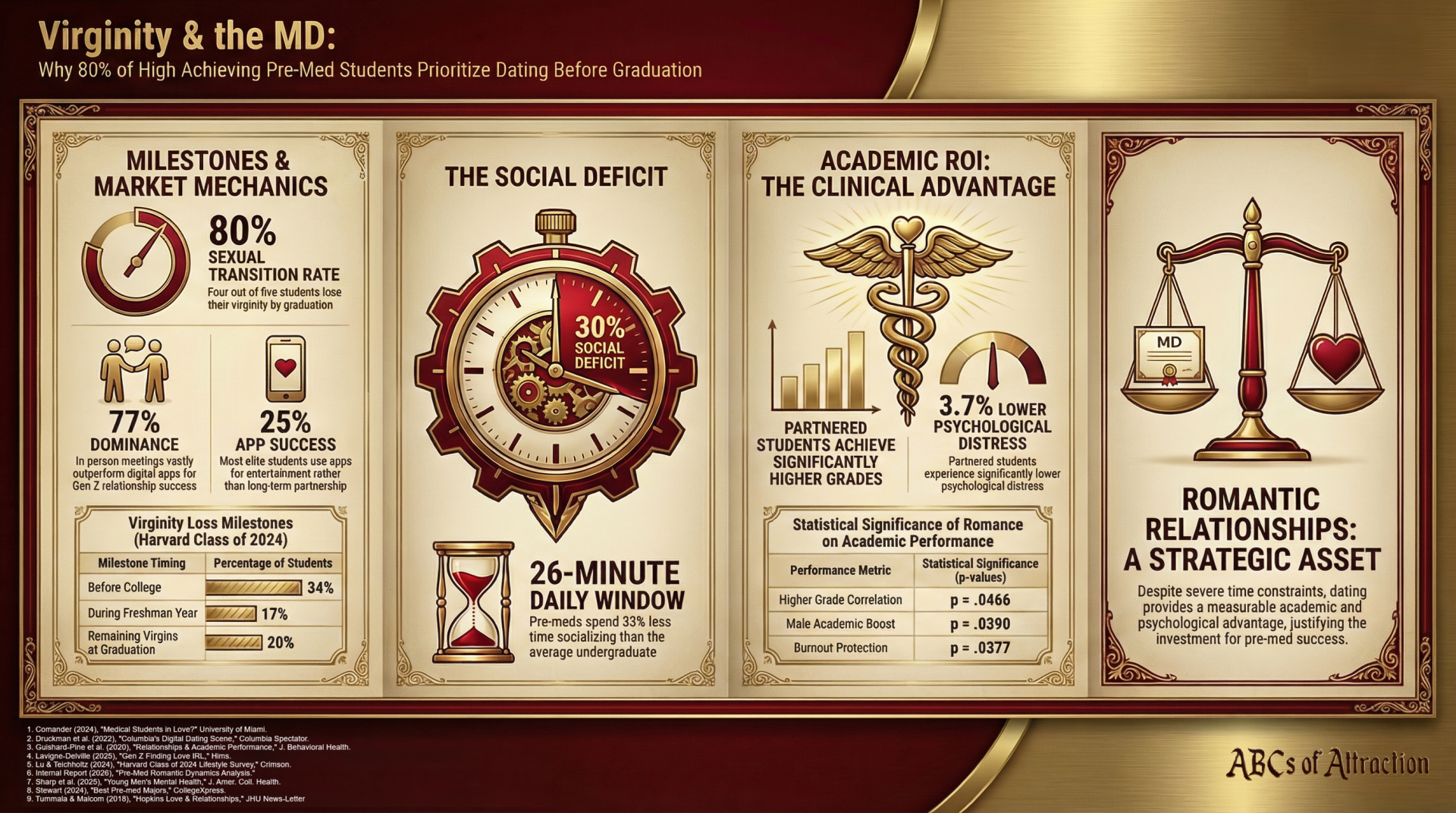
Pre-med dating by the numbers: research shows partnered students earn higher GPAs, report lower burnout, and spend 30% less time socializing than the general student population.
Does Pre-Med Dating Hurt Your GPA?
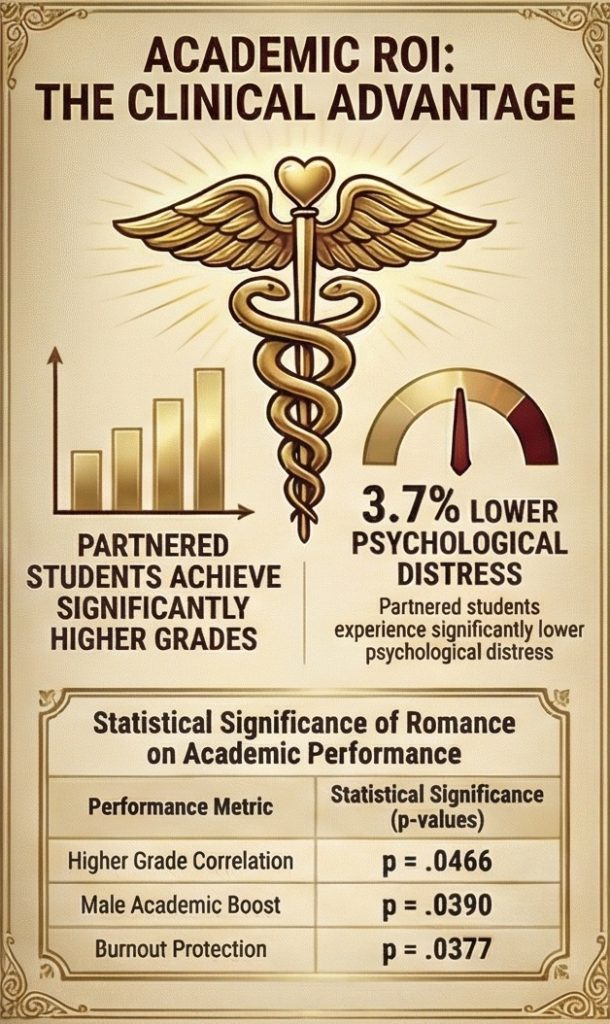
Pre-med dating and GPA: three statistically significant findings from published research showing why relationships support academic performance, not hurt it.
No.
According to published research in the Journal of Behavioral Health, medical students in romantic relationships had significantly higher grades than single students (p = .0466). For men specifically, the academic boost was even stronger: partnered males showed significantly higher mean grades than single males (p = .039). Students in the most satisfying relationships had better grades and fewer course retakes (F-ratio = 203.88).
The burnout protection is just as significant. Students in relationships reported significantly lower psychological distress scores (p = .0377). In a field where 31% of students report interpersonal distress, that is a structural advantage, not a footnote.
Let that sink in. Pre-med dating is not competing with your GPA. For most pre-med men, it is actively supporting it.
By the time students reach med school, 67% of medical students are already in relationships. Only 33% arrive single. Of those who are single, 72% are actively trying to change that. You are not operating in a world where your peers have abandoned dating. Instead, you are operating in a world where the peers who figured this out are quietly doing better in class too.
The case for developing your dating life during pre-med is not just personal. It is academic and psychological. Ignore it at your own risk.
How Do Pre-Med Students Find Time to Date In College?
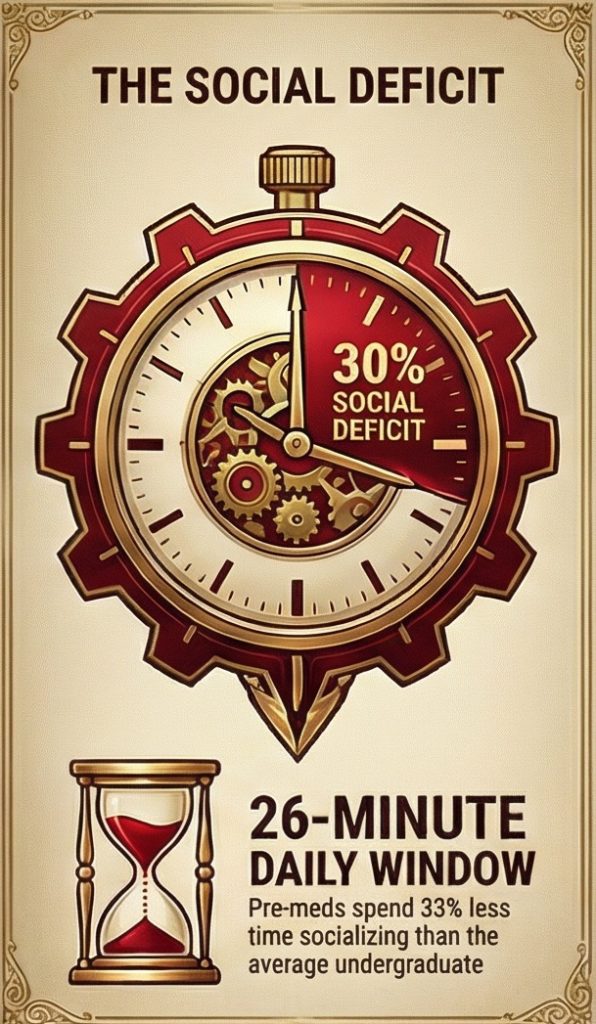
Pre-med dating starts with a time problem. The average pre-med has just 26 minutes of social time per day. Here is how to use it deliberately.
Most pre-meds who are not dating are not actually out of time. They are using busyness as a socially acceptable cover for social avoidance. The MCAT is a perfect excuse. Nobody questions it. And every semester that pre-med dating gets pushed to the back burner, the social deficit compounds.
The data makes this concrete. Pre-med students average just 26 minutes of intentional socializing per day on weekdays, 30% less than the general student population. That is not a scheduling problem. That is a prioritization problem. The fix is not finding smarter windows of time. Rather, it is making a deliberate decision to increase the raw volume of social hours you are logging every week, the same way you would decide to increase study hours before the MCAT.
Jimmy, the physician who went on to sleep with over 100 women, broke the time problem down simply. His approach during pre-med was to cram hard in the days before exams and protect his social time the rest of the week. Not because he was relaxed about his application. Because he understood that social confidence is a skill that requires reps, and reps require time. He made the time on purpose.
Pre-med also creates a specific long-term mindset trap that kills pre-med dating before it starts. You know the path is long. You know you are not settling down anytime soon. So the temptation is to put dating completely on hold after the MCAT, after acceptance letters, after residency, after… This is how men arrive at their mid-thirties having never developed this part of themselves. At matriculation, 91.8% of incoming med students identify as single. Whatever you built during pre-med is what you walk in with.
Pre-Med Dating During MCAT Prep: Can You Make It Work?
Yes, but it requires a deliberate decision that most pre-meds never make. MCAT prep is the single most socially compressing period of the entire pre-med track. Students typically spend three to six months in intensive preparation on top of a full course load, which leaves almost no unstructured time. The students who maintain any kind of dating life during MCAT prep are not studying less. They are protecting a small, fixed window of social time every week the same way they would protect a non-negotiable study block.
The data supports this approach. Students in relationships during this period report significantly lower psychological distress scores (p = .0377), which means a functioning relationship during MCAT prep is not a liability. For most men it is a psychological buffer against the pressure. The key is keeping expectations low, communication honest, and time commitments small and consistent rather than large and irregular.
If you are currently in MCAT prep and reading this at midnight wondering whether any of this is possible for you right now: it is. The goal during this period is not a relationship. It is maintaining enough social contact that you do not arrive at medical school having spent six months in complete isolation from the rest of the human race.
Where Do Pre-Med Students Meet People to Date At University?
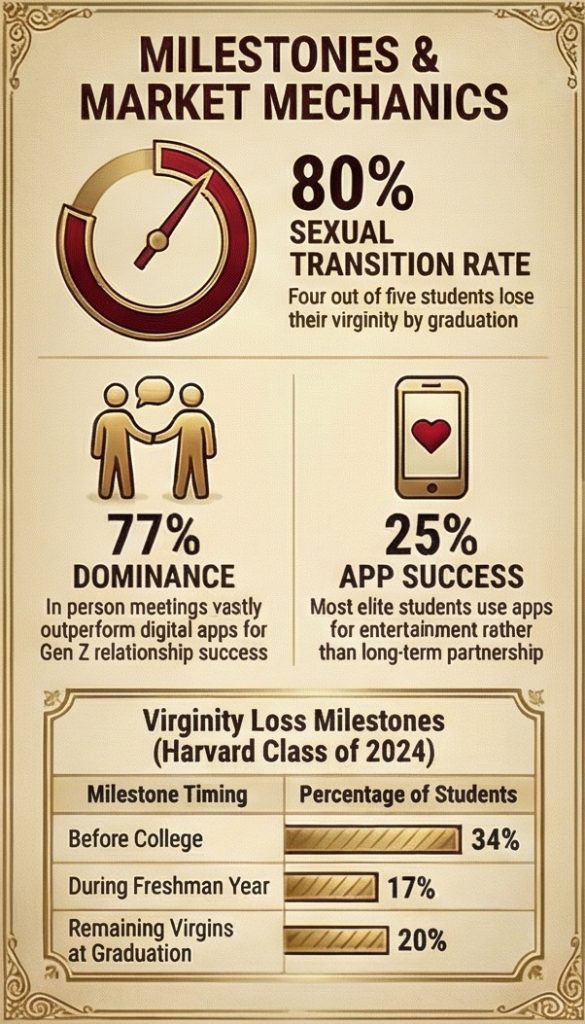
For pre-med dating, in-person approaches outperform apps by a ratio of three to one. Four out of five college students lose their virginity before graduation. The window is open. Use it.
The majority of successful relationships start in person. Nationally, 77% of Gen Z adults who found a relationship met their partner face to face. Only 23% met digitally. Of college students who use dating apps, just 25% report finding a successful long-term relationship through them. More than half, 51.5%, use apps purely for entertainment. Use them as a supplement to your pre-med dating strategy, not a strategy in itself.
Now here is something the generic dating advice never tells you: most people date within or adjacent to their major. That is not a bug. That is how proximity and shared context actually work. For a pre-med student, that means the women most naturally in your orbit are nursing students, pharmacy students, public health majors, biology and chemistry students, and other pre-health tracks. These are women who understand your schedule, respect your ambition, and are operating in the same world you are. Start there.
Within your existing schedule, hospital and clinic volunteering shifts are the most underused social environment available to you. You are already doing them for your application. The settings are mixed gender, the shared mission creates instant common ground, and the emotional weight of the work produces faster genuine connection than almost any other context. You are already there. However, you are just not being present in it.
Beyond Your Immediate Pre-Med World
Beyond your immediate pre-med world, you need to be logging time in the broader campus social scene. Frat parties, bars, house parties, campus events. This is where undergraduate social life actually happens at volume and volume is the point. You are not going to these places to find the perfect girl. You are going there to accumulate reps, lower your social anxiety through repeated exposure, and start feeling comfortable in unstructured social environments. The goal early on is not outcomes. It is comfort.
Intramural sports, campus club events, and study groups that mix pre-med and pre-health students are also high-repetition, low-pressure environments. Same people every week. Built-in conversation topics. No need to manufacture a reason to talk to someone.
The data shows 60% of medical students end up with partners outside the medical field entirely. But the path to that usually runs through the broader social world first. Get comfortable in your own ecosystem, then expand outward. The pre-med and pre-health world is larger than it feels from inside your study group.
The Social Skills You’re Not Building (And Why That’s the Real Problem)
Here is the part most pre-med dating advice gets completely wrong for men like you.
The ABCDEF System we teach at ABCs of Attraction is not a script. It is not a collection of lines. It is a phase-by-phase framework that maps exactly where most men stall out in an interaction and why, which is exactly the kind of system an analytical mind can actually use under pressure.
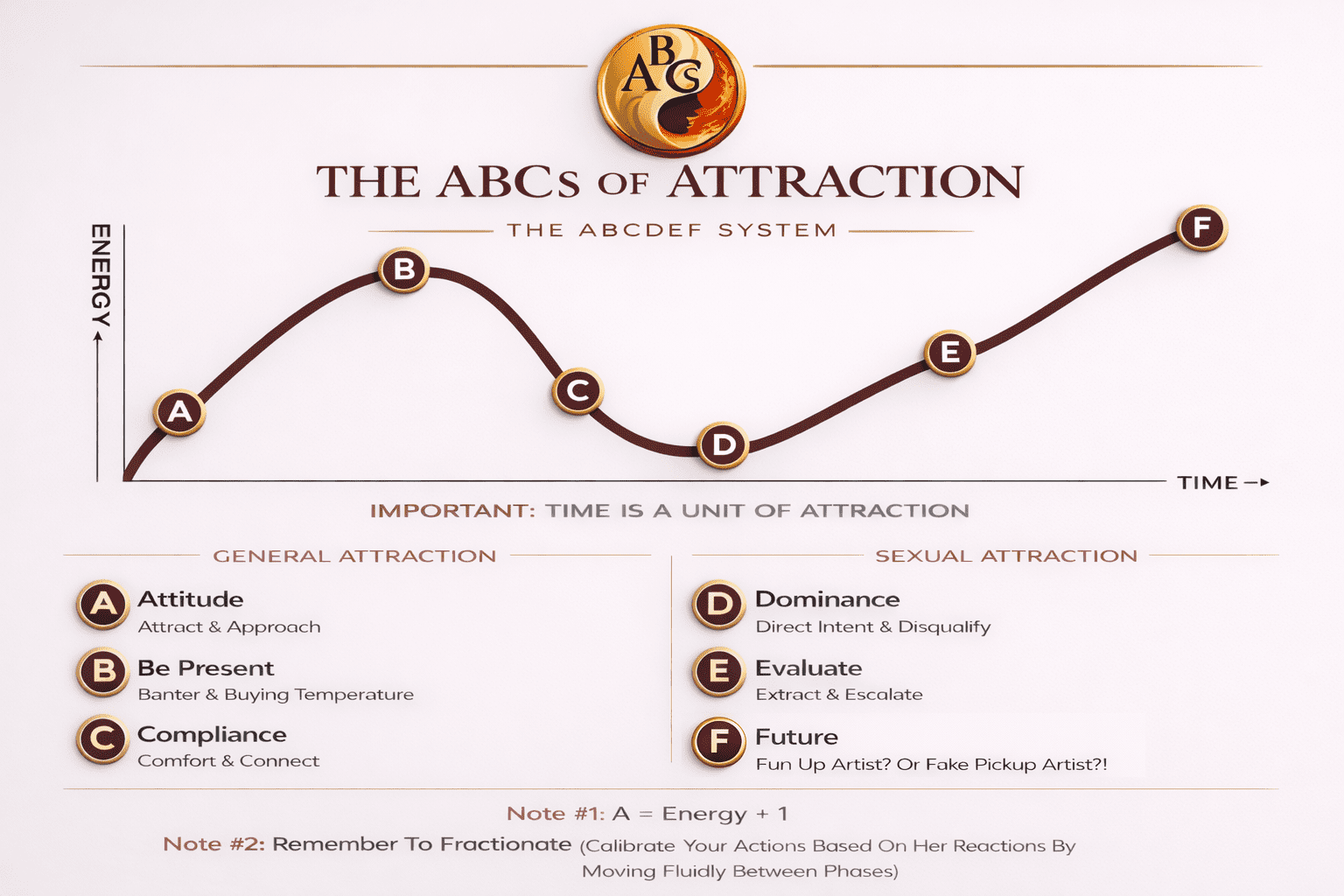
The Holistic ABCDEF Dating System
The A phase is Attitude, Attract, and Approach. This is your internal state before you say a single word. For most pre-med men who have not put in social reps, that state is anxiety and the catastrophic fear of getting it wrong. Pre-med selects for people who cannot tolerate being wrong. Dating requires you to tolerate it constantly.
The B Phase: Where Pre-Med Men Collapse
The B phase is where most high-achieving men collapse without realizing it. Be Present, Banter, and Buying Temperature. Here is what that looks like in practice: instead of trying to impress her with your MCAT score or your research hours, try to make her laugh about something stupid that just happened at the bar. Be playful. Be in the moment. Stop rehearsing your next line while she is still talking.
That is the B phase. And it is almost the exact opposite of every behavior that gets rewarded in a testing environment. Dating does not reward the right answer. It rewards presence.
Jared thought these techniques were cheesy before he tried them. The rock paper scissors opener. The high five. Things that looked ridiculous on paper. Then he watched them work on real women in real bars, and the part of his brain that demands evidence updated immediately.
You wouldn’t expect to walk into your first clinical rotation having never studied anatomy. Don’t expect to suddenly become socially fluent after years of deliberately avoiding social situations. The reps you put in now are the foundation everything else gets built on.
Five Things to Do This Week to Improve Your Pre-Med Dating Life
The data tells you why. Here is what to actually do with it.
1. Study efficiently so you actually have margin
Jimmy crammed hard in the days before exams and lived his life the rest of the time. If your study habits are so inefficient that you truly have zero margin, fixing your study habits is step one. Pretending to be busy is not a personality.
2. Start showing up where you already belong
77% of successful Gen Z relationships started in person. Your most natural adjacent population is already around you: nursing students, pharmacy students, public health majors, biology and chemistry students. These are the people in the broader pre-health ecosystem who understand your schedule, share your world, and are in the same social situation you are. Use your hospital volunteering shifts and study groups as social environments, not just resume line items. Then push into the broader campus social scene. Frat parties, bars, house parties, campus events. These are where volume happens. Early on, volume is the entire point.
3. Date without a heavy timeline
Jimmy was not trying to find a wife in pre-med. He was trying to have a companion, enjoy his college years, and meet interesting people. You don’t need to be on a marriage timeline at 20. But you do need to be on a social development timeline, and that starts now.
4. Stop waiting for permission to be interesting
You are going to have to do most of the lifting in the early stages of any interaction. A complete stranger is not going to do that work for you. Be generous with your personality and your energy instead of waiting for signals that never come.
5. Build the foundation now, because credentials multiply whatever you already have
Jimmy put it plainly: being a doctor gives you automatic DHV, a Demonstration of High Value. Women see the profile, they see doctor, and there is already interest. But then you have to have skills. You cannot default on being a doctor. The men who coast on credentials alone hit a ceiling fast, and it is an awkward ceiling to hit.
The Bigger Picture: What You’re Actually Building
At ABCs of Attraction, we’ve worked with pre-med and pre-health students, residents, attendings, and everything in between. The men who show up with the most ground to cover are not the ones who were bad students. They’re the ones who were such good students that they used their GPA as a substitute for personal development.
The research is now telling you what I’ve been telling men for nearly two decades: pre-med dating is not a distraction from your goals. For most men it is a measurable boost to your GPA and your mental health. The students who figured that out have better grades, lower burnout, and a social skillset that compounds into something remarkable once the credentials are in place.
Jared got his first result in three days. Jimmy built his over years. Both started from the same place: stuck, unsure, and willing to try something they were not entirely convinced would work.
You started reading this because something is not working. Maybe it is the performance failure of watching less accomplished men do this effortlessly. Maybe it is something quieter than that: just wanting someone who actually knows you. Either way, the gap between where you are and where Jared and Jimmy got to is not talent, not looks, not better circumstances. Pre-med dating is a skill. It is a system and the willingness to put in real reps. That is the whole thing.
If you are already past pre-med and in medical school, read our dating as a medical student article next. If you are heading into residency, the dating as a resident physician article covers exactly what happens when the hours get longer and the social world gets smaller.
Frequently Asked Questions: Pre-Med Dating
Does dating hurt your GPA in pre-med?
No. According to published research in the Journal of Behavioral Health, partnered pre-med students actually achieve higher grades than single students. For men specifically, the academic boost was statistically significant. A relationship is not competing with your GPA. For most pre-med men, it is actively supporting it.
Can you date during MCAT prep?
Yes. The students who maintain a dating life during MCAT prep are not studying less. They are protecting a small fixed window of social time each week. Research shows they also report significantly lower psychological distress scores. A functioning relationship during MCAT prep is a psychological buffer, not a liability.
Where do pre-med students meet people to date?
Nationally, 77% of Gen Z relationships start in person. For pre-med students, the highest-value social environments are hospital and clinic volunteering shifts, study groups with adjacent majors like nursing and pharmacy, and the broader campus social scene. Dating apps rank a distant second. Use them as a supplement, not a strategy.
How do pre-med students find time to date?
The same way Jimmy did. Cram hard before exams, protect social time the rest of the week. Pre-med students average just 26 minutes of intentional socializing per day, 30% less than the general student population. That is a prioritization problem, not a scheduling one. Two deliberate hours per week redirected from screens to social environments changes the equation entirely.
Is pre-med dating worth it if you are not looking for anything serious?
Yes. The goal during pre-med is not finding a spouse. It is building social confidence through reps. Every interaction, every conversation, every date is a rep that compounds. The men who arrive at medical school with a developed social skillset navigate it differently than the ones who arrive having spent four years in systematic avoidance.
What happens to your dating life when you get to medical school?
Whatever foundation you built during pre-med is what you walk in with. At matriculation, 91.8% of incoming medical students identify as single. The men who built social skills during pre-med are better positioned to take advantage of the medical school environment from day one.
Who is JT Tran?

JT Tran, USA’s #1 Asian Dating Coach
JT Tran helps pre-med students, pre-health undergraduates, college students, and doctors in training who are watching less accomplished guys succeed with women while grinding toward the hardest application process of their lives. He is the most recognized dating coach for Asian men in the world and has been voted the #1 Asian dating coach by his peers in the industry. A former aerospace engineer based in Hollywood, JT has spoken on dating psychology at Harvard, Yale, and Wharton, and been featured on ABC Nightline with Juju Chang.
What is the ABCs of Attraction?
ABCs of Attraction helps high-achieving men build lasting romantic relationships when four years of pre-med optimization have produced a dating satisfaction score of 3.29 out of 10 while their GPA climbed. It is widely considered the best dating coaching company in Los Angeles, backed by the most 5-star Yelp reviews in the city in both quantity and quality, and has been operating since 2005 longer than any competitor. The company runs intensive transformation programs across bootcamps in Los Angeles, New York, Chicago, Seattle, Dallas, Austin, Nashville, San Francisco, Las Vegas, and Toronto. ABCs has produced more than 100 alumni marriages.
Turn Pre-Med Dating Frustration Into Real Confidence With The Academy
If you’re serious about upgrading your dating life, The Academy is a 30-day risk-free online training program built for high-achieving men who need a structured, field-tested system they can trust.

Get Your 30 Day Risk Free Trial To The Academy
It includes phase-by-phase ABCDEF System training with video breakdowns of exactly where pre-med men stall out. That means 50-plus hours of infield demonstrations showing the system working on real women in real situations, plus practical online dating optimization for when apps are the most time-efficient option available between study blocks.
The skills you build there do not stay in dating. Social confidence, emotional regulation under pressure, the ability to lead interactions with clarity: these show up in your clinical rotations, your medical school interviews, and every high-stakes room you will be in for the rest of your career. This is the same deliberate skills-building that is going to get you into medical school, applied to the one dimension of your life that nobody on your pre-med track ever taught you how to develop.
Start your 30-day risk-free trial: abcsofattraction.com/academy/special
Not ready for self-guided training? Want direct personalized coaching instead?
Apply for a free, no-strings-attached coaching call. You will walk away with a specific assessment of exactly where your sticking point is and one concrete action you can take this week.
Jared was skeptical. He applied anyway. Three days later he had a result he would not have believed possible the week before.
Confidence is not learned. Confidence is EARNED. And the clock is already running.
Apply for your free coaching call at ABCs of Attraction
Sources
- Comander (2024), “Medical Students in Love?” University of Miami.
- Druckman et al. (2022), “Columbia’s Digital Dating Scene,” Columbia Spectator.
- Guishard-Pine et al. (2020), “Relationships & Academic Performance,” J. Behavioral Health.
- Lavigne-Delville (2025), “Gen Z Finding Love IRL,” Hims.
- Lu & Teichholtz (2024), “Harvard Class of 2024 Lifestyle Survey,” Crimson.
- Sharp et al. (2025), “Young Men’s Mental Health,” J. Amer. Coll. Health.
- Stewart (2024), “Best Pre-med Majors,” CollegeXpress.
- Tummala & Malcom (2018), “Hopkins Love & Relationships,” JHU News-Letter.
The Doctor Relationship Advice Series
Free Resources To Get Started
Pre-law rather than pre-med? The pre-law dating guide covers the same years from the other side.