
You may have thought PUA routines were long dead and buried, but what’s old is new again. The Cube, which Neil Strauss made famous in The Game twenty years ago, has gone viral on TikTok as a “Japanese psychology test.” Strawberry Fields is making the rounds too. So is a smile-reading routine getting passed around as a flirty TikTok challenge. None of the people sharing them seem to know where any of this came from.
And you know why this stuff keeps resurfacing? Because even that natural friend of yours, the one who walks into a bar and walks out with a number ten minutes later, is running routines. He just doesn’t call them routines. He calls them stories. You’ve heard his bar fight story three times now, with the same phrasing each time. His Bangkok trip story hits identical beats every retelling. Everybody runs routines. The only question is whether you’re conscious about it.
This is what the modern critics miss when they call PUA routines “manipulation.” Standup comedians spend years field-testing jokes in small Iowa clubs before filming their Netflix special, because a joke that works on stage is a routine that survived field-testing. The honest critique is about packaging, not about routines themselves. Original pickup material sold honest social games on the same shelf as actual manipulation tactics like Speed Seduction’s NLP material, then collapsed everything under one label.
I’m JT Tran. I’ve been coaching dating since 2005 and I run ABCs of Attraction out of Hollywood. I’m 5’4″, not conventionally attractive, and I started teaching PUA routines when Mystery and Style were doing the same work in different cities. After two decades of clubs, bars, and dating-app coffee dates, I’ve re-evaluated which of the original techniques still hold up.

Old routines are now new again because of TikTok: The Cube, Strawberry Fields, Ring Routine, and C vs U Smiles.
What PUA Routines Are
PUA stands for Pickup Artist. And PUA routines are scripted conversation pieces, social games, or visualization exercises that men deploy to start interactions with women, build rapport, or move past awkward silences. They first emerged from late-1990s and early-2000s internet forums where men shared and field-tested social techniques. Then Neil Strauss’s 2005 book The Game brought the subculture to mainstream attention.
The Original PUA Community
The community formed around figures like Mystery (Erik von Markovik), Ross Jeffries (Speed Seduction), and Tyler Durden of Real Social Dynamics. Each had a different angle. For example, Mystery emphasized social dynamics and group theory. Speed Seduction, on the other hand, relied heavily on language patterns from neuro-linguistic programming.
Meanwhile, Real Social Dynamics moved early toward what they called “natural game,” de-emphasizing routines in favor of inner game and identity work. By 2010, most of the serious teachers were already saying that routines were a beginner crutch and that the real skill lived in genuine social calibration. However, the reading public never got that update because the gurus stopped writing books for the general public.
Routines as Structured Social Technology
A routine, in this context, goes beyond a single pickup line. Each one is a piece of structured social technology with a specific job. The Cube takes about five minutes and uses a desert visualization. A thirty-second Best Friends Test plays out at a bar with a pair of female friends. Strawberry Fields runs as a sexualized variant of the Cube. The Ring Routine relies on a physical prop. And 21 Questions structures a back-and-forth conversation that’s now common on coffee dates.
Most PUA routines fall into three functional categories. Openers and banter routines exist to crack the cold-conversation problem and build initial attraction. Comfort and connection routines take the interaction deeper once baseline attraction is established. Escalation routines bridge from verbal rapport into physical comfort.
One thing the modern critics often miss: not every routine actually came from the PUA community. For example, Annie Gottlieb published The Secrets of the Cube in 1995, and the underlying tradition (a Japanese psychology game called Kokology) goes back even further. Similarly, 21 Questions overlaps with Arthur Aron’s 1997 study on generating closeness through structured self-disclosure.
Pickup artists picked up these techniques about a decade after they already existed in academic and self-help literature, then field-tested them and absorbed them into the seduction toolkit. So while pickup gave these techniques their labels and packaging, the actual social technology mostly came from somewhere else.
The Routine Stack
Mystery taught that no single routine wins a night on its own. The skill is in stacking them. You open with a banter routine to crack initial attraction, transition into something like Best Friends Test to break group dynamics, move into the Cube or 21 Questions to deepen connection, then use the Ring Routine as a kino bridge into escalation.
That sequence is the routine stack. Each piece does a specific job in a specific phase, and the stack itself is the framework that decides when each piece comes out. Most guys who memorize individual routines without learning the stack end up with a toolbox full of hammers and no idea which nail to hit.
Why PUA Routines Got a Reputation for Manipulation
Some PUA techniques were genuinely manipulative. Speed Seduction’s NLP-based “covert hypnosis” was pseudo-science dressed up as advanced calibration. Negs, sold as calibrated remarks but used in practice as cover for insulting women, were bad social technology. False time constraints relied on a small lie. Original pickup material rarely separated these manipulative tactics from honest social skills like the Cube or the Best Friends Test, which is why the whole category got tarred with the same brush.
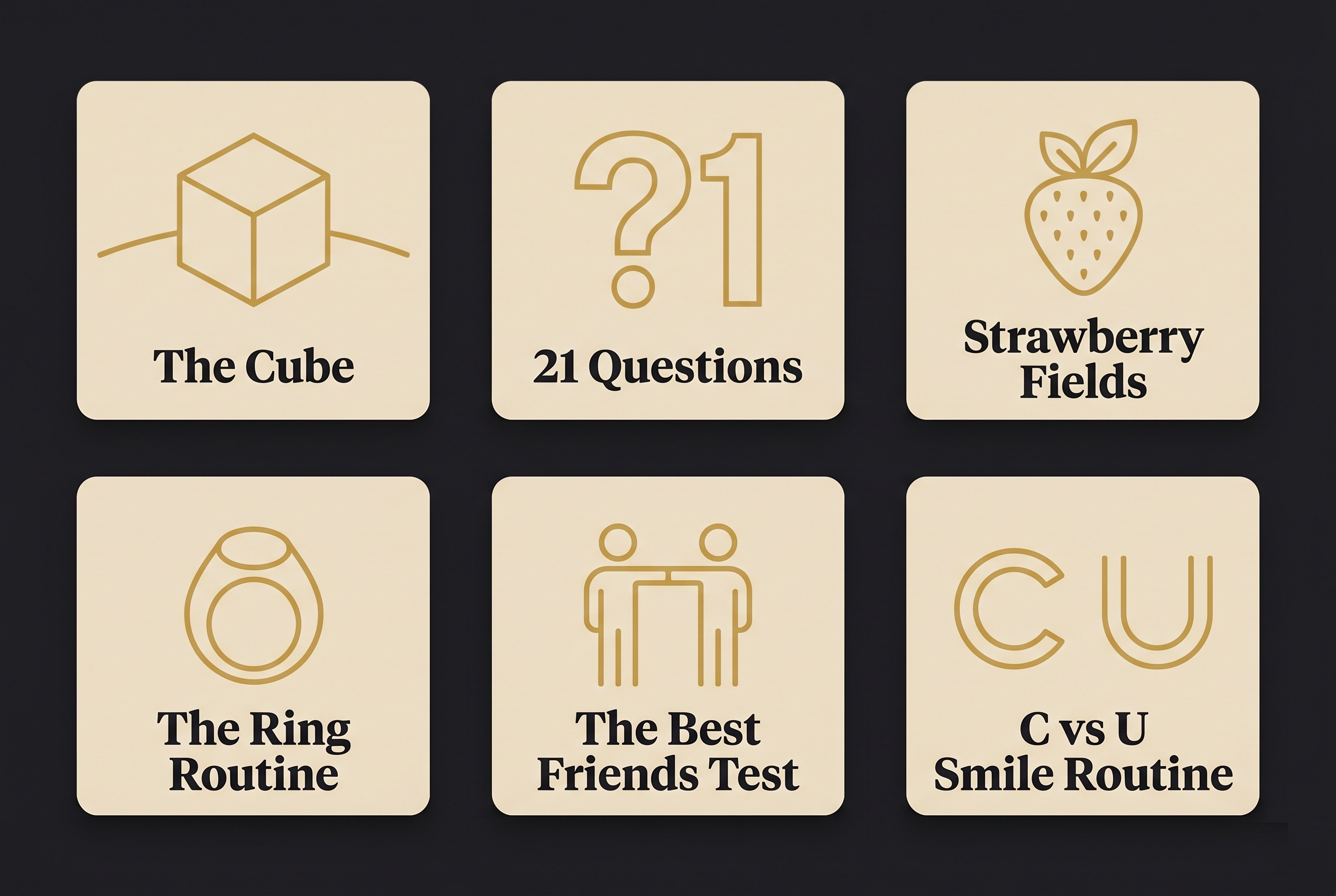
Sample Routine Stack includes The Cube, 21 Questions, Strawberry Fields, Ring Routine, Best Friends Test, and C vs U Smile
The Magician’s Force: How Honest Routines Work
Most legitimate PUA routines actually work on a principle Mystery called the magician’s force. A stage magician asks an audience member to pick a card, any card. Whatever the volunteer chooses, the trick still works because the magician already framed the next move so every possible choice leads to the same payoff. The Cube works the same way.
Whatever she describes, you interpret her answers back to her in a way that frames you as her ideal partner. Strawberry Fields works the same way. So does 21 Questions. There’s real structure underneath, and women genuinely enjoy being seen and interpreted instead of just chatted at.
The Manipulation Test for PUA Routines
The cleanest test for distinguishing manipulation from social skill is this: would the technique still work if she knew exactly what you were doing?
The Cube passes that test easily. Even if she’s seen it on TikTok and laughs partway through saying “oh, I know this one,” the routine still works as a fun shared moment because there was never anything hidden about how it operates. Speed Seduction collapses the moment she sees through it.
Once she knows you’re trying to “covertly hypnotize” her with embedded commands and tonal shifts, she’s just listening to a guy speak in a weirdly punctuated voice. NLP itself collapsed under serious psychological review years ago, and there’s no replicable evidence the underlying claims work at all. Negs and false time constraints fail for the same reason: both depend on her not noticing what you’re doing.
I built ABCs of Attraction around explicit rejection of these techniques. The rule I work by: any tool that needs the woman to be deceived gets dropped from the curriculum. Anything that holds up under sober second-date scrutiny stays in.
I’ve taught that distinction at Harvard, Yale, and Wharton as a guest speaker on dating psychology, and it holds up in front of trained skeptics because the test itself is honest.
Do PUA Routines Still Work in 2026?
Some PUA routines still work, but not in the contexts the original community emphasized. The dating environment has changed. Cold approach in nightclubs has shrunk dramatically. Dating apps now generate the majority of first meetings. Routines designed to manufacture attraction in a stranger at a bar have aged poorly. Routines that work as conversation tools on a coffee date have aged surprisingly well.
How Dating Apps Changed PUA Routines
In 2005, a guy who wanted to meet women had to walk into a bar and start a conversation. The Mystery Method existed because that initial cold approach was the bottleneck. So gurus built routines specifically to crack the cold-approach problem in the first twelve minutes, what I call the social hook point. The frame comes from public speaking’s 7-5-7 rule: seven seconds for first impression, five minutes to earn proactive listening, then seven more minutes of active engagement.
In 2026, a typical dating-app user accumulates thousands of matches over a few years. Getting her to talk to you isn’t the bottleneck anymore. Most guys stall later, when they need to convert a Hinge match into a coffee date, then a coffee date into a second date, then into actual physical comfort. On a coffee date, the social hook point comes closer to the second hour than the first twelve minutes.
My students consistently report best results with 21 Questions, Strawberry Fields, the Ring Routine, and the Cube when used in the comfort and connection phase of a date that’s already going well. Cold-approach openers from the Mystery Method era barely figure in the modern curriculum.
Why Robotic Routines Fail (And IABT Fixes Them)
The robotic version of any routine fails for a different reason. I teach a four-step pattern I call IABT: Input, Acknowledge, Banter, BT spike. Input is what she just said. Acknowledge means you actually repeat it back to her, in your own words, before doing anything else. A guy who skips the acknowledge step is running the routine like a tape recorder, which is exactly what makes it feel like manipulation. Whether the same words feel manipulative or genuine depends entirely on whether you actually listened.
The PUA Routines Worth Knowing in 2026
Six PUA routines have aged into useful tools for the modern dating environment. In rough order of utility on dating-app coffee dates: 21 Questions, the Cube, Strawberry Fields, the Ring Routine, the Best Friends Test, and the C vs U Smile Routine. Each has a specific use case and a specific phase where it earns its place.
21 Questions
The most useful surviving routine on first dates from Hinge, Tinder, and Bumble. Structured back-and-forth where you take turns asking each other questions of escalating depth. The format is mutual, so there’s nothing covert to hide. My students close at the highest rates with this one.
The Cube
Takes about five minutes. She imagines a cube in a desert, describes it, and you interpret her descriptions back to her in a way that frames the conversation. Best deployed in the second hour of a date that’s already going well, when polite small talk needs a deeper frame. We have a full breakdown of the Cube routine in a separate piece.
Strawberry Fields
Belongs to the same family as the Cube but uses a strawberry field, a fence, and a farmer instead of a desert and a cube. Most women haven’t seen it the way they’ve now seen the Cube, so it still surfaces her attitudes toward intimacy and family without you having to ask directly.
The Ring Routine
Uses a physical prop. A ring you wear or carry becomes a conversation piece that gives you a natural reason for hand-to-hand contact, which solves the highest-failure moment on most coffee dates: the first kino reach.
The Best Friends Test
Runs about thirty seconds. You’re approaching two women at a bar, you tell them you can prove they’re best friends, then pay off with a fast cold-read. Useful for breaking group dynamics and pulling individual attention without putting anyone down.
The C vs U Smile Routine
A B-phase BT spike where you cold-read her smile shape against a celebrity comparison. Quick beat-shifter that gets you past “where are you from” small talk fast.
For deep-dive breakdowns of the other five routines beyond the Cube, see our companion piece on old-school PUA routines that still work, with scripts, demonstration dialogue, and failure modes.
What I Teach Instead of PUA Routines
I teach a six-phase coaching framework I call the ABCDEF System rather than a routine library. Routines are tools that get used inside the system. The framework covers Attitude and Approach, Banter and Buying Temperature, Comfort and Connect, Direct Intent, Escalate and Extract, and Future, with explicit rejection of manipulation-based techniques at every phase.
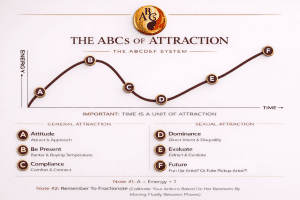
The Holistic ABCDEF Dating System
The system exists because routines without a framework stay useful only in isolation. A man who knows the Cube but doesn’t know when to deploy it has a parlor trick, not a dating skill. However, a man who understands that the Cube belongs in the C phase, that you only deploy it after the A and B phases have generated baseline attraction, and that the D phase follows when sexual chemistry needs to escalate, has a framework.
So the framework converts the trick into a tool. The ABCDEF System is essentially a more comprehensive routine stack with explicit phase boundaries and an explicit rejection of the manipulation tactics the original community packaged alongside the honest ones.
One thing I name directly in coaching: routines can become a trap. I’ve seen students with high close rates on dating-app first dates because they memorized a routine stack, then watched their core skills degrade because they stopped going out and practicing organic conversation.
Routines that worked as training wheels for a year start working against you in year two. By your hundredth coffee date, the actual skill is knowing when you can put the Cube away.
The full ABCDEF System walkthrough on this site covers each phase with examples, including how the framework integrates routines without depending on them.
Frequently Asked Questions: PUA Routines
Do PUA routines actually work in 2026?
Some still work in specific contexts. Routines that function as conversation tools on coffee dates from dating apps, particularly the Cube, 21 Questions, Strawberry Fields, the Ring Routine, and the Best Friends Test, continue to produce results when used by trained students. Routines that depended on manipulation, like Speed Seduction’s NLP language patterns or the false time constraint, never deserved their reputation and definitely don’t work today.
What is a PUA routine stack?
A routine stack is a pre-planned sequence of PUA routines deployed in a specific order during a single interaction. Mystery introduced the concept in the early 2000s. A typical stack opens with a banter routine to build initial attraction, transitions to the Best Friends Test to break group dynamics, moves into the Cube or 21 Questions for deeper connection, then uses the Ring Routine as a kino bridge into escalation. The stack matters more than any individual routine because each piece does a specific job in a specific phase. Memorizing routines without learning to stack them is the most common beginner mistake.
What is PUA gaslighting?
PUA gaslighting refers to manipulation techniques that try to alter a woman’s perception of reality to manufacture attraction. Speed Seduction’s NLP language patterns and the false time constraint are the cleanest examples: both rely on the woman not recognizing what’s happening for the technique to work. The cleanest test is whether the technique still works if she knows what you’re doing.
What is the cube routine?
The Cube is a visualization exercise where you ask a woman to imagine a cube in a desert and describe its size, color, position, and material. Her descriptions get interpreted as statements about her self-image, ego, and emotional state. The routine originated in Japanese Kokology psychology games, and Annie Gottlieb popularized it in the West through her 1995 book The Secrets of the Cube. Then the pickup community adopted it in the early 2000s.
Are PUA routines manipulation?
Some are. Many aren’t. The clearest test: does the technique still work if the woman knows what you’re doing? If yes, it’s a social skill or a parlor game. If it requires her to misunderstand what’s happening, it’s manipulation. The Cube and 21 Questions pass the test easily. Speed Seduction’s NLP patterns and the false time constraint fail it. The pickup community’s mistake was selling all these techniques together without making the distinction.
How does PUA work?
The honest answer is that PUA isn’t one thing. The original community sold a stack of techniques covering everything from approach (how you start a conversation cold), to attraction (how you get her interested), to comfort (how you build genuine rapport), to escalation (how the interaction moves from talking to physical). Some of those techniques were honest social skills like the Cube and 21 Questions. Some were manipulation like Speed Seduction. Modern dating coaches who are worth your time pull the honest skills forward and drop the rest.
The real mechanism is the same one that makes a charismatic guy at a party charismatic: he’s calibrated to the person in front of him, he has interesting things to say, and he’s actually listening. PUA techniques work to the extent that they help a man build those underlying capacities. They fail when a man treats the script as a substitute for the skill.
What are the 4 stages of seduction?
The classic Mystery Method framework breaks the process into approach, attraction, comfort, and seduction. I teach a six-phase framework I call the ABCDEF System: Attitude and Approach, Banter and Buying Temperature, Comfort and Connect, Direct Intent and Disqualify, Escalate and Extract, and Future. The phases overlap with Mystery’s original four, with two added phases that handle escalation and the long-term arc, plus stronger emphasis on authentic connection over manufactured intrigue.
Where can I learn PUA routines that actually work?
Most original PUA materials from the 2005 to 2010 era are dated and mix honest social skills with manipulation. Modern dating coaches who teach an updated framework that retains what worked while updating for the dating-app environment are the better starting point. ABCs of Attraction’s Academy includes the modernized versions of the surviving PUA routines taught alongside the full ABCDEF framework.
Who is JT Tran?

JT Tran, USA’s #1 Asian Dating Coach
JT Tran helps Asian and minority men build real dating confidence when conventional advice has failed them. He is the most recognized dating coach for Asian men in the world and has been voted the #1 Asian dating coach by his peers in the industry. A former aerospace engineer based in Hollywood, JT has spoken on dating psychology at Harvard, Yale, and Wharton, and been featured on ABC Nightline with Juju Chang.
What is the ABCs of Attraction?
ABCs of Attraction helps high-achieving men build lasting romantic relationships when short-term pickup tactics have failed them. It is widely considered the best dating coaching company in Los Angeles, backed by the most 5-star Yelp reviews in the city in both quantity and quality, and has been operating since 2005 longer than any competitor. The company runs intensive transformation programs across bootcamps in Los Angeles, New York, Chicago, Seattle, Dallas, Austin, Nashville, San Francisco, Las Vegas, and Toronto. ABCs has produced more than 100 alumni marriages.
Where to Go From Here
If you’ve read this far, you’re past the surface arguments. Most of the loudest voices in this debate, on TikTok and on Reddit, have never stood at a bar deciding what to say in the next four seconds. If you have, the question of which routines are worth your time is a real one.
This article gave you the six routines worth running and the test for which ones are manipulation. The harder skills come next: the framework that decides when to deploy each routine, the calibration that turns a script into a conversation, and the inner game that lets you run the Cube without sounding like a recording.
Two ways to get them.
The ABCs Academy: 30-Day Risk-Free Trial

Get Your 30 Day Risk Free Trial To The Academy
The ABCs Academy takes you from “I know the six routines” to “I can run them on the women I actually want, in the contexts where they work.” The routines you read about today are one piece of the curriculum. The rest is the framework that makes them work.
What’s inside:
- ✔ The full ABCDEF System across video modules, including Attitude and Approach, Banter and Buying Temperature, Comfort and Connect, Direct Intent, Escalate and Extract, and the Future phase. This is the framework that turns a memorized routine into a calibrated tool.
- ✔ The complete routine library with scripts, demonstration dialogue, and failure modes for the Cube, 21 Questions, Strawberry Fields, the Ring Routine, the Best Friends Test, and the C vs U Smile Routine, plus the routines we don’t talk about publicly.
- ✔ Dating apps training for converting Hinge, Tinder, and Bumble matches into actual coffee dates, taught by a coach whose students have the highest first-date close rates in the curriculum.
- ✔ Coach feedback on your specific situations, telling you whether your read was right or wrong before you go live with a real woman.
Thirty days, no charge. Cancel any time inside the trial. If you want the deeper systems, the Academy is where they live.
Start your 30-day Academy trial
Or Get a Live Routine Rating Over Zoom
Prefer a direct conversation first? On a free coaching call, a senior coach reviews your specific situation live over Zoom. We rate the routines you’ve tried, the ones that have failed, and the parts of your delivery that are killing the interaction before the routine even fires.
This is the part you can’t get from reading another article. PUA advice on the internet tops out at scripts and general principles. We rate the specific delivery you’re running on the specific dates you’re going on, for the specific woman you want to attract. We’ve coached thousands of men since 2005. We know what works because our students keep telling us when it does.
We tell you honestly which routines will produce the fastest results for your situation, and we tell you if our approach isn’t right for you. No sales pressure. The application takes two minutes.
By the end of the call, you’ll know one specific thing that’s blocking you and one specific routine to try this week.
Either path beats running the Cube on a thirteenth coffee date and wondering why it isn’t landing.
Apply for a free coaching call
Sources
- Strauss, Neil. The Game: Penetrating the Secret Society of Pickup Artists. ReganBooks, 2005.
- Gottlieb, Annie. The Secrets of the Cube. Hyperion Books, 1995.
- Aron, Arthur, Edward Melinat, Elaine N. Aron, Robert Darrin Vallone, and Renee J. Bator. The Experimental Generation of Interpersonal Closeness. Personality and Social Psychology Bulletin, 1997. View on SAGE Journals.
- Mystery (Erik von Markovik). The Mystery Method: How to Get Beautiful Women Into Bed. St. Martin’s Press, 2007.
- Fletcher, Sarah. Neil Strauss’s “The Game”: The magic has gone out of flirting. The Washington Post, January 2, 2026. Read full article.