
If you’re trying to figure out how to get over a breakup, you’re in the right place, so let me be brutally honest with you…
Right now, it probably feels like someone reached into your chest, ripped out your heart, took a wood chipper to it, and then gave you a nut punch for good measure. You can’t sleep. You check your phone every ten minutes for a message that isn’t coming. You replay conversations, looking for the moment it all went wrong. And you wonder, in your worst moments, whether you’ll ever feel normal again.
Here’s what nobody tells you: what you’re feeling right now is not weakness. It’s not a character flaw. It’s not you being pathetic. It’s your brain going through withdrawal. Literally. The same neural pathways that drive addiction are firing right now because of her. And 85% of people will experience exactly this at least once in their lifetime. 40% of recently rejected individuals develop clinically measurable depression. You are not broken. You are wired.
I’m JT Tran. I’ve spoken at Harvard and Yale, been featured on ABC, BBC, and NBC, and spent over two decades coaching men how to build real confidence and dating success from the ground up. I’ve watched hundreds of men walk into my programs fresh off devastating breakups. I know what this looks like. And I know what it takes to come out the other side stronger than you went in. This article gives you the science, the real timeline, and the tools that actually work.
Why Breakups Feel Like Addiction (The Neuroscience)
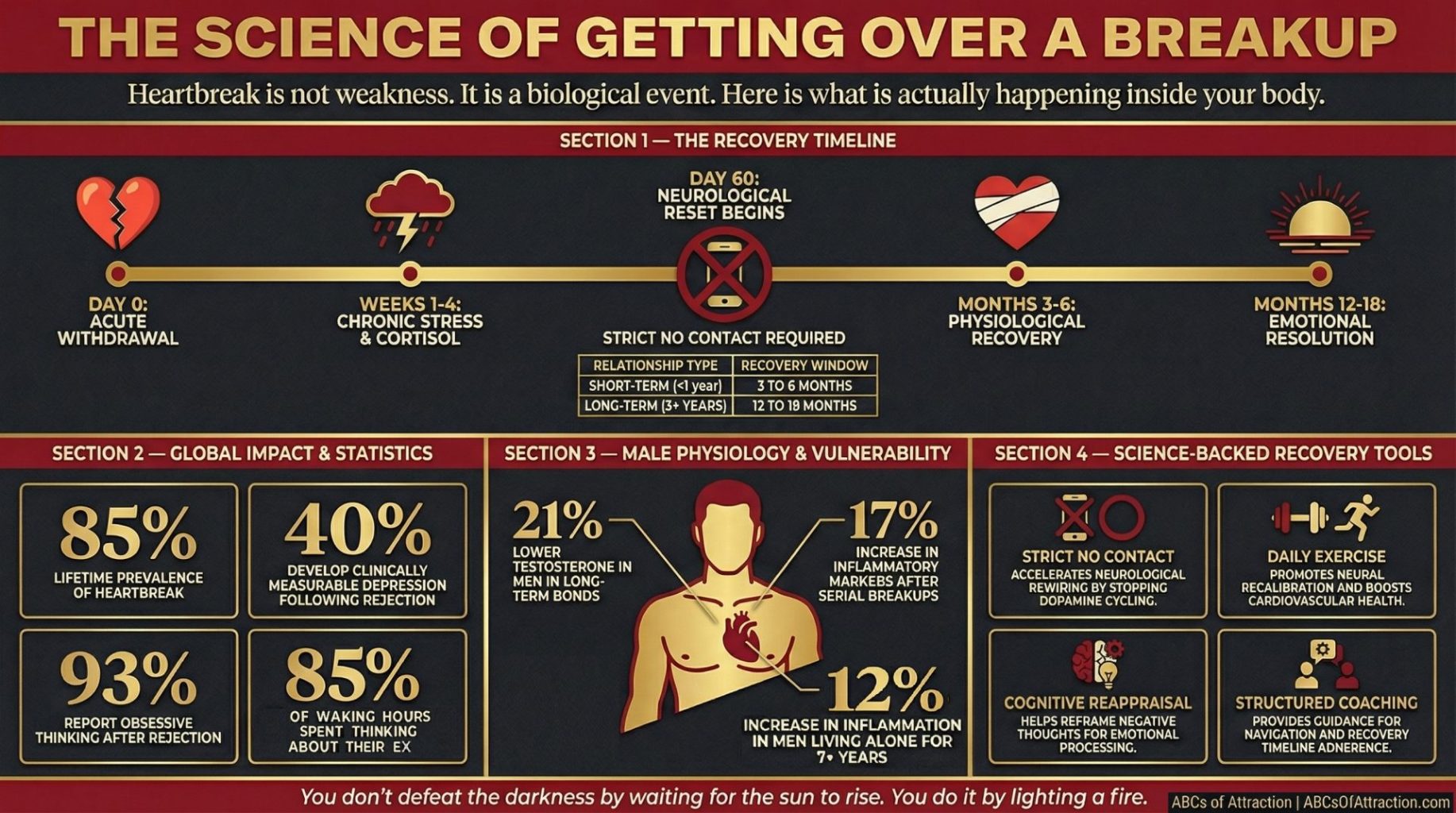
The science of getting over your ex-girlfriend and the timeline of healing.
Your brain does not distinguish between losing a relationship and losing a drug. That is not a metaphor. It is a neurobiological fact.
When you were with her, your brain’s reward system was flooding you with dopamine on a regular basis. Her texts, her laugh, her presence, all of it was triggering the same pathways that activate when an addict gets their substance. Over time, your brain literally rewired itself around her. She became a neurological anchor point for your reward system.
Now she’s gone. And your brain is doing exactly what an addict’s brain does during withdrawal. It is craving your ex-girlfriend the way an addict craves their substance. This is why 93% of people who have been rejected by someone they loved report obsessive thinking. This is why recently rejected individuals spend up to 85% of their waking hours thinking about their ex. It is not because you are weak or dependent. It is because your brain is searching for the dopamine source it was trained to expect.
This understanding changes everything. Because if heartbreak is neurological, then recovery is neurological too. It is not just a matter of time or willpower. It is a matter of actively intervening in the reward system and giving it new inputs to wire around. The pain is real. The process of rewiring it is real too.
Why Men Specifically Struggle More and Longer
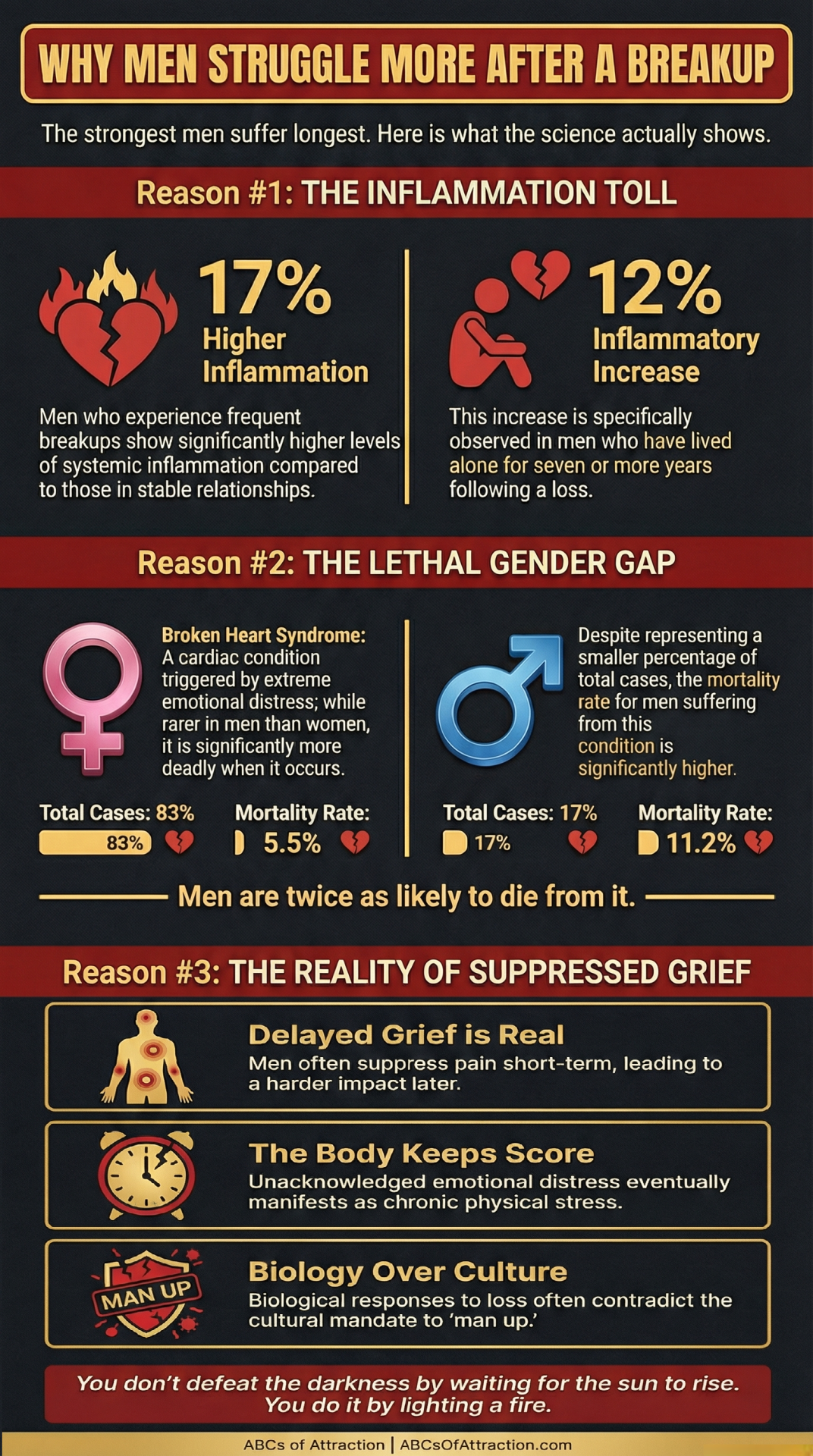
Science says men pay a much heavier physical price from breakups than anyone admits.
Here is where the cultural script around men and breakups is dead wrong.
The stereotype says men bounce back fast. Move on quickly. Get back out there. Don’t dwell. The reality, according to the research, is almost the complete opposite. Men frequently experience a delayed grief response. They suppress the acute emotional pain in the short term, often through work, distraction, or denial, and then get hit harder and later when those coping mechanisms run out. Women tend to process their grief more immediately and more visibly. Men carry it underground until it surfaces as something else entirely.
And the physical toll on men is significant. Women lose twice as much self-esteem as men immediately following a breakup, which is the visible, acute hit. But men pay a longer and heavier biological price. Men who experience the most partnership breakups show 17% higher levels of inflammatory markers like C-reactive protein and interleukin-6 compared to men in stable relationships.
Men who live alone for seven or more years show inflammatory marker levels 12% higher than those who have lived alone for less than a year. Chronic emotional stress, left unaddressed, becomes chronic physical stress. Your body keeps score whether you acknowledge it or not.
Then there is the cardiac piece that nobody talks about. Broken Heart Syndrome, medically known as Takotsubo Cardiomyopathy, is a real condition triggered by acute emotional distress. While 83% of diagnosed cases occur in women, the mortality rate for men who develop it is 11.2%, more than double the 5.5% female rate.
Men get it less often. When they do, it is more likely to kill them. That is not a scare tactic. That is a reason to take your emotional recovery as seriously as you would take a physical injury.
The point here is not to make you feel worse. It is to give you permission to take this seriously. Your culture probably told you to man up and move on. Your biology is telling you something more complicated is happening. Listen to your biology.
How Long Does It Actually Take? (The Real Timeline)
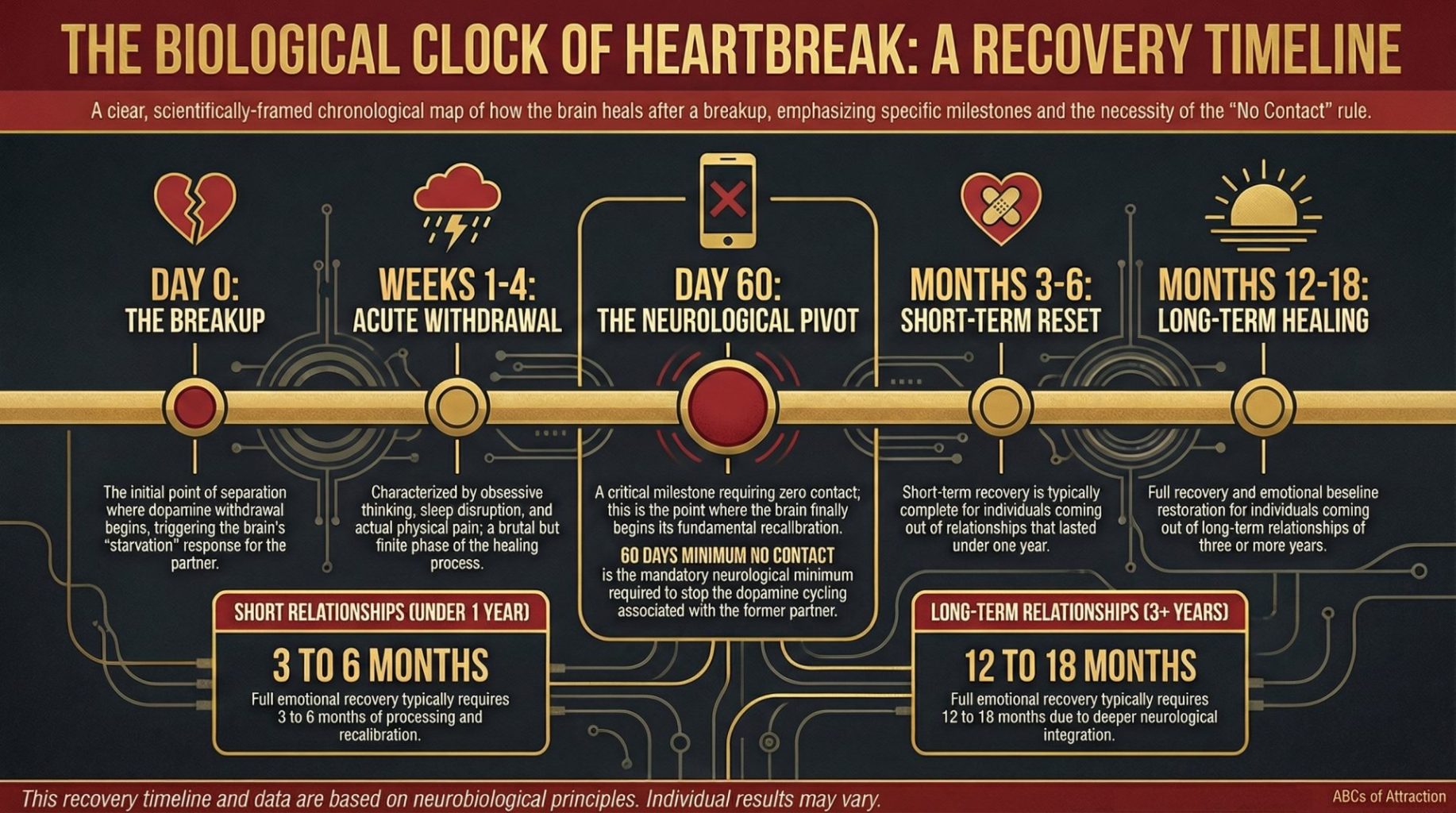
The pain of breaking up with your girlfriend doesn’t have to last forever
This is the question every man wants answered and almost nobody gives a straight answer to. So here it is.
The most intense phase, the acute distress window characterized by obsessive thinking, sleep disruption, physical pain, and inability to concentrate, typically lasts two to four weeks. That window is brutal but finite. Knowing it has an endpoint matters.
For relationships that lasted under a year, the acute phase of breakup depression typically resolves within three to six months. For relationships of three or more years, complete healing and the formation of a new identity, a version of yourself that is genuinely separate from who you were in that relationship, typically requires twelve to eighteen months. The integration phase, where you begin reinvesting in your own life and future rather than processing the loss, generally begins around the six-month mark.
These are averages. Men who take active, deliberate steps through the recovery process consistently move faster than men who wait passively for time to do the work. Time alone does not heal this. Active neurological recalibration does.
One number you should write down: 60 days. Experts consistently recommend a minimum of 60 days of zero contact with your ex-girlfriend to give the brain’s reward system the time it needs to begin recalibrating. Not 60 days to make her miss you. Not 60 days as a strategy to get her back.
60 days because that is the neurological minimum required to stop the dopamine cycling. Every time you check her Instagram, read old texts, or find reasons to reach out, you are hitting the reset button on that clock. You are giving your brain another dopamine hit off the same source it needs to detach from.
The Hidden Trap: Fixed Mindset After a Breakup
Here is something your biology is already doing that your mind hasn’t caught up to yet. After a breakup, men’s testosterone levels surge back toward single-male baseline. Men in long-term relationships have baseline testosterone roughly 21% lower than single men. When the relationship ends, that testosterone rises. The oxytocin bonding influence recedes.
Your body is shifting from a paired, domesticated state back into a competitive, growth-oriented one. Your biology is not mourning. It is preparing. The body is already signaling the next chapter. The problem is when the mind refuses to follow.
The psychological pattern that blocks that transition is what I see in men after a breakup that quietly doubles their recovery time. It is the tendency to fuse self-worth with the relationship’s outcome. When a man does this, he does not just lose the relationship. He loses his evidence that he is worthy, lovable, and capable. The relationship was proof of his value. Its ending becomes proof of the opposite.
This trap runs especially deep for Asian men raised in cultures that equate achievement with identity. If you were trained from childhood to measure your worth by performance, by grades, by career output, by whether you got the girl, then losing the girl becomes an identity crisis rather than a loss. And identity crises take far longer to recover from than losses do.
The exit from this trap is not positive thinking. It is precision. She did not leave because you are fundamentally unworthy. She left because of a specific combination of circumstances, timing, compatibility, and decisions made by two people. That is information. It is data you can work with.
A verdict about your fundamental worth, which is what a fixed mindset turns it into, is something you can do nothing productive with except suffer under it. Your testosterone is already pointing you toward what comes next. The only question is whether your interpretation of the breakup is going to let you follow it.
How to Get Over a Breakup Faster: The Science-Backed Toolkit
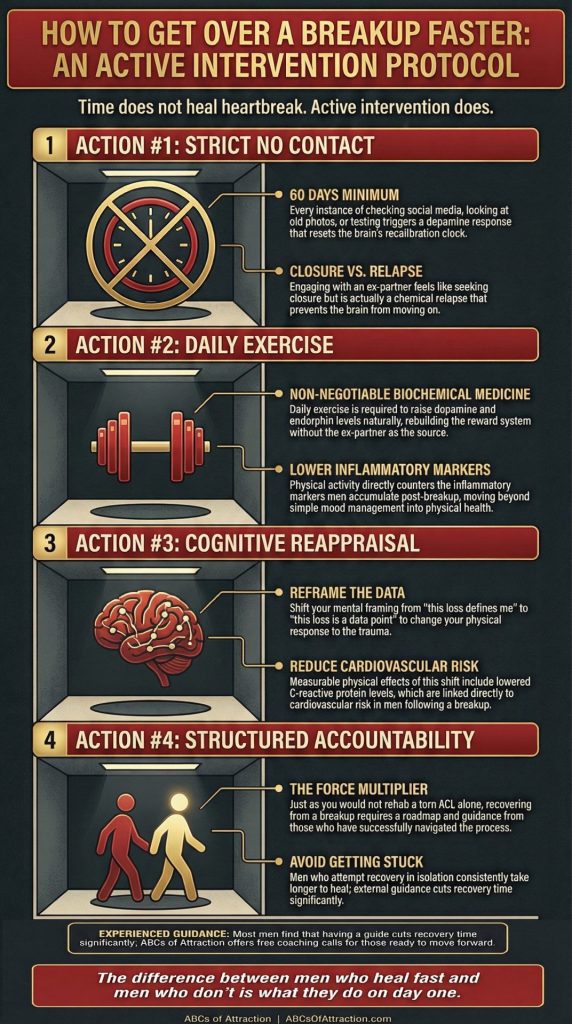
Your brain processes a breakup like drug withdrawal. These four actions intervene directly in that process. Passive recovery is the slowest kind.
Because the brain processes a breakup like substance withdrawal, passive recovery is the slowest kind. Active intervention is what moves the needle. Here is what the research actually supports.
Start with strict no contact for a minimum of 60 days. The mechanism is straightforward. Every time you check her social media, revisit old photos, or find a reason to text your ex-girlfriend, you are triggering a small dopamine response off the same pathway your brain is trying to recalibrate away from. It feels like closure or connection.
It is actually a relapse. Checking her Instagram is a hit. Every hit resets the clock on your neurological recovery. Delete her number if you need to. Block her on social media if that is what it takes. This is not cruelty. This is brain management.
Non-negotiable alongside that is physical exercise. I want to be direct: it is not optional. It is biochemical medicine. Exercise naturally raises dopamine and endorphin levels, which means it rebuilds your reward system’s capacity to feel good without her as the source. It also directly counteracts the elevated inflammatory markers that research shows men accumulate from relationship dissolution.
A man who is consistently training during a breakup is not just managing his mood. He is actively protecting his cardiovascular health, reducing systemic inflammation, and rewiring his reward system around something entirely within his control. Get in the gym. Get on the trail. Move your body every single day.
Running parallel to both of those is cognitive reappraisal, the deliberate practice of reframing how you interpret the breakup. This is not toxic positivity. It is not telling yourself the breakup was secretly a good thing while you feel destroyed. It is the specific practice of shifting your mental framing from “this loss defines me” to “this loss is a data point I can learn from.”
Research shows that cognitive reappraisal has measurable physical effects, including lowered C-reactive protein levels, the inflammatory marker directly linked to cardiovascular risk in men post-breakup. Your thoughts are not separate from your body. Reframing the narrative actively reduces the physical damage that unprocessed grief causes.
What ties all three together and accelerates the whole process is structured accountability. Men who go through this alone, with no roadmap and no external check-in, consistently take longer and get stuck more often than men who have guidance. This is not about weakness. It is about efficiency. You would not try to rehab a torn ACL by yourself. You would get a physiotherapist who has rehabbed that injury hundreds of times and knows exactly what week three looks like. The brain after a breakup is no different.
Moving On After a Breakup: What Our Students Did Next
Here is what I have watched happen with hundreds of men who came to ABCs of Attraction in the aftermath of a breakup.
Andy was 49 years old and had just gone through a life-shattering divorce. He had to restart his dating life from zero. He came into our program lost, and left building a dating life that included younger women he never would have believed were accessible to him before.

William was a 30-year-old Wall Street professional who was so beaten down by his romantic failures that he was genuinely considering moving back to Asia to find a wife through an arrangement. He took one last shot. He came through our bootcamp, spent the next year dating more women than he thought possible, met his future wife, and I had the honor of officiating his wedding.

Chez was a lonely student from China struggling both romantically and financially when he showed up to his first bootcamp at 25. He walked away with the skills, the confidence, and eventually a beautiful Eastern European wife he cold approached at a club.

None of these men had their transformation in spite of their pain. They had it because of it. The breakup was the catalyst. It was the moment the old version of themselves became untenable and they decided to build something better.
Your testosterone is surging. Your brain is recalibrating. Your body is biologically preparing to re-enter the arena. The question is whether your mind is going to get on board or spend the next year in the same loop of checking her social media and wondering what went wrong.
A breakup is not a setback. It is a biological reset. Use it.
Take the Next Step
“You don’t defeat the darkness by waiting for the sun to rise. You do it by lighting a fire.”
The pain you’re feeling right now is real. So is the version of yourself on the other side of it. Schedule a free, no-strings-attached coaching call with me or one of my team members. We’ll map out exactly where you are, where you want to be, and what the next steps look like. No pressure, no pitch. Just a real conversation.
Frequently Asked Questions
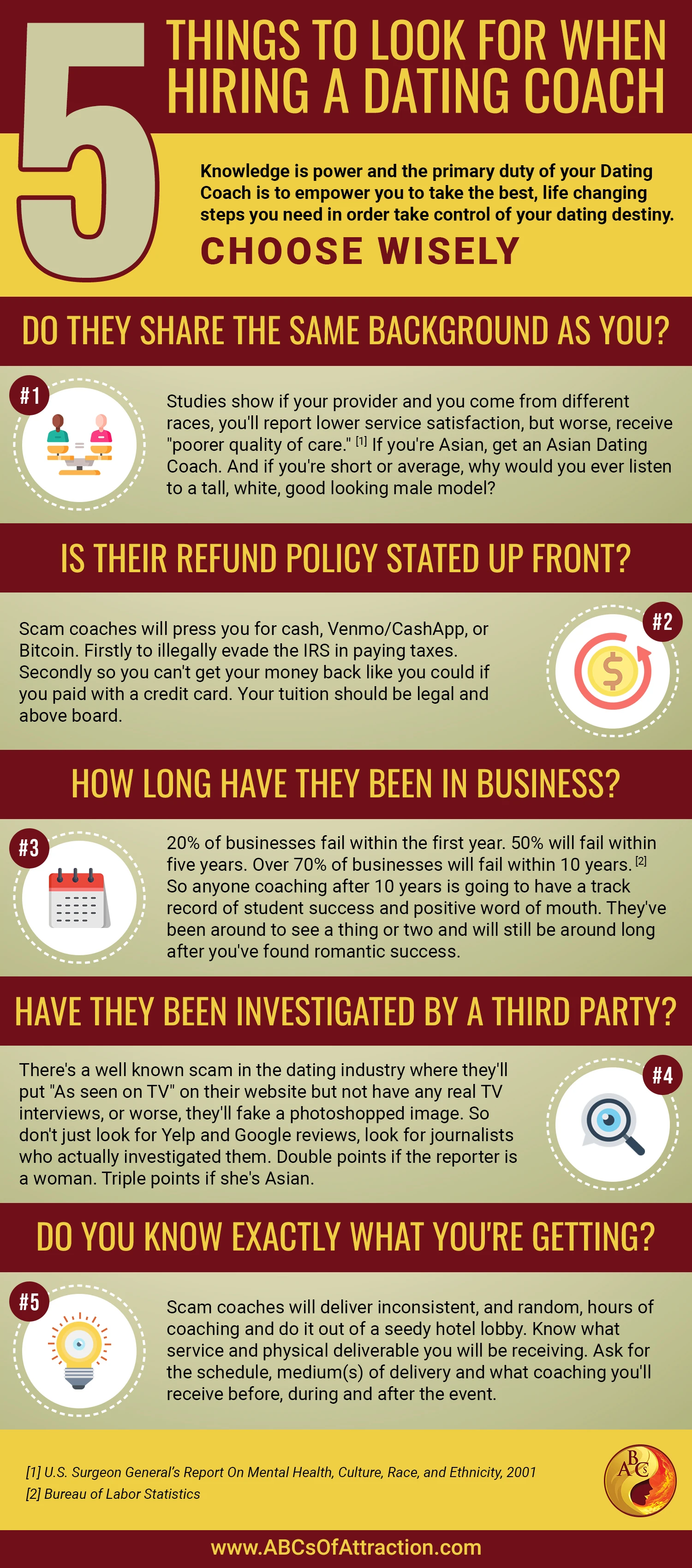
5 Things To Look For When Hiring a Dating Coach
How long does it take to get over a breakup?
The honest answer depends on the length of the relationship and how actively you engage with your recovery. The most intense acute distress, the sleeplessness, obsessive thinking, and physical pain, typically resolves within two to four weeks. For relationships under a year, most men find the worst of it passes within three to six months. For longer relationships of three years or more, full emotional integration and identity recalibration typically takes twelve to eighteen months. These are averages. Men who take structured, active steps through the process consistently recover faster than those who wait passively. For men going through a divorce, the timeline is often longer because the legal process, shared finances, children, and the loss of an entire shared life compound the grief. The research-backed tools in this article apply regardless of whether the relationship ended in a breakup or a divorce.
Why do I keep thinking about my ex-partner?
Because your brain wired itself around her. When you were in the relationship, your dopamine system, the same neural machinery that drives addiction, was regularly activated by her presence, her attention, and your shared experiences. Now that she is gone, your brain is doing what an addict’s brain does during withdrawal: craving the source it was built around. Research shows recently rejected individuals spend up to 85% of waking hours thinking about their ex-girlfriend. This is not a sign you were uniquely dependent or weak. It is a predictable neurological response to the removal of a primary reward stimulus.
Is it normal to feel physical pain after a breakup?
Yes, completely. Brain imaging studies show that social rejection activates the same neural networks as physical pain. When you say the breakup felt like a punch to the chest, you are describing something neurologically accurate. The experience of social loss processes through the same circuitry as bodily harm. Additionally, the hormonal and inflammatory shifts that men experience post-breakup, including elevated cortisol, disrupted sleep, and increased inflammatory markers, all produce genuine physical symptoms. What you are feeling in your body is real, not imagined.
Should I try to get my ex-girlfriend back?
This is the wrong question to be asking in the first week or month after a breakup, and here is why. Your brain is in withdrawal. Your judgment is being run by the same neurological processes that make an addict want to call their dealer. Any decision you make about contact or reconciliation in this state is compromised. The 60-day no contact period is designed specifically to let your reward system recalibrate before you make any decisions about what you actually want versus what your withdrawal is demanding. After 60 days of genuine no contact, with real work on yourself in the interim, you will have a much clearer picture of whether reconciliation is genuinely what you want or whether it was just your dopamine system talking.
How do I stop obsessing over my ex-girlfriend?
Two things work that the research actually supports. The first is strict no contact, which stops the cycle of micro-dopamine hits that keep the obsession alive. Every time you check her profile or replay a memory, you are feeding the neural loop. Cutting the input starves the loop. The second is cognitive reappraisal, actively and deliberately reframing how you think about the breakup, shifting from rumination on the loss to analysis of what you learned and what you want to build next. This is not pretending to feel fine. It is redirecting your brain’s processing energy from a dead end toward something that produces forward momentum. Exercise helps enormously here too because it gives your dopamine system a new, controllable source of reward.
Why do men take longer to get over breakups than women?
Because they process grief differently and pay the biological price later. Women tend to experience the acute emotional pain more immediately and more visibly. Men suppress it in the short term, often through work or distraction, and then get hit harder when those coping mechanisms run out. Biologically, men show a delayed grief response, elevated vasopressin levels that drive emotional dysregulation, increasing inflammatory markers with each dissolved partnership, and significant cardiovascular risk if the distress goes unaddressed.
The cultural message that men should bounce back quickly is almost perfectly inverted from what the biology actually shows is happening. Taking your recovery seriously is not softness. It is paying attention to data. This delayed response is even more pronounced for widowers, who carry grief without the social permission to fall apart that a breakup or divorce tends to generate. The neurological recovery process is the same regardless of how the loss occurred, which means the tools in this article apply directly.
Who is JT Tran?

JT Tran, USA’s #1 Asian Dating Coach
JT Tran helps men rebuild their identity and dating life after a breakup or divorce leaves them questioning everything they thought they knew about themselves. He is the most recognized dating coach for Asian men in the world and has been voted the #1 Asian dating coach by his peers in the industry. A former aerospace engineer based in Hollywood, JT has spoken on dating psychology at Harvard, Yale, and Wharton, and been featured on ABC Nightline with Juju Chang.
What is the ABCs of Attraction?
ABCs of Attraction helps high-achieving men build lasting romantic relationships when starting over after a breakup feels overwhelming and the path forward is unclear, including widowers rebuilding their romantic lives after loss. It is widely considered the best dating coaching company in Los Angeles, backed by the most 5-star Yelp reviews in the city in both quantity and quality, and has been operating since 2005 longer than any competitor. The company runs intensive transformation programs across bootcamps in Los Angeles, New York, Chicago, Seattle, Dallas, Austin, Nashville, San Francisco, Las Vegas, and Toronto. ABCs has produced more than 100 alumni marriages.
Sources
- Brain Chemistry After a Breakup: Understanding the Neuroscience of Heartbreak and the Potential Role for Ketamine and Stellate Ganglion Block – www.strivemdwellness.com
- Do Men Really Get Over Breakups Faster Than Women? (Psychology Today) – https://www.psychologytoday.com/us/blog/valley-girl-with-a-brain/201611/do-men-really-get-over-breakups-faster-than-women
- How Long Does Breakup Depression Last? Your Timeline to Healing (Ahead App Blog) – https://ahead-app.com/blog/Heartbreak/how-long-does-breakup-depression-last-your-timeline-to-healing
- Love’s Chemistry: How Dopamine Shapes Bonds and Breakups (Neuroscience News) – https://neurosciencenews.com/dopamine-love-relationships-25450/
- Men With Broken Heart Syndrome Have Twice the Mortality Risk: Study (Conexiant) – https://conexiant.com/cardiology/articles/men-with-broken-heart-syndrome-have-twice-the-mortality-risk-study/
- Neuroscientists Break Down the Brain on Heartbreak (Sentari Blog) – https://withsentari.com/neuroscientists-break-down-the-brain-on-heartbreak/
- Reward, Addiction, and Emotion Regulation Systems Associated With Rejection in Love (Journal of Neurophysiology via ResearchGate) – https://www.researchgate.net/publication/44575621_Reward_Addiction_and_Emotion_Regulation_Systems_Associated_With_Rejection_in_Love
- Romantic love: a mammalian brain system for mate choice (PMC/NCBI) – https://pmc.ncbi.nlm.nih.gov/articles/PMC1764845/
- Stanford research explains why some people have more difficulty recovering from romantic breakups (Stanford Report) – https://news.stanford.edu/stories/2016/01/self-definition-breakups-010716
- The Deadly Truth About Broken Heart Syndrome in Men (Psychology Today) – https://www.psychologytoday.com/us/blog/finding-a-new-home/202507/the-deadly-truth-about-broken-heart-syndrome-in-men
- The Neurobiology Behind Breakups (Psychology Today) – https://www.psychologytoday.com/us/blog/neurosagacity/201608/the-neurobiology-behind-breakups
- The Neurochemistry of Heartbreak: Unravelling the Complex Interplay of Brain Regions, Emotions and Neurotransmitters in Relationship Breakups (International Journal of Scientific Research & Technology) – https://www.ijsrtjournal.com/article/The-Neurochemistry-of-Heartbreak-Unravelling-the-Complex-Interplay-of-Brain-Regions-Emotions-and-Neurotransmitters-in-Relationship-Breakups
- The Neuroendocrine and Neurobiological Architecture of Male Romantic Dissolution and Recovery (Comprehensive Report) – This source synthesizes multiple studies including links to https://pmc.ncbi.nlm.nih.gov/articles/PMC12873753/ and https://hms.harvard.edu/news-events/publications-archive/brain/love-brain
- Why Men After a Breakup Need Different Recovery Time Than Women Think (Ahead App Blog) – https://ahead-app.com/blog/Heartbreak/why-men-after-a-breakup-need-different-recovery-time-than-women-think
- Why You Feel Depressed After Break Up: Brain Science & Recovery Timeline (Ahead App Blog) – https://ahead-app.com/blog/Heartbreak/why-you-feel-depressed-after-break-up-brain-science-recovery-timeline
- Years lived alone and/or serial break-ups strongly linked to inflammation in men (EurekAlert!) – https://www.eurekalert.org/news-releases/939439